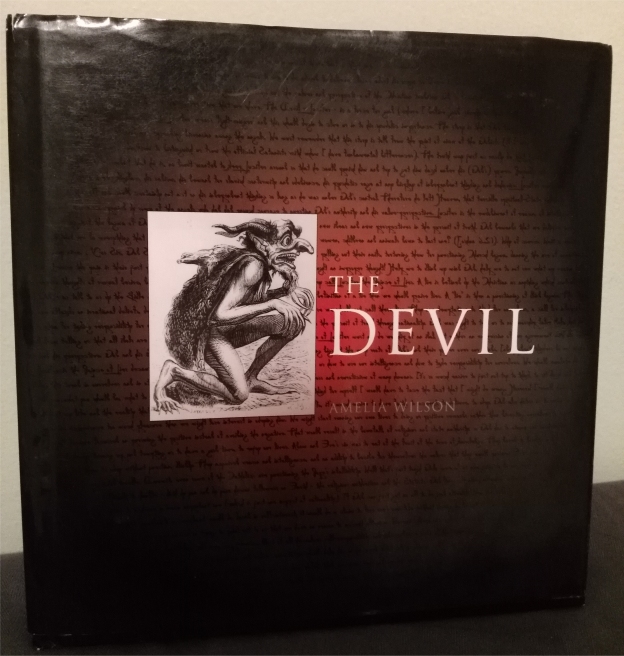
Amelia Wilson – The Devil

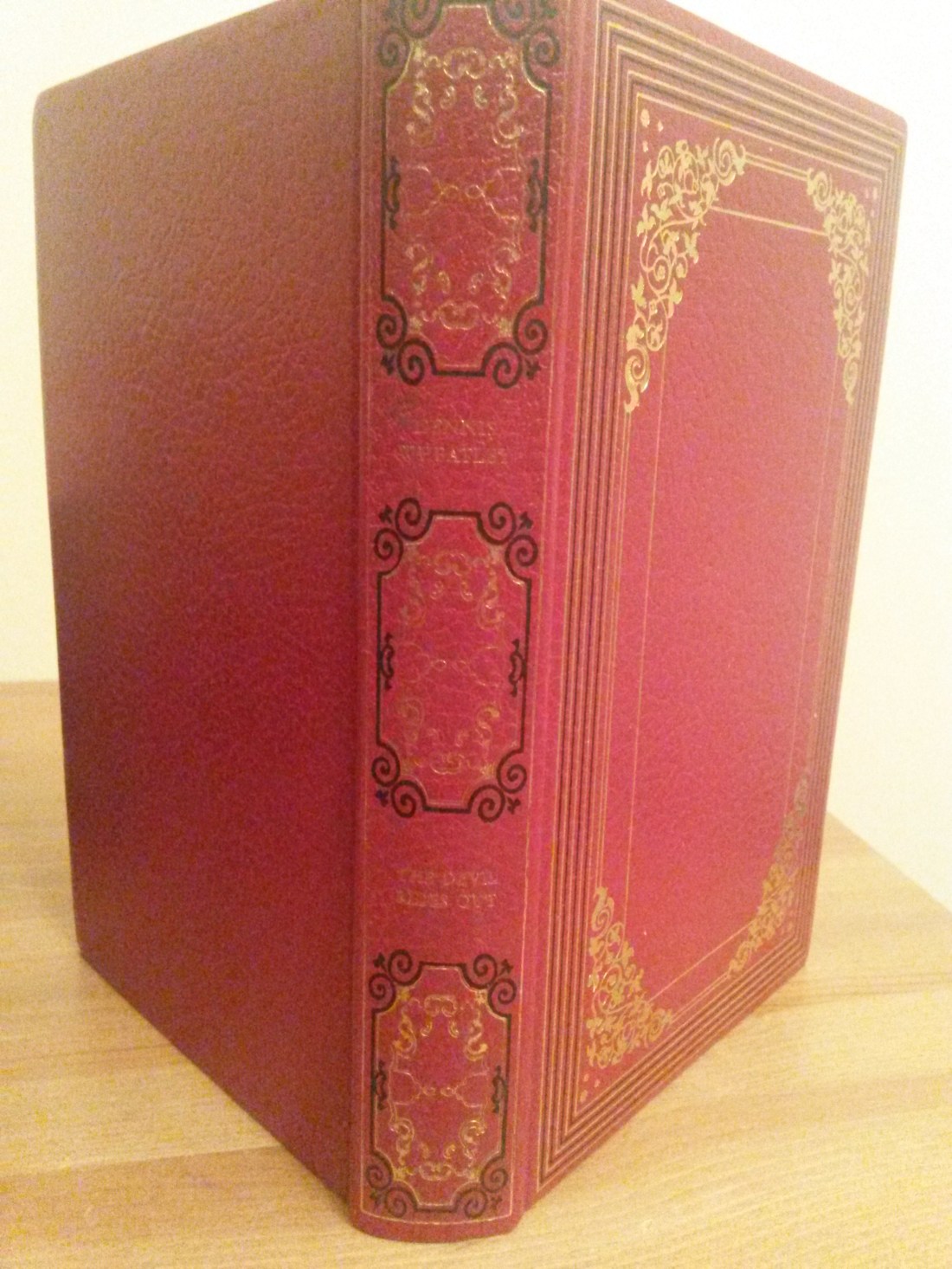
amelia wilson the devilThe Devil – Amelia Wilson
Barrons – 2002
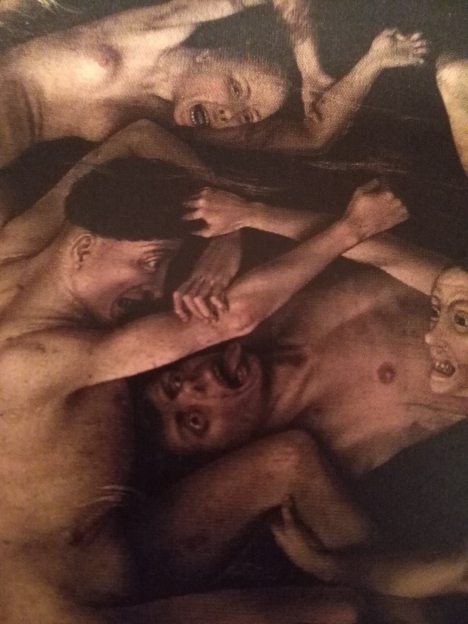
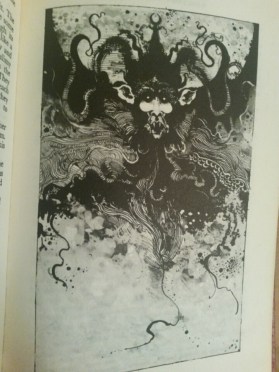
I bought this book for 2 dollars from a thrift store years ago. I finally picked it off the shelf recently because it’s short and I needed a break from a very long, dry Gothic novel that I have been reading. It met my expectations but did not exceed them. The paper it’s printed on is nice, and there are lots of cool pictures, but it contains very little information that I haven’t come across before.

The first half of the book goes into the origin of Satan as a devil. It discusses Biblical pseudepigrapha, folklore and Zoroastrianism. I liked this part, and was pleased at the level of detail it went into. Wilson clearly does not like how Christians have turned Lucifer into the bad guy.

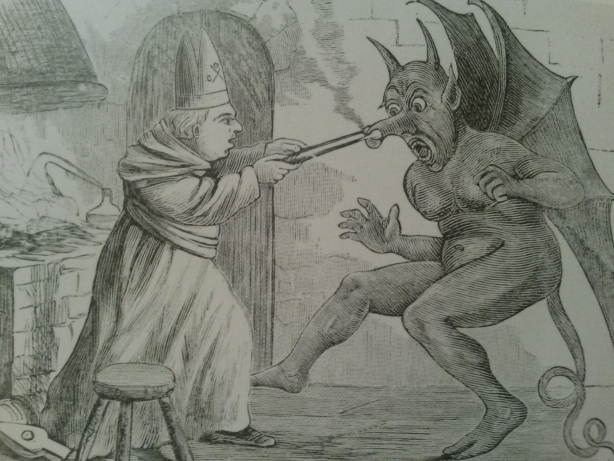
ride to the sabbathRide to the Sabbath!

Next up, there is a section on the witch trials. Nothing special. This is followed by a short and very disappointing chapter on Satan’s place in modern society. There’s a page or two on films featuring the Devil, and very cursory glance at how he has influenced modern music. The Church of Satan is mentioned, but the author doesn’t attempt to explain its philosophy. There is one reference that quite irritated me. It reads; “One figure who has stirred a lot of controversy, is Aleister Crowley, a renowned ceremonial magician and expert in the occult who wrote extensively on the subject. There is no hard evidence that Crowley was in fact a Satanist, although many people who do consider themselves Satanists have read his books.” That’s all the book has to say about Crowley. There is absolutely no explanation as to why Wilson thought it important to mention him, and the wording of her reference suggests that Crowley was a Satanist because many Satanists have read his books. By the same logic, drinking water and breathing air are also Satanic. If you want to read a decent book on Satan’s place in modern culture, check out Gavin Baddeley’s Lucifer Rising.

hell
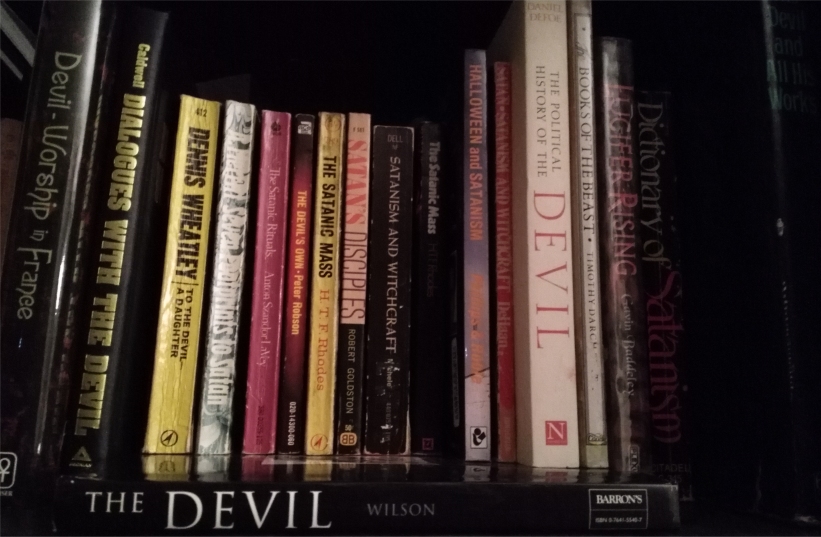
Wow, this is the most boring post I’ve written in quite a while. In fairness to myself though, I wasn’t give much to work with. This book wasn’t absolutely awful, but there are plenty of far more insightful texts on the same topic. I’ll keep it only because I enjoy filling my bookshelves with books that mention the devil in their titles.
devil books

Die Faustbücher

faust demon 17It was long ago that I first noticed the big can of worms labelled ‘Faust’ on the shelf of literature,  and despite an occasional peek inside, I was never certain of the precise nature of its gooey contents. Recently, I felt compelled to make a more thorough investigation, but after determining to take down the curious container in order to examine its contents, it slipped off the shelf, smashed on my head, and covered me with its slime.

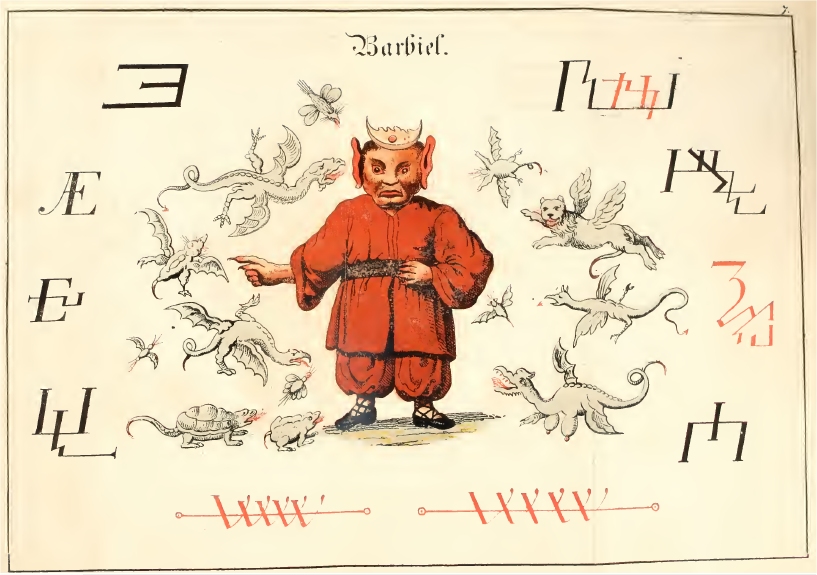
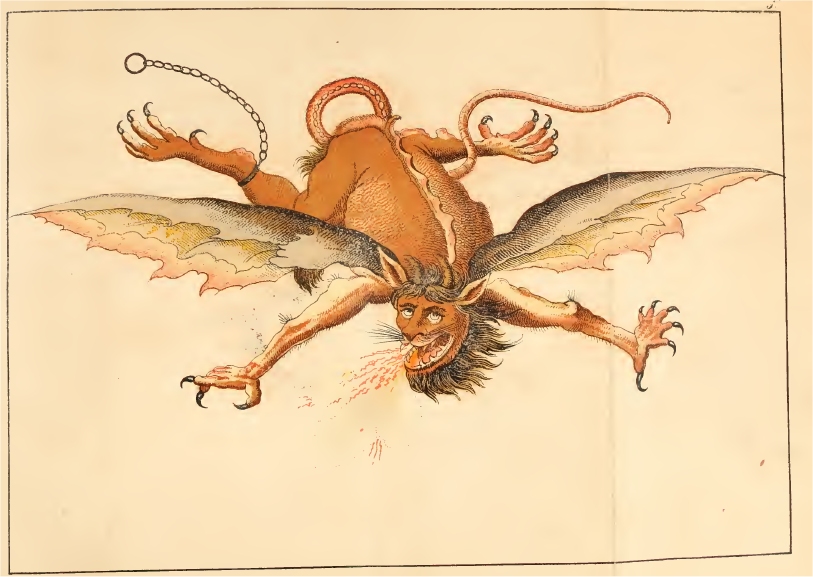
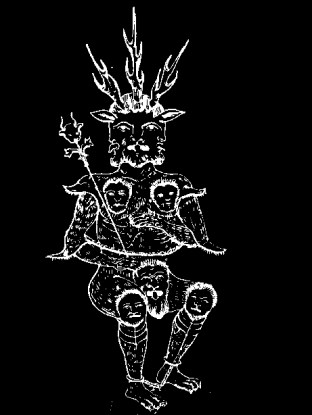
faust demon 13The (very cool) illustrations throughout this post are taken from Doktor Johannes Faust’s Magia Naturalis et Innaturalis (Dreifacher Höllenzwang, letztes Testament and Siegelkunst), the Faustian Grimoire.

The Faustian legend, the story of a man selling his soul to the devil for a few years of power and wisdom, has so many potential sources that it is quite impossible to say precisely where it came from. The character of Faust draws on several real individuals including Simon Magus, Agrippa of Nettesheim, Paracelsus and the actual Johann Georg Faust, a travelling German magician who lived in the 16th century. However, as fascinating a topic as this is, I don’t want to pretend that I have any novel ideas on the origin of the legend. My goal for this post is more to outline and examine some of the major strains of the rather complicated textual history of Faust. The Faustian legend has long been considered an appropriate topic for serious academic study, but despite, if not because of, the quantity of writing about this legend, it can be quite tricky to distinguish between the different types of books about Faust. I’m going to look specifically at Faustian chapbooks, the plays that immortalized the legend, and some Faustian grimoires.
faust demon 16

The first printed versions of the Faust story appeared in German chapbooks in the late 16th century. The very first and seemingly most popular of these Faustbuchs was titled Historia von D. Johann Fausten, dem weitbeschreyten Zauberer und Schartzkünstler or The History of the Damnable Life and Deserved Death of Doctor John Faustus. The first widely read edition of this text was published in 1587 in Frankfurt by Johann Spies, but a slightly different, shorter version exists in manuscript form. New editions of this Faustbuch almost always contained additions to the tale (usually appropriations of other folk tales), and as the Wolfenbüttel Manuscript dates from the same time as the Spies edition yet contains a more concise version of the tale, it is assumed to be closer to the original text. (We do not know the origin or author of the original text.) The Spies version was translated into English in 1592, and it was almost definitely this translation that introduced the story of Faust to Christopher Marlowe. (I got my info on the Wolfenbüttel Manuscript here.)

I read the online translation of the Wolfenbüttel Manuscript and the 1592, English translation of the Spies edition of the Faustbuch.  Both tell the standard story of Dr. Faustus. (I’m going to assume that my readers have some familiarity with the legend, but for those who need a reminder, it’s basically the tale of a smart lad who gets bored, sells his soul to the Devil for 24 years of servitude, spends the rest of his life either causing mischief or having theological debates with his Hellservant, and eventually comes to regret his decision just before he has his body torn apart and strewn in shite.) The Faustbuch gives more detail on some of the events that are only briefly alluded to in other more popular versions of the tale, including Faust’s trips to Hell and Outer-Space, but the sections in here that Goethe and Marlowe chose to omit completely are chapters in which Faust plays the role of a folk hero, uniting lovers or stealing wine from the wealthy to give to poor students. There was one part where he comes across four other magicians who are performing a party trick that involves them cutting off their heads and reattaching them. Faust gets jealous and interferes with their trick so that one of their heads becomes unattachable. It really reminded me that episode of the X-Files where the magician’s head fell off. The other memorable Faustian rarity included in here is an episode in which Faust temporarily curses a man’s penis with flaccidity to prevent him from making love to another fellow’s wife.

The manuscript version has only 44 chapters, while the Spies version has 63. These extra chapters tell of Faust seeking paradise from a mountaintop, explaining the nature of thunder, casting a spell on some drunks to keep their mouths open forever, showing the Duke of Anholt a big magical castle, getting Mephistopheles to summon him 7 beautiful women so that he can ride them, digging a tunnel to treasure guarded by a Hellish serpent, and a few other bits and pieces. Later editions of the Faustbuch doubtlessly contain more such additions, but I’m in no rush to seek them out.

And indeed many other chapbooks were printed about Faust, but they all seem to have been published in German and I haven’t been able to track down translations. Wikipedia mentions Das Wagnerbuch (1593), Das Widmann’sche Faustbuch (1599), Das Pfitzer’sche Faustbuch (1674), and Faustbuch des Christlich Meynenden (1725). I haven’t read any of these, but I presume that they are just slightly different tellings of the same story. Several of these texts, along with a bunch of Faustian grimoires, were assembled in a collection called Das Kloster by a guy called Johann Scheible between 1845 and 1849, but again, I don’t think this has ever been translated in its entirety.
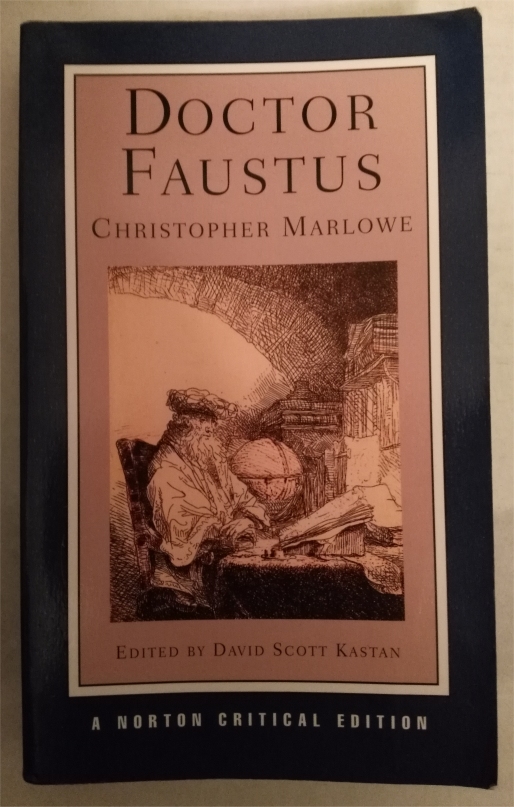
marlowe faustThe Tragedy of Doctor Faustus: Norton Critical Edition – 2005
Christopher Marlowe

Marlowe’s play played a huge role in popularizing the legend amoungst English speaking audiences, and may still be the most popular version of the story. It was written between 1588 and 1593, but the earliest surviving text version of the play dates from 1604 (the so called A text). There’s also a longer version of the play, dating from 1616 (the B text). The B text spends more time making the Pope look like a dickhead, features slightly more on-stage devilry, goes into more detail on the Horny Knight subplot (not as interesting as you might think), and depicts a more gruesome end to Faustus. There’s also lots of small differences between the wording of the two texts. Both versions are considered canonical at this stage, and many printings of the play include the two of them.

Personally, I reckon the A text is probably the best place to start if you haven’t read anything else about Faust. (The additions in the B version are frivolous, and they upset the tone of the play in my opinion.) In the A text, Marlowe trims the folkish-fat from the Faustbuch, and while presenting an issue that demands contemplation, he doesn’t get bogged down in existentialism; as George Henry Lewis wrote, “The reader who opens ‘Faustus’ under the impression that he is about to see a philosophical problem treated philosophically, will have mistaken both the character of Marlowe’s genius and of Marlowe’s epoch.” This is the reduced nonsense version of the tale and genuinely one of my favourite pieces of literature. I beseech you to take the time to read it if you have not already done so.

Marlowe 2nd edition.jpgTitle page of 2nd edition of the B version of the text.

 I first encountered Marlowe’s Faust in a class on Renaissance literature when I was 20. I had a part-time job in a carpark at the time and I managed to read the two versions of the play over the course of my Sunday shift. It felt mighty good to get paid for reading a book (although the essay that I wrote about the play afterwards was absolutely rubbish). 10 years have passed, and as it so happens, I managed to reread the B text while in work today.  It still felt good.

The popularity of Marlowe’s Faust led to several other dramatic treatments of the play including William Mountfort’s The Life and Death of Doctor Faustus, made into a farce (1697) and John Rich’s The Necromancer, or Harlequin Dr. Faustus (1723), but these were mere pantomimes. The texts are online, but I have spent the last month reading nothing but different versions of the story of Faust, so I’m not going to bother with them right now. The next important development in the story of the story of Faust comes in the 19th century when Goethe completes his version of the tale after working on it for almost 60 years.
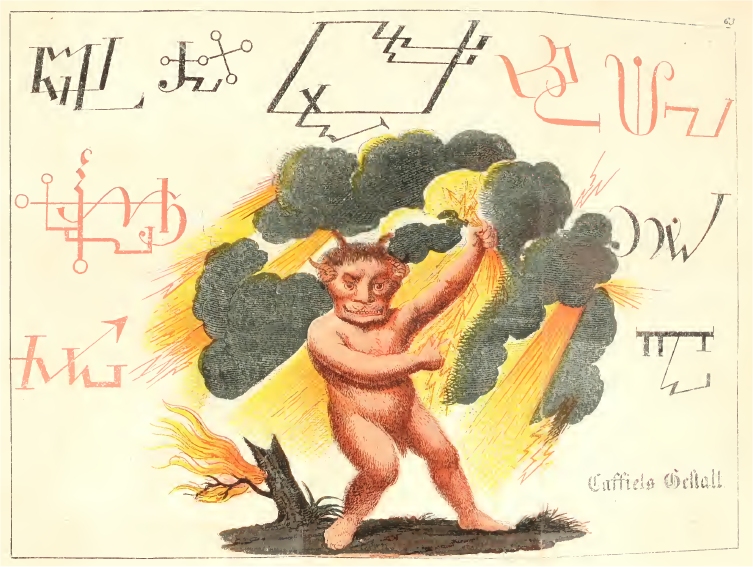
faust demon 4It is quite certain that Goethe was familiar with at least some of the Faustian Grimoires that were kicking about Germany at the time. (Although this image almost definitely dates from after his death.)

While there are two versions of Marlowe’s rendition of the story of Faust, there are two parts to Goethe’s. (There are several early versions and drafts kicking about too, but unlike Marlowe’s, there is some certainty about which is the definitive version of Goethe’s play.) The first versions of Goethe’s Faust appeared in the early 1770s, but the first version of a distinct Part One was published in 1808. It was revised 2 decades later. The second part was published in 1832, a few months after Goethe’s death. He had only just finished it when he died.

faust part oneFaust: Part One – Penguin Classics Edition – Translated by Philip Wayne (1971)
Faust: First Part – Bantam World Drama – Translated by Peter Salm (1967)

Part One is a relatively straightforward version of the first part of the tale of Faust. The biggest difference here, and this doesn’t really come into play until Part Two, is that Goethe’s Faust doesn’t make a deal with the Devil; he makes a bet with him. Faust bets Mephistopheles that nothing the Devil can offer him will be able to provide him with any real sense of satisfaction. Goethe also introduces Gretchen, a corporeal love interest for the Doctor, and it is Faust’s betrayal of Gretchen that makes this play a tragedy.

Goethe’s Faust is considered by many to be the single finest accomplishment of German literature. The entire work is full of allusions to mythology, philosophy and 19th century German politics, and although Part One seems very straightforward in comparison to Part Two, it still contains some rather weird bits that are hard to make sense of. Believe me, I’ve had to read Midsummer Night’s Dream more times than I can count, so when I saw the section titled “Walpurgis Night’s Dream” I thought I’d breeze through it. Let’s just say that I was very wrong… Also, Goethe’s Faust is considered a Closet Drama (a play that is not actually meant to be performed), and while it looks like a play, it reads more like an epic poem. Because of its complicated poetic nature, any translation is bound to be infinitely inferior to the original. Thankfully, one of the versions of Part One that I own is a straightforward prose translation. I read this in conjunction with chapter summaries online to make sure that I was getting the most out of the work.

faust demon 5

I first read Part One a few years ago, but I went over it again for this post. Directly afterwards, I picked up the copy of Part Two that I had nabbed from a free books table at school last year. To my great disgust, the translator had attempted to put the whole thing in rhyming verse. I went to the library the next day and took out a few different translations. They all rhymed. It turns out that the rhyming scheme and meters used in Part Two are actually relevant to its plot; hence the lack of prose translations. I judged the 2009 Penguin translation by David Constantine to be the best one. It contains brief chapter summaries and decent notes. I also found these online chapter summaries and notes by Bruce McLennan to be extremely helpful in making sense of what was happening.

faust part twoFaust: Part Two – Penguin Classics Edition – Translated by Philip Wayne (1971)
Faust: Part II – Penguin Classics Edition – Translated by David Constantine (2005)
Faust I & II – Princeton – Translated by Stuart Atkins (1994)

Part Two of Goethe’s Faust steers well away from the traditional Faust story. Here, Faust falls so madly in love with the conjured phantom of Helen of Troy that he travels to the underworld of Ancient Greece so that he can be with her. He is accompanied by Mephistopheles and a Homunculus created by his friend Wagner. (I wondered if Goethe, a German Freemason might have encountered the mysterious Die Sphinx, but it was actually published 41 years after his death!) Things get a bit awkward because Mephistopheles is a Christian devil (I mean a Devil according to Christianity, not a Devil that goes to mass), and devils don’t have any jurisdiction in the Greek underworld. The three lads embark on separate journeys of self discovery and each encounter a bunch of different, often rather esoteric, characters from Greek mythology. This is fairly heavy going; I’m decently familiar with Greek mythology, but I would have been completely lost without the footnotes.

goethe and defoeI noticed that this shitty version of Faust Part Two has the exact same cover as another shitty book in my collection. (Image is Eugène Delacroix’s Mephistopheles Over Wittenberg, 1839)

mephistophiel
Goethe’s Mephistopheles (and his Homunculus) seem to be extensions of Faust’s personality rather than separate characters. (I’m sure there have been essays written comparing these three characters to Plato’s tripartite soul, Freud’s Id, Ego and Superego and probably even the Father, Son and Holy Spirit.) Goethe’s Faust isn’t a warning to the curious; it’s a deeply symbolic and philosophic exploration of virtue, evil and human nature. I’m sure the original German text is far more enjoyable, but Constantine’s translation is still a rewarding (if very challenging) read.

“These metaphysics of magicians,
And necromantic books are heavenly;
Lines, circles, scenes, letters, and characters;
Ay, these are those that Faustus most desires.”
Marlowe’s Faustus – Act I, Scene I

Magical books play a role in all of the different versions of the Faust story that I have thus mentioned, and it was only a matter of time before followers of the legend began seeking/counterfeiting these diabolical grimoires. There are many grimoires attributed to Faust, but like everything else relating to this legend, they’re mostly in German. The most well known is probably Magia naturalis et innaturalis, oder dreifacher Höllenzwang, letztes Testament und Siegelkunst. Like the other Faustian grimoires, this work was supposedly written in the early 16th century, but the earliest edition dates from a few hundred years later. (This one was supposedly from 1505, but it was published in 1849.)

black raven
Magia naturalis et innaturalis features the above image of a black bird right at its beginning, and you might read online that this image has supposedly led to the book becoming known as The Black Raven. However, looking for a translation Faust’s Black Raven will almost certainly lead you to a pdf version of very short Faustian grimoire titled ‘Doctor Johannes Faust’s Magical Art and Miracle Book or The Black Raven or also called The Threefold Coercion of Hell’. I’ve seen a few other bloggers complain that this translation isn’t accurate and that it’s far too short. While I can’t comment on the accuracy of the translation, I can say for certain that this is not supposed to be a translation of Magia naturalis et innaturalis. This short document is actually a translation of a grimoire called Dr. Johann Faustens Miracul-Kunst- und Wunder-Buch oder der schwarze Rabe auch der Dreifache Höllenzwang genannt that was included in Scheible’s Das Kloster (original text here).

original black raven.jpgThe Black Raven of Dr. Faust’s Wonderbook

Owen Davies, in his Grimoires: A History of Magical Texts, refers to what sounds like yet another text featuring the curious bird, and so it seems that that the Black Raven is actually a subgenre of Faustian grimoire rather than a specific text.

Magia naturalis et innaturalis has been translated, but these translations have been put out in small runs, and I haven’t found a copy online. I really doubt that the text lives up to the standard of its accompanying images anyway; it looks like a Kabbalistic nightmare. I did read through the translation of the shorter Black Raven, but reading it wasn’t nearly as entertaining as trying to figure out where it came from. People distinguish between Faustian grimoires and Solomonic grimoires, but this read like a shit version of the Grand Grimoire: Draw a circle on the floor, say a few spells, howiye Mephisto.

An assortment of Faustian Demons from Magia naturalis et innaturalis

Well that about covers what I wanted to say. Hopefully this post will help clear things up for anyone doing preliminary research on the texts of Faust legend. There are of course many more books on, about and supposedly by Faust, but I have limited this post to the Faustian Chapbooks or Faustbooks, the major dramatic representations, and the grimoires attributed to the learnéd doctor. Although the legend of Faust is distinctly satanic and deals with the occult, allusions to the legend and the Faustian theme are to be encountered infrequently by anyone with an interest in literature. I hope it will be a long time before I write another dedicated Faustpost, but you are quite sure to come across references to this legend in many of my future posts. To conclude then, I want to warn you that if you’re seriously considering making an infernal pact with the Prince of Hell but are worried about the consequences… don’t hesitate. Remember that Goethe’s Faust got away with it. Open a vein and sign up immediately. You’ll be fine.

Oh, and happy Easter!

Satan’s Disciples – Robert Goldston

satans disciples goldston.jpg
Ballantine Books – 1962
I added this book to my to-buy list immediately after stumbling across a picture of the cover somewhere online. I was worried that the book itself might not live up to the cover image, but it delivered.

This is a trashy and rather sensational history of satanism and witchcraft. Robert Goldston skips the boring parts (numerology, kaballah, astrology, palmistry…) and goes straight for the sadistic orgies, blood sacrifices, and hag torture. Needless to say, I enjoyed every page.

The introductory chapter to this magnificent work claims that “It can be safely asserted that from the year 1200 until the middle of the seventeenth century, the overwhelming majority of the people in Europe worshipped Satan and regularly attended his festivals.” While I have come to expect this kind of exaggeration from Christian writers writing about Satanism, nearly all of Goldston’s condemnations are actually directed at the church. He doesn’t quite espouse Satanism, but the book, as a whole, almost seems like an attempt to justify it.

While claiming to be a “a full account of witchcraft for modern readers”, this is really more a mish-mash of descriptions of some of the grislier characters, legends and phenomena from the history of witchcraft, each description doing its utmost to err on the side of ridiculous. Included are tales of the ‘blood cows’ of Elizabeth Bathory, how Oliver Cromwell sold his soul to the devil (I believe it, the cunt!), a woman who gives birth to a pair of goblins and feeds them to her dog, and Doctor Fian, a Scottish wizard who specialized in pube magic. There’s a wonderful account of a priest who stupidly banished a demon to a toilet and thus ended up with a burnt, shit-besplattered arsehole, and there’s the heartwarming tale of the Chatelaine De Beauvoir, a lady that I can’t find mention of anywhere else who managed to convince a troop of young men to be her sex slaves. She divided these men into different groups of animals (some were dogs, some were birds) and had them do her perverted bidding. When a police officer inquired how she maintained control over these fine fellows, he was told that she did so by feeding them her shit. What a cool lady! There’s also plenty of other stories about rape, incest and cannibalism. This book definitely doesn’t shy away from the nasty stuff. There’s one particularly brutal account of a young nun who is accused of witchcraft and jailed. Confined to her cell, she is routinely raped by her three guards. At first this treatment leads her to attempt suicide, but she later grows to like it and eventually ends up spending the non-getting-raped parts of her days worshipping Satan.

Towards the end of the book, Goldston temporarily abandons his objective of chronicling the history of witchcraft and devotes a single chapter to the actual practice of Black Magic. Chapter 11, Spells, Curse and Demons, is basically a grimoire in and of itself. It includes useful spells to cure gout, guard against vicious animals, summon Satan, get rid of a headache and kill your enemy. Crucial stuff.

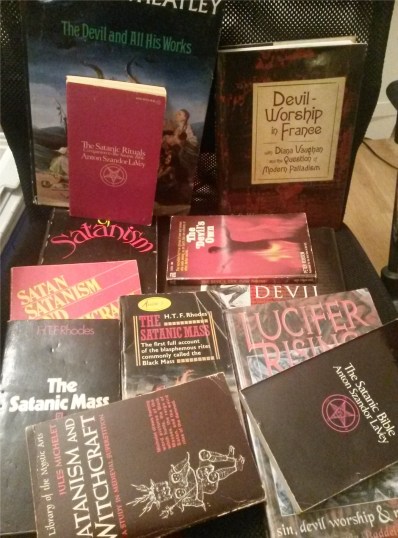
In ways, this book was quite similar to Peter Robson’s The Devil’s Own, but while equally as trashy, this one contains a bibliography and actually makes frequent reference to real historical texts. I wasn’t surprised to see William Seabrook’s book on witchcraft in its bibliography either. All three of these books have a delightful bullshit/reality ratio, and if you have enjoyed one of them, you will definitely like the others. I would really love to know if anyone has recommendations for similar books.


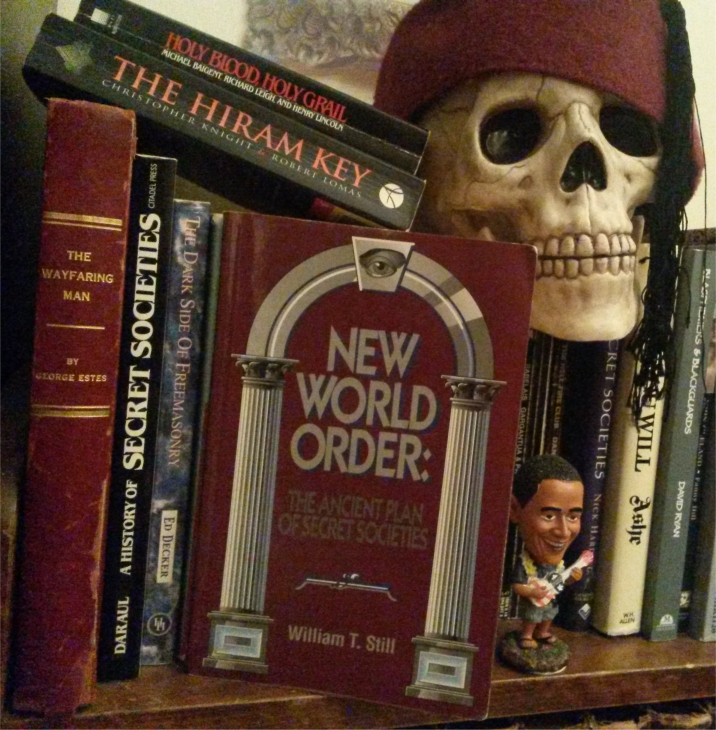
Illuminati Confirmed! – New World Order (The Ancient Plan of Secret Societies) – William T. Still
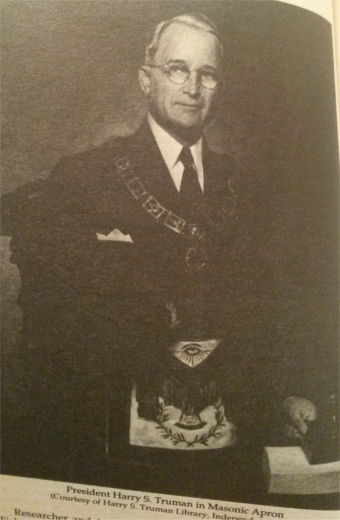
nwoNew World Order (The Ancient Plan of Secret Societies) – William T. Still
1990 – Huntington House Publishers

After a very boring introductory chapter, this book contains about 70 pages of tolerably silly conspiracies, but then it gets very, very boring. Just from the cover, I expected something similar to  Ed Decker’s Dark Side of Freemasonry, and I wasn’t far off. This is a book of conspiracies from the point of view of a conservative Christian author.

As far as these things go, it was fairly well researched. William T. Still is clearly a nutjob, but he’s competent enough to provide his references. The book contains nothing I haven’t come across before, but it was novel to see how the author managed to link the Atlantean origins of secret societies, William Shakespeare’s true identity, and the Freemason’s involvement with the Jack the Ripper murders. Still is the kind of wacko that Umberto Eco was making fun of in Foucault’s Pendulum.

truman
The central idea behind the book is that the Illuminati is a Luciferian/Satanic cult dedicated to exterminating religion, taking over the world, and bringing about the reign of the Antichrist. If America doesn’t adopt conservative politics and good old-fashioned family values, the country is going to allow itself to be taken control of by a small group of the super-wealthy who don’t care about anyone but themselves. The scary thing about this book is that you know that the people who read it and have taken it seriously are the exact same people who are going to vote for Donald Trump.

The Illuminati has recently reentered the public consciousness. Nearly every teenager in North America has seen the ‘Illuminati Confirmed’ memes. Why now? Maybe it’s because the idea of a small, faceless group of the super wealthy being in charge of America is actually less frightening than the faces of the small group of the super wealthy that clearly are running the country.

Some Thoughts on Satanism…

Image1Satanism is a truly ridiculous concept. Satan, a character most famous for his appearances in the New Testament of the Christian Bible, is supposed to be a nasty, horrible, unpleasant individual, a real shit. Why would anybody choose to follow him?
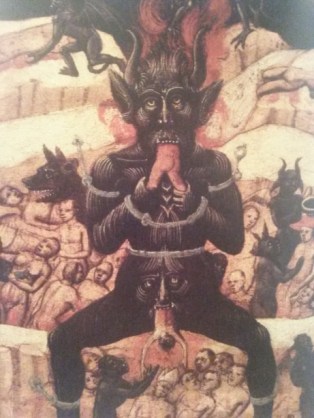
Imagine this. You’re working in a restaurant and some dickhead customer starts getting lippy because there’s mayonnaise on his sandwich. You understand his dilemma, mayonnaise is fucking gross, but he’s being rude with you and acting as if it’s your fault. You can’t speak your mind to him because you need to keep the job, but you determine to remember his face in the hopes that you will someday be able to wreak vengeance on him.

Ok, now fast forward 5 years. You have since become a millionaire and bought a big house on the outskirts of town. One night you are sitting at home, watching a good film and sipping on a glass of fine Beaujolais wine. Ahhhh, what bliss! But hark, there’s a knock at the door. Low and behold, it’s the shithead that complained to you about the mayo in his sandwich. You remember him, but he has no recollection of you; complaining to service workers is a habit of his and he doesn’t keep track. It turns out that he got separated from his friends on a camping trip and he has had to walk 30 miles back to the city alone. He managed to say hydrated by drinking his own piss, but he’s starving and he’s asking if you could spare some food. You tell him that you were about to sit down to dinner and you invite him in. Once he’s sitting at the table, you stroll into the kitchen and return  with a jar of Hellmans and two spoons. Bon Appetit, cunt!

I presume that you’ve realised that in the above scenario you’re a Satanist, the shitty customer is Christianity, and the mayonnaise is Satan. Let me clarify; Satan sucks for everyone, but Christianity is so shitty that it’s actually worth debasing yourself by pretending to like mayonnaise in order to defy it. I hope that makes sense; I think it’s a pretty tight analogy.

20160822_231909
You might then ask whether Satanists are really worshiping Satan or just pretending to worship him in order to scare/upset Christians. Well, it’s a little of column A, a little of column B. The Satan of Satanism isn’t quite the same Satan that appears in  the New Testament; he has been upgraded. To a Satanist, Satan represents freedom rather than evil

Let me clarify; Satanism and Devil worship are not the same thing. To Satanists, Satan is a good guy. There are relatively few people who actually worship the ‘evil’ Satan that appears in the Bible, and those that do are morons. To worship that Satan, you would have to believe the stories about him, but believing the stories about him would mean that your Holy Book would be the same Holy Book as the Christians. This would make you a shitty Christian instead of a Satanist.

20160822_231559

So if Satanism is not about the pursuit of evil, what is it? Well, it’s impossible to pin it down at this stage. Most modern forms of Satanism are derivations of LaVeyan Satanism, which is, at its roots, a pragmatic reevaluation of morality. It’s basically Nietzschean philosophy dressed up for Halloween. Labeling this mode of thinking as ‘Satanism’ prevents most people from taking it seriously, but this very repulsion allows Lucifer’s hordes to delude themselves into believing that they are edgy elitists and not just a shower of fedora-goths. (LaVeyan Satanism is atheistic; Satan is thought of as a symbol rather than a deity.)

20160822_231939

The really shitty thing about Satanism is that it’s not nearly as cohesive in practice as I’ve so far made it out to be. It’s an absurd, if entertaining concept, and like all ‘religions’, it acts as a magnet for absolute morons. I joined a bunch of ‘Satanic’ discussion groups on facebook (for research purposes), and I have been absolutely horrified with the stupidity of the people posting in those groups. I’m talking serious idiots here; cretins of the lowest order. Most of the people who publicly declare themselves Satanists are cringey teenagers or aging, uneducated slipknot fans. Think of a 40 year old white guy with 2 ball-bearing necklaces, a lip piercing, and a 19 year old girlfriend that he met in a Dairy Queen after the ICP concert; a guy whose facebook profile pic is a moody black-and-white selfie with a superimposed pentagram. The people who want you to know that they’re Satanists are a lowly bunch indeed.

Also, the self-centeredness and focus on power of Satanism make it really attractive to far-right dickheads and racist scumbags. Fuck those people.

Satanism is quite funny, but the term Satanism is used and understood in such drastically different ways that it has become nonsensical and impractical. It means entirely different things to different groups of people, and due to their common levels of ignorance and opposing understandings of the term, these different groups of people are very unlikely to take the time to try to understand each other.

I’m sure there are plenty of people who disagree with what I’ve said here. Let me know what you think. Leave a comment below, email me, or message me on facebook.

20160822_231816Now, get outta here!

Who is the Duke De Richleau? The Devil Rides Out, Strange Conflict and Gateway to Hell

It may come as surprise to some of you, but I am neither French nor a Duke. Le Duc De Richleau is the hero in a collection of 11 novels by Dennis Wheatley. For all of the philistines reading my blog, Wheatley was a prolific author of trashy adventure novels. Most of his books were spy novels, but he was also a self proclaimed expert on the occult, and some of his books, 2 of which I have already reviewed, deal with black magic. The Duke De Richleau series contains 3 Black Magic novels, including The Devil Rides Out, perhaps Wheatley’s most famous book.


20160605_232803
The Devil Rides Out
Hutchinson and Co – 1972 (Originally published 1934)
It’s been a long time since I read this one, but I remember it well enough to know that you don’t need an in-depth review to decide whether or not you should read it. This book is about Satanists, pentagrams, rituals, goats, spells, and demons. If you know that much and don’t want to read this, you’re a piece of shit. This is definitely one of the best places to start if you haven’t read any Wheatley before. The movie is deadly too, but for the love of Satan, read the book first.
2016-06-05 23.32.5920160605_232906
My copy of Devil Rides Out is a fancy hardback reissue. Some of these have illustrations.


20160605_232704
Strange Conflict
Arrow – 1981 (Originally published 1941)
Unlike the other two books in this post, I read this one last week, so it’s still fairly fresh in my memory. This was an enjoyable entry to the series, but it’s a pretty bad book. It sees the Duke and his mates being hired to discover how Nazi U-Boats have been successfully figuring out the trade routes of English ships. Using astral-projection, the Duke figures out that the Nazis are getting their info from an evil Voodoo priest in Haiti. Ok; Voodoo Nazis, sounds great right? Well yeah, that is super cool, but let’s just think about the idea of using astral projection as a means of espionage for a moment. Astral projection gives the Duke the ability to leave his body and go anywhere in the world. The book starts off with him sitting in his apartment in London as the city is being bombed to shit. WHY THE FUCK DID HE WAIT 2 YEARS TO START SPIRIT-SPYING? Why did he not volunteer to start sleep-creeping the Nazis as soon as they entered Poland? Also, out of the Duke’s team of friends, 3 out of the 5 are able to astrally project themselves. If 60% of people can do so, why the fuck were the British government so fucking slow to organize a full-on Astral attack on Germany? It doesn’t make any sense.

Anyways, as soon as they figure out that the bad guy is in Haiti, they decide to head over to kill him in his sleep. I have mentioned elsewhere that Wheatley was not one to be concerned with cultural or political sensitivity, and a trip to Haiti provides several lolworthy examples. This was written in 1941, so the author’s use of the term Jap is excusable, but referring to the “Jap” character as a “dirty little yellow rat” might be a bit much for the modern reader. Failing that, the description of the Haitian natives is sure to offend:
“Those coloured bums have just no powers of organisation at all and it’s like one big tropical slum. If it weren’t for the climate and the masses of fruit that can be had just for the plucking the whole darned lot of them would have starved to death long ago… The niggers live in little more than tents made from tying a few banana palms together.”  There’s another thoroughly unpleasant passage describing the parents of a missing teenager whose corpse has just been found in the hospital; “The man and woman were Mulattoes… The woman was a characterless bag of fat which appeared to have been poured into the good-quality silk dress that restrained her ample figure”.
He also refers to one of the black characters as a “wooglie”, although I’m not entirely sure whether or not that’s a racial slur. (My guess is that it probably is.) To top it all off, the book ends in an amazing proclamation on the superiority of the Anglo-Saxon race.

2016-06-05 23.31.59
Mr Wheatley, you charmer!

I’ve mentioned elsewhere that I don’t mind reading racist books as long as I’m not giving money to the author. In this case, the author is long dead, and I buy these books second hand. However, the most recent editions of Wheatley’s novels have been abridged, and the horrible racism and misogyny have been removed. This is utterly infuriating. It’s not that the publishers want to prevent the spread of racist ideas; it’s that they want to make Wheatley more palatable to the tumblr generation. Fuck that; if you buy a book about Nazi devil-worshippers but get offended by fictional characters’ racism, you need to kill yourself immediately. Yes, Wheatley was a shit, but if you can’t read a book by a person that you might not like in real life, you’re a stupid fucking loser. If you come across something in a book that makes you uncomfortable, think critically and learn from the experience. Censorship of literature is immoral, and anyone who begs to differ can go and help themselves to a hearty swig of bleach.

The rest of this book is standard Wheatley fare; chases, rituals, beautiful but enchanted young women, demons, the works… The ending involves a bit of the old deus ex machina, and I got the feeling that ol’ Dennis might have been making it up as he went along. I wouldn’t recommend this one as a starting point for his work, but it’s worth a read if you like this kind of garbage.

20160605_232625
Gateway to Hell
Arrow – 1974 (Originally published 1970)

I don’t remember much about this one to be honest. It definitely wasn’t as good as Devil Rides Out, but I gave it 5/5 stars on goodreads, so it was obviously thoroughly enjoyable. More diddies on the cover too; can’t go wrong like.

Overall, Wheatley’s writing is bad (He admitted so himself), his plots are silly, and a lot of his ideas are liable to trigger you into oblivion, but I really love his books. There’s something comic-booky about them, and I like to treat myself to one in between heavier stuff. These are just the Black Magic novels from the Duke De Richleau series, and I’ll probably review the others at some stage too.

Happy Birthday to the Marquis De Sade!

hand
I’ve been meaning to do a post on the Marquis De Sade since I started this blog, and what better day to do it than his 276th birthday! De Sade’s life was as interesting as his books, and it’s hard to know where to start with him. I have an awful lot to say about the lad, and I’m sure this won’t be my only post on his work.

Trigger Warnings: Rape, Murder, Blasphemy, Bestiality, Rape

(You said Rape twice…)

sodom
The 120 Days of Sodom & Other Writings – Marquis De Sade
Grove Press – 1987

My introduction to De Sade’s writing was 120 Days of Sodom. It is, without a doubt, the vilest book that I have ever read.  It’s a bit like the GG Allin of literature; it’s fucking horrendous, but it’s kind of cool that somebody did it. This book is so far ahead of its competition in terms of offensiveness, that any attempt to outdo it would seem petty.
It’s a fairly long book, and it’s very formulaic in some ways. I read it over a few days, and it really got to me. This is one of the very few books that has actually given me nightmares. (Imagine drifting off to the land of Nod only to find yourself being forced to attend a ‘blood-orgy’ in a subterranean vault. Yes, a ‘blood-orgy’; I distinctly remember that phrase from the dream.) As it so happens, this is also one of the very few books that has actually made laugh so hard that tears ran down my face. There is one part in which a man “fucks a goat from behind while being flogged; the goat conceives and gives birth to a monster. Monster though it be, he embuggers it.” Now THAT’S comedy! “Monster though it be” HAHAHAHAHA!!! The man is having sex with his own mutant offspring! LOL!!! 

When introducing one of the characters, a lady named Thérèse, De Sade notes;
“Her ass was peppered with wounds, and her buttocks were so prodigiously slack one could have furled the skin around a walking stick; the hole in this splendid ass resembled the crater of a volcano what for width and for aroma the pit of a privy; in all her life, Thérèse declared, she had never once wiped her ass, whence she had positive proof that the shit of her infancy yet clung there”
Some people view him as a philosopher, some ill-informed individuals imagine him as a sexual-revolutionary, but I think that De Sade has to be interpreted as a comedian with an extremely childish sense of humour. I can imagine him, sitting in his prison cell, chuckling away to his heart’s content as he wrote down the most vulgar, repulsive things he could imagine. The man had nothing to lose, and his writing gave him an opportunity to lash out at those who landed him in prison. His mother in law had had him jailed for abusing a prostitute, and if you read between the lines in books that he wrote in jail, all you’ll see is the phrase “You think that was bad? I’ll show you bad!”
Petulant, but truly hilarious.

justine
Justine, Philosophy in the Bedroom, and Other Writings – Marquis De Sade
Grove Weidenfeld – 1990

Next up is Philosophy in the Bedroom/Boudoir. I actually read the Penguin Classics version of this one, but I own the Grove Press edition. This takes the form of a dialogue between a young girl and a group of libertines who attempt to convince her to abandon her morality. It’s been a few years since I read it, but I remember this being very, very funny. The blasphemies in here are priceless; I recall some of the characters attempting to shout out phrases such as “Christ be triple-fucked” as they reach their orgasms. There is a long and boring section towards the end that discusses 18th century French politics, but it’s not essential to the plot, and you can just skip over it. This one isn’t quite as repulsive as 120 Days, but it does get pretty nasty.

I have also read the Oxford’s World’s Classics edition of The Misfortunes of Virtue. The Misfortunes of Virtue, written in 1787, is probably De Sade’s most palatable book. It’s still full of rape and misery, but it makes its point without getting too disgusting. It’s about a virtuous young woman who does her best to stay good. Every time she fails to take the opportunity to do something bad, something horrendous happens to her. It’s a fairly depressing text. Four years after publishing this one, De Sade decided it wasn’t horrible enough, so he rewrote it with extra rape and pooing, and renamed it Justine. 6 years after this, he rewrote it again, making it even more repulsive. Unfortunately, the final, 1797, version has never been published in English. The text in my Grove edition is the second version, but I haven’t got around to reading it yet.

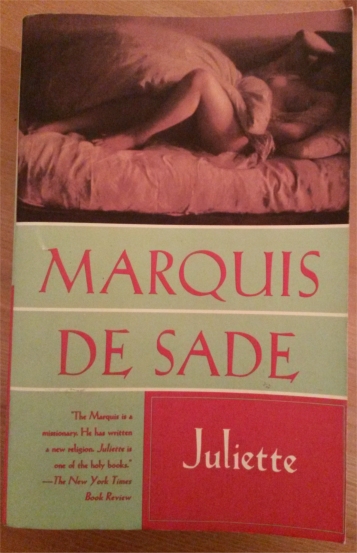
juliette
Juliette – Marquis De Sade
Grove Press – Not sure of year of publication (This edition lists a website though)

Although I own a copy, I have not yet read Juliette. Juliette is the companion book to Justine. While Justine was a little Goody-Two-Shoes, her sister Juliette was a bad girl who reaped the rewards of evil. I’m sure Juliette is a hoot, but it’s 1200 pages long, and although I have enjoyed his other works, De Sade’s books aren’t easy reads. 1200 pages of horrendous rape and murder seems like quite a commitment at the moment.

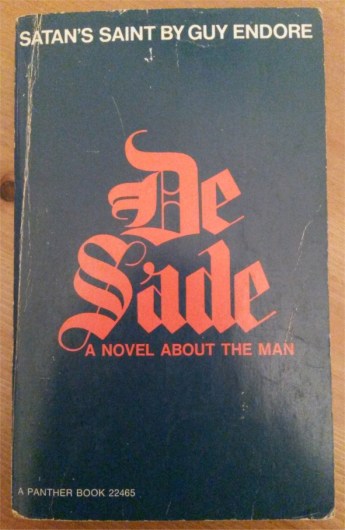
I just got this in the post the other day. It’s a novel about the Marquis from the 1960s. I’m sure it’s trash, but what a great title!
satansaint

Everyone has heard of De Sade, but not many people have actually read his books. He was a funny chap, but he was also a pathetic loser in a lot of ways. His anti-moral philosophies seem to have been a major influence on several forms of modern Satanism, and while I understand his point of view and agree with much of what he as to say about religion, I think that most of what he has to say is very shitty. Shitty, but sadly realistic. Anyways, that’s enough for tonight. If you want to discuss De Sadean/Sadistic philosophy, please give me a shout.

Happy Birthday Donatien Alphonse François!

*Although this post appears to have been posted on the 3rd of June, it was actually written and posted on the 2nd. De Sade was born on June 2nd, 1740.

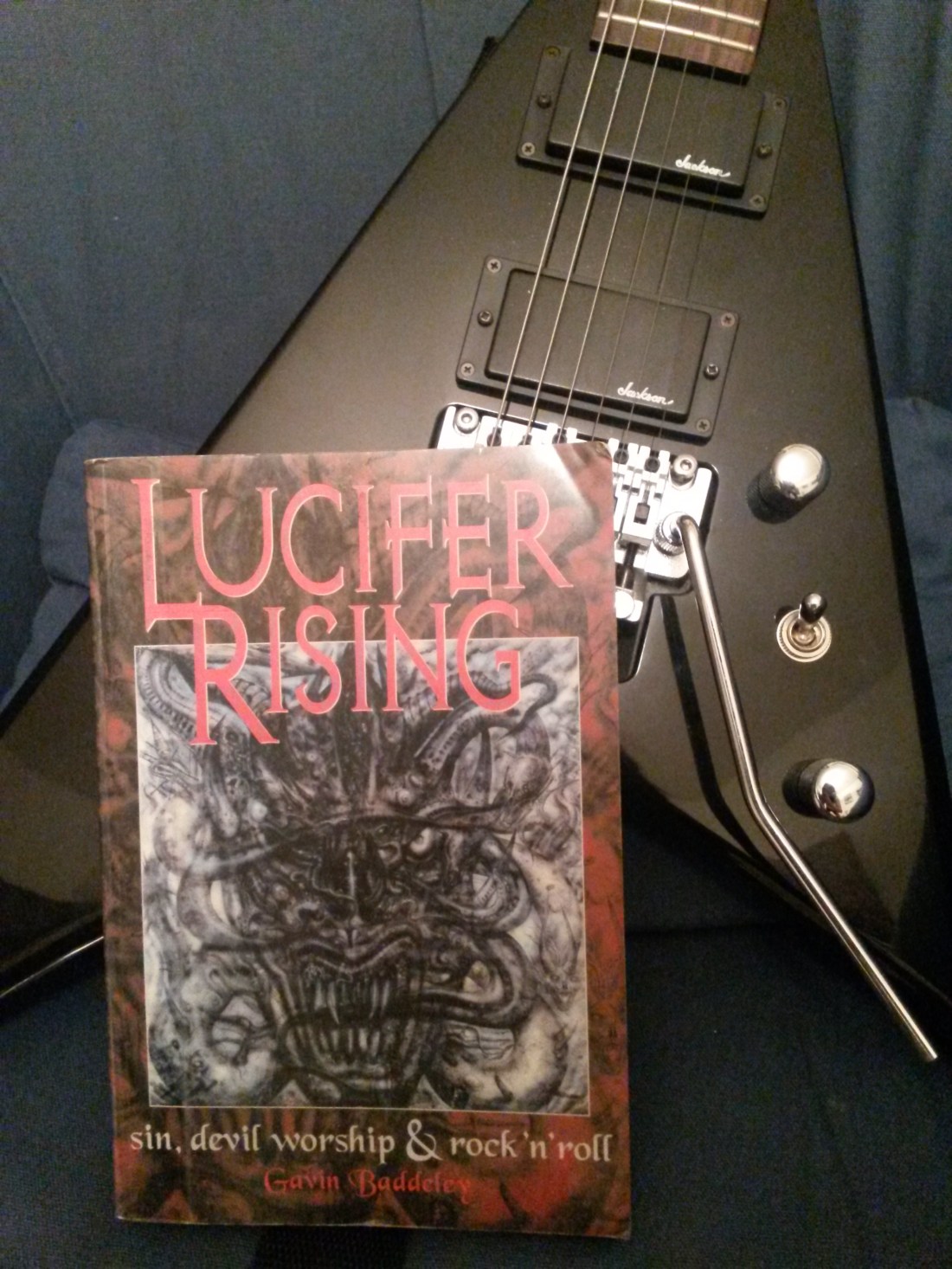
Lucifer Rising – Gavin Baddeley

20160512_224450
Plexus – 2006

This book deals with the different manifestations of Satanism within modern culture. It focuses on rock music and heavy metal, but it also discusses serial killers and horror movies. Sounds pretty great, right? A recommendation for this book showed up on my goodreads account, and my copy was ordered within moments of reading its description. I’m pleased to say that it didn’t disapoint. The author is a priest in the Church of Satan, and the history and outlook of LaVeyan Satanism is central to this book. I like LaVey, so I was entertained, but the author’s tone might be grating on some readers, particularly if they were Christian.

The first few chapters give a short yet surprisingly comprehensive history of Satanism, but the latter half of the book is mostly taken up with interviews. Some of these are excruciatingly embarrassing (Glen Benton is an idiot), and some are genuinely hilarious (Euronymous is precious). Varg Vikernes from Burzum has claimed that the interview with him is entirely fake. (He also claims that this is the worst book that he has ever seen.) I know lots of Burzum fans who claim to dislike Varg. Well, I always thought Burzum’s music was crap,  but I think he’s a pretty funny guy. (Don’t get me wrong; I know he’s a right-wing scumbag, racist, murderer and all-round crazy person, and I certainly wouldn’t say that I ‘like’ him, but let’s be honest; he regularly brings the lols.) There were a few interviews in here that weren’t hugely insightful, and it seemed that some of the interviewees may have been chosen based on their availability rather than their unique insight or authority on the topic, but this doesn’t take away from the cooler parts of the book. It might also be worth noting that I’m a fan of quite a few of the musicians interviewed herein, so I was probably more entertained than most people would be. If you don’t like rock music, this book might be a bit boring.

Baddeley suggests that there are as many different forms of Satanism as there are forms of christianity. (He also shows how hazy the lines between some forms of christianity and Satanism can be.) This book acknowledges the fact that Satanism is a very loosely defined set of beliefs and behaviors, and the author provides a thorough and entertaining account of the movement’s more interesting facets. (I picked up some cool recommendations for bands, movies and books too.) Overall, I would recommend this as a good primer for anyone with an interest in the Devil’s place in Rock’n’Roll.

I started writing a paragraph about my own take on Satanism, but it turned very lengthy very quickly, so I think I shall save it for a later date. Until then, Hail Satan!
(Update: This is what that paragraph eventually turned into.)


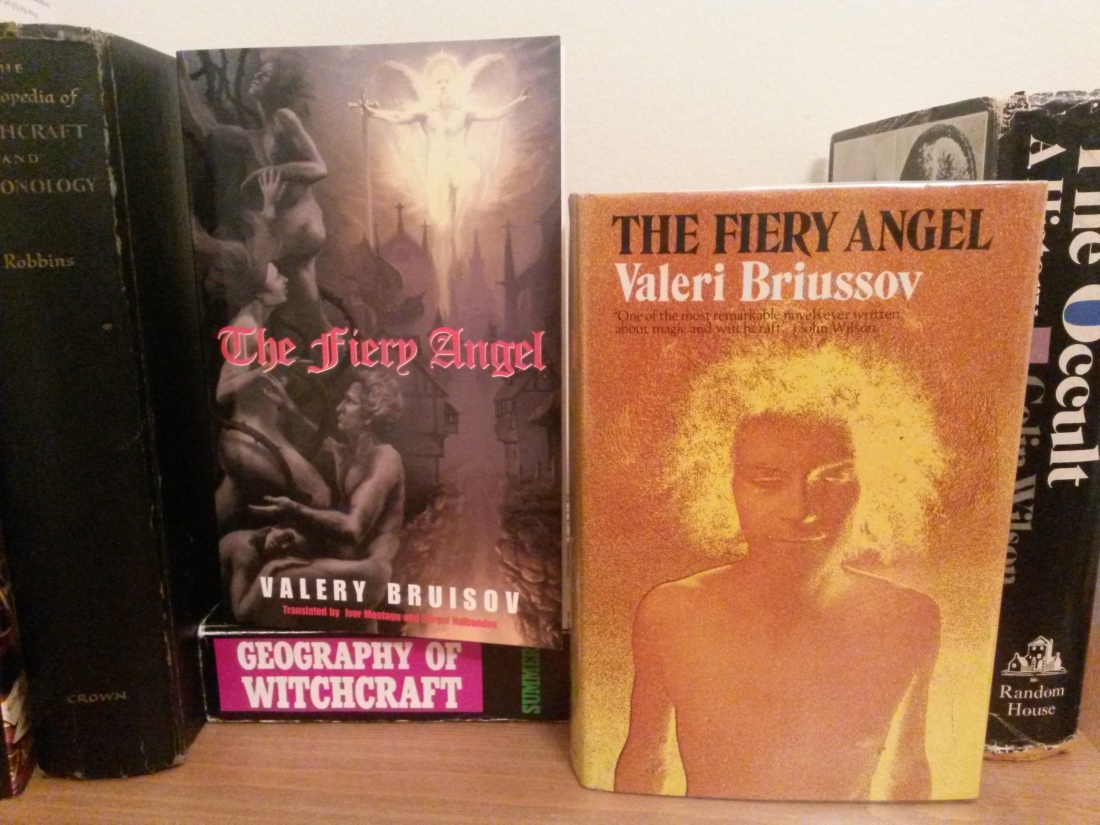
The Fiery Angel – Valery Bryusov

20160325_000821

Neville Spearman – 1975 (Valeri Briussov)
Dedalus – 2005 (Valery Bruisov)

I came across the title of this book when I was reading Colin Wilson’s The Occult two years ago, and from his description, I knew that I’d have to read it at some stage. I spent a while trying to track down a copy at a decent price, and when I found one, it spent a few months lying on the shelf before I got around to reading it. When I finally got around to it, I was met with an unpleasant surprise. Some of the pages were entirely blank. See the below video for details:


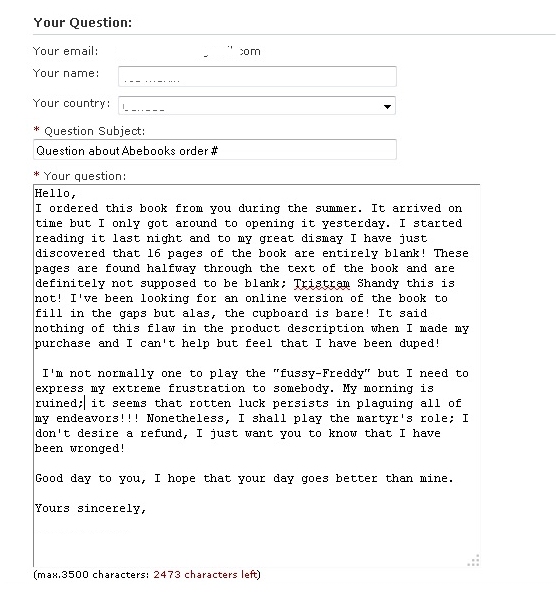
Like I said, I had ordered this a good while before picking it up to read, and so I didn’t feel it fair to demand a refund. I doubted that the bookseller had known about the defect, but I was having a slow day in work, and I decided to drop them an email to pass the time. Below is the message I sent.

my email

When I wrote that email, I did not expect a response. Fortunately, I was wrong; they replied promptly:
response
Many’s the stupid email I have sent, but I have never been so satisfied with a response. Normally you get a feebly polite apology. I take my hat off to the individual who sent the above response to me. It makes me happy to think that there are companies out there that deal with customers as they should be dealt with. If you’re talking to a jackass, talk to them like they’re a jackass. (Although, note that the seller did very courteously offer to send me a replacement.) I was extremely satisfied with my dealings with this seller, and I encourage all of my readers to buy books from them whenever the opportunity arises.

Anyways, I soon thereafter bought a different copy of the book (the more recent Dedalus edition), and that version lay on my shelf for another year before I got around to it. While the Spearman edition has a foreword by Colin Wilson, the Dedalus version has an afterword by Gary Lachman. Surprisingly, the Dedalus version also omits a two page foreword by Bryusov himself that really should be part of the text. In it, Bryusov claims to be the editor of the tale and not the author so-to-speak. Otherwise, the text of the two books are identical copies of the same original printing. (There are identical imperfections on the same pages in both versions, one of which looks like a squished fly.) If I had to choose, I would buy the Spearman version, but I would make sure that it has all of the pages before buying! (My copy is missing pages 76, 77, 80, 81, 84, 85, 92, 93, and a few more.)

Two things before I start my actual review. First of all, the name of the author is spelled differently on my two copies of this book. It’s spelled Valery Bryusov most places online, so I’m going to use that spelling. Next, this post contains a few spoilers. If you are sure you want to read this one and you’re like me and like knowing as little as possible about a book before reading it, maybe you should read the book before you read the rest of this. (But make sure you do come back to finish reading this when you’re done. I discovered some cool stuff about this book that you’ll want to know!) If you’re not sure about whether or not you want to read this one yet, read away. The spoilers here won’t ruin the suspense of the novel.

So what’s the big deal here? Why did I bother with this book? Well, it’s a novel about magic, the witch-craze, repressed sexuality and perversion. What more could I possibly ask for? Set in 16th century Germany, it tells the story of a hard man called Rupprecht who’s making his way home after gallivanting around Mexico for a few years. He becomes enchanted by a girl who is staying in the same hotel as him, but he quickly notices that she’s carrying some serious baggage; she is possessed by demons and she practices black magic. As so often happens, this woman’s personality flaws make her seem all the more attractive, and Rupprecht decides to wander around with her for a while. She tells him that she’s searching for a former lover, and Rupprecht agrees to help her find him. Oh, and it also turns out that her old lover is either an angel or devil. (We’re never made entirely sure which side this ‘Fiery Angel’ is on.) At this point, Rupes’s compliance makes you start to wonder whether it was by natural or infernal means that he was so enchanted; shouldn’t he be taking this as his cue to tell Renata to fuck off?

Well, they wander around a while looking for the Fiery Angel, but Renata gets disheartened and decides that the only way to find him will be to ask the devil for help. Renata doesn’t want that kind of guilt on her conscience though, so she convinces Rupprecht that he should sell his soul so that she can find out where her boyfriend is. Rupprecht is a hard man and everything, but he clearly gets off on kinky sado-masochistic power struggles. The more he can debase himself for the sake of his lady, the stronger his mental ‘gasm shall be! He offers his soul to Satan and actually kisses the Dark Lord’s ringpiece in order to cuckold himself; what a creep!

There are several other twists and turns in their complicated relationship, but eventually Renata runs away on Rupprecht. After a bit of moping around by himself, he bumps into Faust and Mephistopheles and wanders around with them for a while. When he finally stumbles across Renata again, she has joined a nunnery, changed her name to sister Maria, and she’s gotten herself accused of witchcraft. (Typical, right?) She is of course guilty of witchery, but one gets the impression that the reasons she is being charged have less to do with her actions and more to do with the fact that nunneries are mad places full of mad people. The whole thing very quickly turns into a Devils of Loudun situation, and Renata is sentenced to death. Rupprecht tries to rescue her, but things don’t really go according to his plans.

That’s the basic plot of it, but there’s a tonne of cool bits that I’ve left out. Rupprecht attends a witches’ Sabbath, he spends time with Cornelius Agrippa and Johann Weyer, he performs ceremonial black magic and summons demons, and Renata and he have a tonne of kinky sex. (Ok, so we don’t get the juicy details, but judging by the way they act with eachother and the fact that Rupprecht claims that Renata wanted to do more than just regular inny-outty, we can assume that no door was left unopened!) One interesting feature of the text is the fact that although this is a novel about witchcraft and magic, it is also very much a piece of historical fiction. At no point in the book does anything happen that might not actually be explained in real life. Perhaps the most curious thing that occurs is that Renata knows Rupprecht’s name before he introduces himself, but I’m sure you can imagine 100 different ways that a person might find out the name of another guest at the same hotel as them.

Despite the fact that it is mentioned in neither Colin Wilson’s foreword in the Spearman edition nor Lachman’s afterword, it turns out that this book, particularly the last few chapters, is actually largely based on a true story. In 1749, a nun named Renata Maria Saengen von Massau was one of the last women in Germany to be executed for the crime of witchcraft. (She died in 1749, but The Fiery Angel is set over 200 years earlier; I don’t think any dates are specifically mentioned, but Cornelius Agrippa, who dies at the end of the book, actually died in 1535.) I found two different accounts of the real Renata’s life in my library. One is from Robbin’s Encyclopedia of Witchcraft and Demonology. This is a rather sympathetic account that suggests that poor Sister Renata was a victim of mass hysteria. The other account of her life that I read was in Montague Summers‘ book, The Geography of Witchcraft. Monty was fully convinced that this woman was indeed a vile Satanist, and his account is even more fanciful than Bryusov’s.

Despite their different standpoints, Summers and Robbins both present the same basic story. Sister Renata had entered a nunnery when she was about 19 years old. She spent the last 15 of her 50 years in the nunnery as the subprioress. Everything was going fine in her life until a girl named Cecilia Pistorini started throwing fits in order to gain entry into the convent. Cecilia believed her hallucinations and spasms were messages from God, and she thought that this should allow her to skip through the novitiate stage of becoming a nun. Renata wasn’t convinced, and she suggested that the girl might have been putting it all on. Cecilia remembered this, and when she eventually became a nun, she convinced herself and others that Sister Renata was a witch. As she was dying, another senile old hag of a nun claimed that Renata had bewitched her, and this forced to the prioress of the convent to look into the matter. Word got out, and the idea that Renata was a witch caught on with other idiot nuns in the convent. They started imagining that they had been bewitched or possessed and a bunch of them started screaming things out during mass. The more attention they got from the local priests, the more horny they became and the more they acted up. This did not look good for poor Renata. She denied all of the allegations at first, but after twenty lashes with a consecrated rawhide bullwhip, she started to remember her sins.

In Renata’s confession, she claims to have given herself to Satan when she was only 8 years old. She spent her teenage years having sex with demons and learning the craft of Satanism, and then when she was old enough, she decided to join the convent with the sole purpose of bringing it down from the inside. (It’s a bit hard to understand how the other nuns didn’t notice anything for the first 49 years that she had been there.) She claims to have ridden to the Sabbath several times a week, to have made love to the Devil on countless occasions, and to have stolen consecrated hosts with the purpose of throwing them into the toilet. The way she stole the hosts was pretty cool. Before she would go to receive communion, she would cut slits in her flesh, and when the priest would give her the communion wafer, she would sneakily stick it into the communion-shaped holes that she had carved into her own body. She did this just so she could throw the body of christ into the crapper. What a legend!

There’s an interesting part in the Verbatim Reports from Sister Renata’s trials that might have been Bryusov’s source of inspiration for the character of Rupprecht.

“Q. Was she a witch?
A. Yes.
Q. Where did she learn this and from whom?
A. A grenadier had taught her in Vienna, where she and the whole household had gone with her father during the Hungarian war.
Q. How did she meet this grenadier?
A. As happens in wartime. The grenadier had often given her bread when she was hungry, and finally he promised to teach her something.
Q. What then did this grenadier finally teach her?
A. He gave her a paper, on which all sorts of letters were written. On this paper she had to draw a circle and stand inside it. In addition, she had received a charm [Zetel] with various words on it; and if she could read these words, then she could make passers-by in the street lame and crippled.”

In The Fiery Angel, Rupprecht doesn’t meet Renata in Vienna, but he is a soldier that meets her in a time of need, and they do spend time together studying the black arts. I think it’s quite likely that Rupprecht originated as a re-imagining of the mysterious grenadier from the real Renata’s confessions.

In the book, Renata dies in Rupprecht’s arms, but the real Renata was not quite so lucky. Her judges decided to show her some leniency in her execution though, on account of the fact that she had been seduced by Satan at such a young age. She was shown the courtesy of having her head chopped off before being thrown into a barrel of burning tar. Apparently the executioner made such a clean cut that her head popped clean off her body with the first blow from his sword, and he was given a round of applause for his accuracy. Imagine a crowd of people cheering a man for decapitating a 69 year old woman.

All in all, this is a very interesting book. I found the first half dragged a little bit, but it really picks up later on. Bryusov knew his stuff when it came to witchcraft, and there are a few books mentioned in here that I am going to have to try to track down. In truth though, this book is more about the psychology of attraction than it is about black magic. Apparently the plot of the story is largely based on events from the author’s own life. He basically took the story of a love triangle that he had been involved in, chose characters from a famous witch trial to play the roles, and set the story 200 years before those people had actually lived. The result is actually deadly. I mean, as mad as it sounds, I think this book would be an enjoyable read for a person with no interest in witchcraft or demonology. For those of us who are interested in those topics, this is a must read. Five stars.

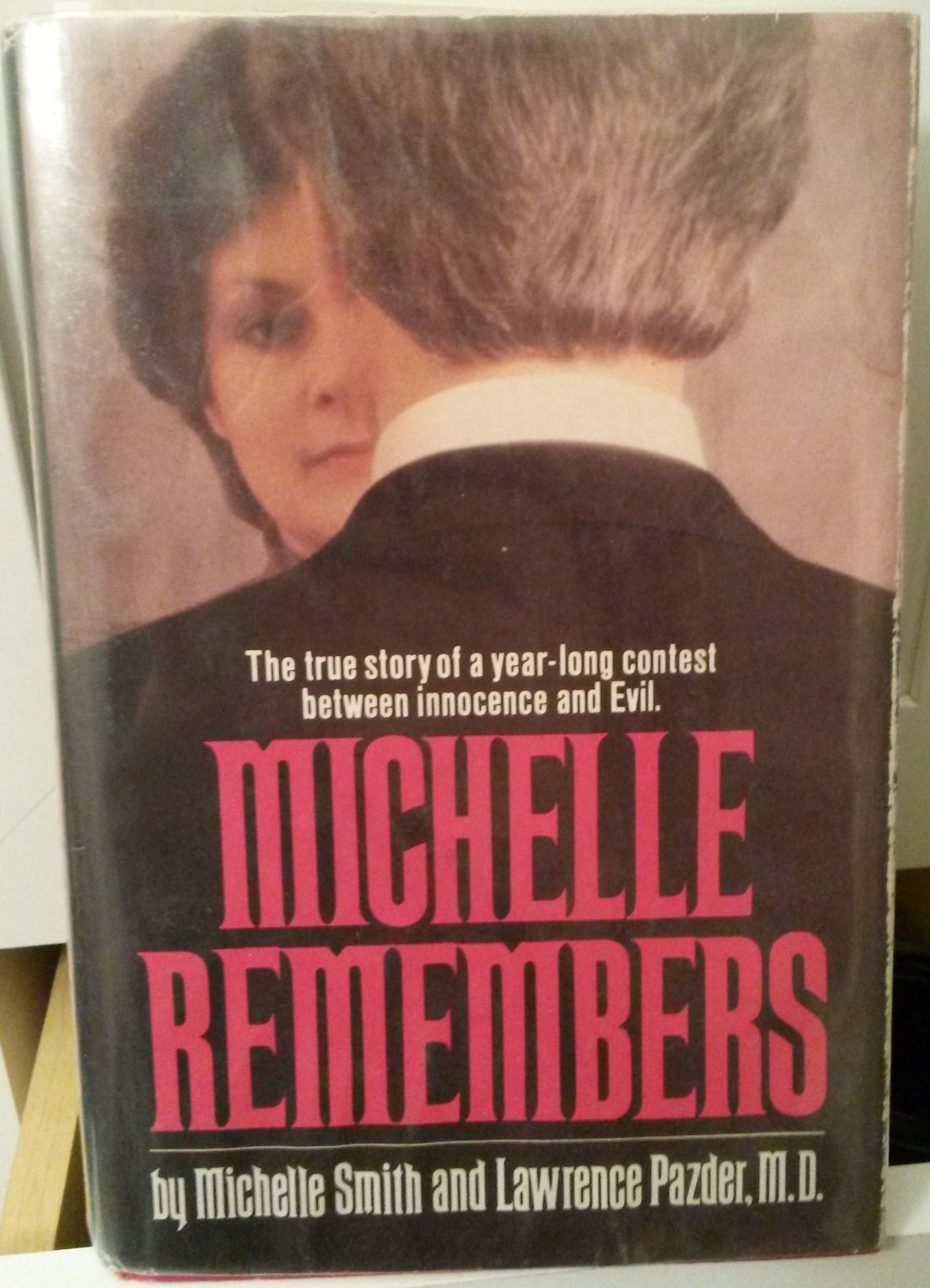
Michelle Remembers – Michelle Smith and Lawrence Pazder

michelle remembers ross bay
Congdon and Lattes – 1980
I have been horrendously busy with school and haven’t had the opportunity to update this blog, but I feel that this post will make up for my absence. I’m reviewing a Satanic classic; Michelle Remembers. Packed full of horrendous scenes of murder, enemas, cannibalism, and perverse diabolic rituals, this is the book that kicked off the satanic ritual abuse panic of the 80s. It tells the story of Michelle, a woman from Victoria BC who at the age of 27 began to uncover repressed memories of Satanic abuse that she had suffered 22 years earlier. It’s a fascinating piece of writing for several different reasons, and I have quite a lot to say about it.

So, the basic premise of the book is that as a child, this woman, Michelle, suffered such horrendous abuse at the hands of a coven of Satanists that she entirely repressed all memories relating to it. When she becomes an adult, she has a nightmare and goes to tell her psychiatrist about it. The pair become convinced that the nightmare means something, and through a kind of self-induced hypnosis that is never properly explained, Michelle summons forth her 5 year old self who proceeds to give a first hand account of the part of Michelle’s life that she herself was completely unaware of.

michelle smith lawrence pazderA real pair of plonkers. Take a good minute there to really look into the eyes of that utter imbecile. That common, stupid-looking woman believed that Jesus Christ and Lucifer personally did battle over her soul.

According to the child version of Michelle, her mother started taking Michelle to Satanic rituals when she was very small. At one of the first ceremonies, Michelle is anally fingered and frigged and forced to watch her mother engage in an orgy. Michelle gets upset when she sees a woman between her mother’s legs, so she hits her mother’s licker with a bottle. Everyone else in the room sees this happening and joins in on the fun. The saucy lesbian is stabbed to death in front of the child while she is still underneath the woman that she has been pleasuring. Not the worst way to go, I guess…

After Michelle has rudely attacked her lover, the mother abandons her naughty child and leaves her with the Satanists. I’ll be honest here; they’re not very good babysitters. They fill Michelle’s bumhole with water and then make her squirt-squirrel her sphincter’s plentiful bounty onto a Bible. They bury her alive. They kill a bunch of cute kittens in front of her. They cut up quite a few dead babies and mash some of them into Michelle’s face. They rape the child and make a snake go into her fanny. They introduce her to another child, allow them to make friends, and then they cut the other child’s head off and tell Michelle to put the body back together like a jigsaw puzzle. They bury her alive again, this time in a grave with a bunch of live cats. They make her eat part of a burnt corpse. They also cut two holes in her scalp and try to sew on a pair of horns onto her head.  All in all, they’re not very nice to her.

Child abuse is literally the least funny thing in the world, and I would not jest about these events if they had ever actually happened.  Michelle Smith you see, is a lying piece of trash who made up the whole thing.

An internet search will provide you with countless reasons to believe that this book is absolute nonsense, but I’ll just mention a few of the more salient points. Michelle Smith’s real name was Michelle Proby. Lawrence Pazder’s real name was Lawrence Pazder. Why did Michelle use a fake name if Pazder was using his real one? Well, it was probably to hide some of the evidence that proves that she was full of shit. Michelle had two sisters you see, one older and one younger, and neither of them are ever mentioned in the book, nor have they ever corroborated her story. Michelle’s father claimed that he could personally discredit every sentence in the book. He said, “It was the worst pack of lies a little girl could ever make up. The book took me four months to read, and I cried all the time. I kept saying to myself: ‘Dear God, how could anyone do this to their dead mother?’” He said of his late wife, “There never was a woman on this earth who worked harder for her daughters. There was no hanky panky or devil-worshipping.” He also said that he took Michelle to church every Sunday despite the fact that Michelle claims never to have had a religious upbringing.

One of the first memories Michelle unveils is of one of the Satanists, a man named Malachi, putting her into a corpse infested car and driving it into a wall. The Satanist was trying to make it look as if the corpse had died in the crash (whereas in “reality” this was the corpse of the woman whom Michelle attacked for sucking on her mother’s juicy pussy.) Victoria is a small city; a car crash in Victoria in the 1950s would definitely have made it into the local papers. Surprisingly enough though, no account of any such incident was ever published. Could it be that it never happened? Yes. Definitely.

Michelle was supposed to have been satanically, ritually abused over the course of about a year. One of the rituals she describes is said to have lasted between 80-90 days. Somebody had the good sense to check the attendance records at the school Michelle was supposed to be attending at the time. Guess what; Michelle Proby never missed any significant amount of time from school. Either the teachers were in on the Satanism or Michelle was full of shit.

In some of my favourite parts of the book, Michelle describes how she is taken to Ross Bay Cemetery and buried alive in an old grave. She describes the woman who is with her pulling the top off the grave and lowering her down into the earth. The only problem with this is that the lids of the graves in that cemetery are solid fucking rock and far too heavy for a single person to lift. If Michelle is truly stupid enough to believe that this nonsense happened, I really hope her delusions are vivid and terrifying. I hope she could smell the corpse.

Michelle imagining herself in her rightful place. Hopefully she is underground at this stage.

The other claims about Victoria are pretty silly too. She describes how all of the many  Satanists cut off the middle finger from their left hand. You’d think that this trend might be noticed in a small city of 50,000 people. Also, surely somebody noticed all of the dead babies that were going missing. It seems like somebody is smushing up a dead baby every ten minutes in this crazy book.  The authors’ only textual evidence of the Satanic problem in Victoria comes from a newspaper article called Witchcraft in Victoria from 1977. The article is about a series of claims from a drug addicted, delusional,  evangelical christian named Len Olsen who was eventually sued for his lies. Here is a cool video featuring the guy about whom he made the slanderous claims.

Are Michelle’s claims really that outlandish? It is possible that a dangerous cult was operating in Victoria at the time; after all, there are sickos everywhere. Well, if Michelle had only told that part of the story, I really doubt that people would have gotten as worked up about this book. The thing is, Michelle goes on to claim that Lucifer himself begins to attend the rituals that she is privy to. We are not talking some meddlesome demon here, we are talking Prince of Hell, the Arch-Fiend, Satan, THE DEVIL HIMSELF. Michelle ‘the imbecile’ Smith wants us to believe that the Fallen Angel Lucifer took the time to travel from Hell to Victoria to participate in a ritual in which he would personally rough up a 5 year old girl.

Not only that, but Michelle is only able to escape because Mary, the virgin mother of Christ, and Jesus Christ of Nazareth, the only son of god, show up to save her. This, stupid, under-achieving, plain little fart of a woman wants people to believe that Christ and Lucifer came to earth to personally do battle for her soul. Jesus and Mary, who couldn’t bother their holes coming down to stop the holocaust, decided that they had better travel to earth to come to the aid of an ugly little cur with no personality.

2016-02-29 21.50.00See the blur behind the flame? The fools who wrote this book would have you believe that that is the virgin Mary.

Now, if I was going to write a book to inspire moral panic and public outrage, I would do a little research to make my claims seem believable, but Michelle and Lawrence decided not to bother. It shows. Michelle’s description of satanism is unfounded, illogical and incredibly silly. The rituals of the cartoony ‘satanists’ in this book make absolutely no sense; the basic idea behind them seems to be ‘do whatever is wrong’. This is very clearly the satanism of a person who knows absolutely nothing of the subject. A Dennis Wheately novel, this is not. Perhaps the worst part of the book is the persistent rhyming speech that Michelle attributes to Satan. According to her, the Dark Lord can only speak in rhyming couplets. His chapter-long speeches are truly excruciating to get through. I think one of them reads;

My name is Satan, my Kingdom is Hell,
I will hurt your arm, oh little Michelle,
Swear allegiance to me, and poop on this book,
for if you say no,  your ass I shall fuck.

Ok, so I obviously wrote that. But I have just read back over some of the actual rhymes in the book, and I have to say that mine is far less silly. Why would the Devil be limited to speak in rhymes? That doesn’t make any sense Michelle, you stupid piece of garbage.

These are Michelle’s drawings of the Devil. Depending on his moods, he would either take the form of an owl with a tail, a fraggle, or a two-legged lizard dog

At several points, Pazder actually refers to the perpetrators here as members of the Church of Satan. Apparently Anton Lavey threatened him with legal action to get him to withdraw these claims, but they’re still in my copy of the book.

michelle remembers front cover
Doesn’t the cover of this edition make it look less like a book about satanic rituals and more like a romance novel about a really boring woman who falls in love with her psychiatrist and tries to give him everything he wants even if it means sacrificing her own dignity? Well, actually…

One of the odd features of this book is that although it was written by the protagonists, it is told in the third person. The narrative perspective makes the book feel like a novel and thus makes it a more tolerable read, but it also adds a lair of buttock-clenching cringiness. Pazder is first introduced in the text as “A handsome man in his early forties,…warm, manly, soft-spoken”, and when Michelle first appears, she is described as “A pretty young woman of twenty-seven, with a  heart-shaped face, a delicate mouth, and bountiful brown curls”. Now either they wrote those descriptions of themselves, or they wrote those descriptions of each other. Anyone who would talk of themselves in that manner is a cunt, and anyone who would write about another person in that manner is looking for the shag.

As the narrative unfolds, Michelle and Lawrence get closer and closer. She goes to see him more and more frequently, and he starts holding her hands and maintaining physical contact with her during their sessions. Michelle grows distant from her husband, and Lawrence starts holding things back from his wife. The authors try to present their blossoming relationship as something pure, positive, and misunderstood, but in reality, these two degenerates were beginning a depraved affair that centered on Michelle’s repulsive sexual fantasies.  Pazder would sit on the couch with one arm around Michelle as she spewed forth her disgusting fantasies about paedophilia, scat-play, and sadomasochism. I am not even exaggerating; that is literally what happened between the two of them. Michelle Pazder was an unhinged sexual deviant, and Lawrence Pazder, a man posing as a psychiatrist, took advantage of the patient in his care for the satiation of his own vile desires. His leading questions and her dependency and desire to please lead to their corrupt bond becoming stronger and stronger. Although it is not mentioned in the text, the pair eventually defied the catholic faith of which they were once so proud by divorcing their spouses and marrying each other. Imagine the sex talk on their wedding night. Ewwwwwwwwww.

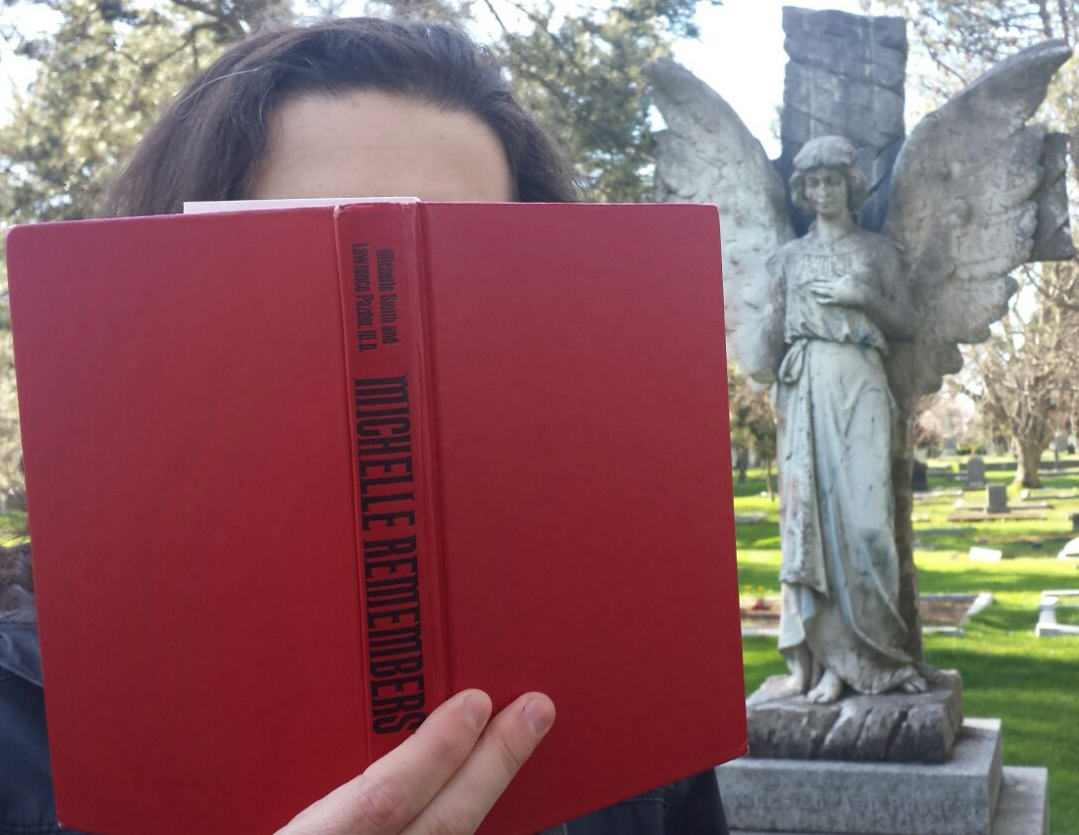
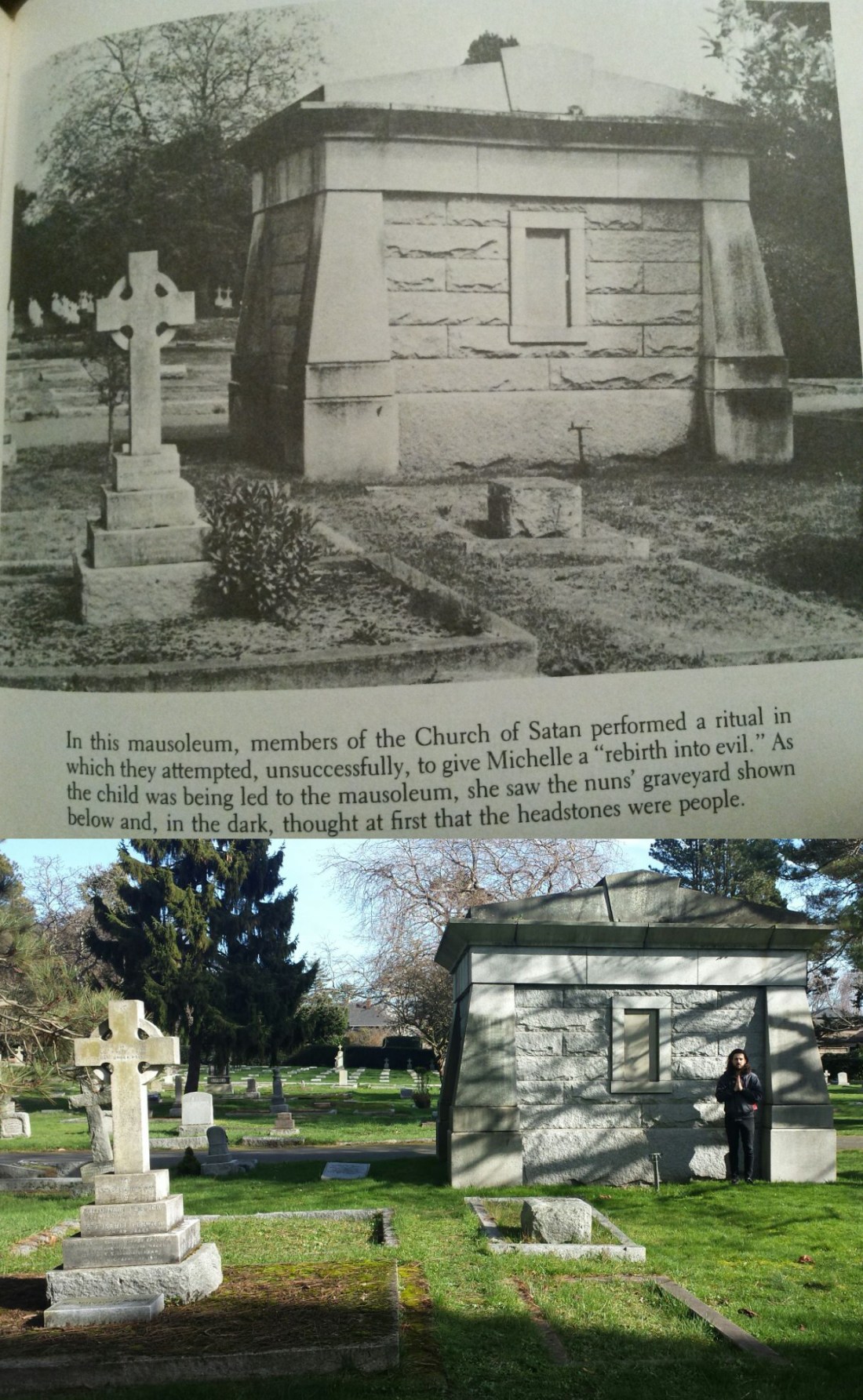
Speaking of marriage, my wife and I were in Victoria recently, and we paid a short visit to Ross Bay Cemetery where much of the book is set. I wanted to see if I could find an entrance to the Satanic Lair that the lads had made, but I didn’t have much luck. However, I did see lots of cool tombstones and decrepit graves.

Some messed up things have actually happened at Ross Bay since the publication of this book. It has suffered a fair bit of vandalism, and has become notorious among heavy metallers due to the alleged actions of a particularly naughty black metal band. While I am all for desecration of hallowed ground, it seems a bit of a shame that people would mess up one of the few interesting historic sites in B.C. If you’re ever in Victoria, the cemetery is an awesome place to go for a stroll.

Below, and in the first image of this post, is the Pooley Angel. This statue was spray-painted blue at one stage and is commonly referred to as the Blue Angel of Ross Bay. Apparently tears can be seen running down its face on the night of a full moon.

ross bay blue angel
COOL!

I recently reviewed Communion by Whitley Strieber, and if you read that review, you will notice that like Michelle, I make fun of ol’ Whit-Strieb for having things shoved up his dirt-box. You may also notice that I didn’t get quite as worked up over the stupid story that he told after regressive hypnotherapy. That’s because Whitley Striber’s equally silly story didn’t end up ruining people’s lives. There are lots of nutty books out there, but Michelle Remembers had a tremendously negative effect on society in the early 1980s. The authors appeared on Oprah and became celebrities, Pazder became known as the leading authority on Satanic Ritual Abuse, and innocent people were publicly  and unfairly accused of child abuse. The only good thing to come from the author’s  irresponsible perversion is the over-the-top 1980s Satanic Heavy Metal that their book inspired. Fundamentalist christians are a pain in the ass, but these two pieces of shit weren’t even particularly devout. (As mentioned above, they divorced their partners and remarried, a mortal sin in the Catholic faith.) They were a pair of attention seeking scumbags who weren’t concerned with how their perverse fantasies might affect the lives of others. I know that Pazder is dead, but we can only hope that Michelle is too.

I hated the authors, but I thoroughly enjoyed this book. If you’ve made it through this review, you’ll probably enjoy it too. Reading it will make you want to listen to Slayer and spit at a priest.

HAIL SATAN 666!!!

michelle remembers mausoleum ross bay