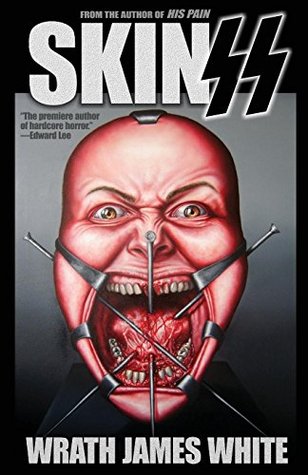
Skinzz – Wrath James White Deadite Press – 2015 (First published 2012)
A splatterpunk novel about violence against racist skinheads? As soon as I found out that this book existed, it bypassed all of the others on my reading list. I read it over a single afternoon. Honestly though, I wanted to like it far more than I actually liked it.
This is the story of a gang of punks and a rival gang of skinheads. The skins beat up some punks and then the punks beat up some skins and so on. The most brutal acts of violence are performed by the racists, and I didn’t feel like they ever got their comeuppance. This was a bit disappointing, but it’s probably realistic.
A few years ago I did a bunch of posts about horror novels centered on rock’n’rollers. A problem I noticed with a few of those books was the authors’ obvious ignorance of the musical genres they were writing about. Skinzz was a little different. This novel is horrifically violent, but there’s no supernatural element involved. This is a book about a rivalry that did and does exist. Realism is more important here, and I was glad to see Wrath James White reference some fairly appropriate bands.
The skinheads listen to Skrewdriver (an overtly racist band) and Agnostic front. I know Agnostic Front had that one dodgy song, but I really don’t think they were ever bona fide racists. That being said, there have definitely been a bunch of racist skinheads who have listened to that band. One of the racist skinheads in this book talks about wanting to go to a Suicidal Tendencies show. I thought this might have been an error when I read it first, but then I realised it was probably intended to make him sound dumb.
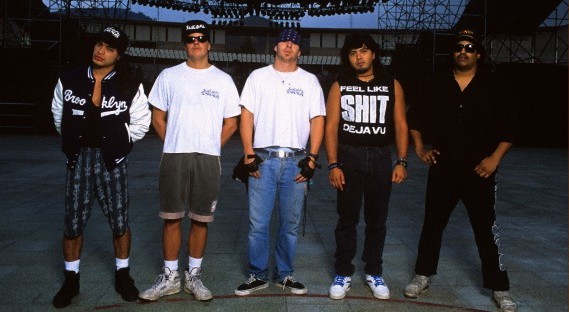
This was Suicidal Tendencies line-up at the time this book is set. Not ideal for racists.
The support band at the Suicidal Tendencies concert is called Terrorist Threat, and they apparently have a song called “Guilty of Being white”. “Guilty of Being White” is a real song by a band called Minor Threat, and while its lyrics are painful to read in 2020, I reckon it’s safe to say that Minor Threat probably weren’t hateful racists. I don’t know why Wrath James White chose to change their name for this book when he left the others unaltered.
While the skinheads listen to mostly non-racist hardcore, the punks just listen to Ministry. Ministry certainly aren’t the first band that jump to mind when I think 1988 punk rock, but in 1988 they were still really cool.
Honestly, I wasn’t hugely impressed with this book. It was very straightforward. The punks are good, and the skins are bad. I mean, racist skinheads are objectively bad, but lets be realistic, so are most punks. Mack, the main character, is a bit too likeable. He’s smart, tall, rebellious, strong, sexy, caring, romantic and cool. Have you ever met a punk? They’re rarely any of those things. Most of the punks I know are ugly, disgruntled dwarves. One of the punks in this book is called “Demon” too. Yuck.
I was hoping that the punks were going to kidnap and torture some of the skins, but that never happened. There’s a violent showdown at the end of the book, but it fell short of what I was looking forward too. Between the simplistic plot and characters and the lack of extreme brutality, this book kinda sucked. I genuinely wanted to like it, but it just wasn’t very good. It felt like it needed a chapter at the end where the protagonist hunts down the really bad skin and brutalises him in an unspeakable manner.
I don’t know much about Wrath James White other than that he used to be a fighter, but that fact along with his kindness to his protagonist suggests to me that this novel might be slightly autobiographical. I had heard good things about him before, so maybe his other books are better. This one wasn’t really awful, but I can’t say I liked it a whole bunch. Maybe I’ll give Wrath James White another go some day.
Last complaint: the author and the publisher refer to this book as Skinzz, but isn’t that the Nazi SS rune on the cover? Shouldn’t it be SkinSS?
The House Next Door – Anne Rivers Siddons Simon & Schuster – 1978
Of all the books that Stephen King discusses in his Danse Macabre, Anne Rivers Siddons’ The House Next Door was the one I least wanted to read. The title is dull (there are several other novels with the same name), the cover is a picture of a house, and I had read that this novel was the only work of horror that the author ever wrote. I expected a boring attempt at a haunted house story. I thought I was going to read about chains rattling in the night and books flying off shelves of their own accord. I did not expect a masterfully written work of psychological terror that was almost impossible to put down.
God damn, this book was a good one.
A house is built on a plot of land beside a rich couple’s house in Georgia, USA. Bad stuff happens to everyone who lives in or even enters this place. I won’t ruin the story by revealing details, but I will say some of the unfortunate turns are utterly scandalous!
It was stupid of me to assume that this book wouldn’t be good because the author wasn’t a dedicated horror author. This is probably one of the book’s strengths. The stuff going on between the characters is great, and the story is well told. Also, Anne Rivers Siddons doesn’t use any of the tropes that a dedicated horror author might struggle to keep out of a haunted house book. One of the characters makes a joke about the house being built on ancient Indian burial ground, but that’s about it.
No, this is not vulnerable heroine tiptoeing through the attic by candlelight horror; it’s much more subtle and disturbing. The bad stuff that is going down here is just a few steps past seeming unfortunately coincidental. There’s no single instance that you could really claim was supernatural. Any one (or two or even three) of the events recounted could happen, but as the misfortune builds, so do our suspicions. There is something creepy about this house.
This book probably highlights the actual fears of upper middle class Americans in late 1970s: you find out in the opening pages that the characters in this book are willing to lose their friends rather than their reputations. There’s probably some deeper social commentary in here too, but I’m not overly concerned with that stuff. I read this for entertainment’s sake, and I was thoroughly entertained. This was an awesome book, and it had genuinely creepy moments. I can heartily recommend it to anyone looking for a good read.
Bullet Through Your Face – Edward Lee Deadite Press – 2010
I rarely give up on a book, and when I do, it’s usually a piece of garbage about new age occultism. I normally struggle through fiction even if it’s awful, but I could not bring myself to finish this one.
Bullet Through Your Face is a collection of three “short novels” by Edward Lee. I’ve read and enjoyed books by Edward Lee before, and I was well aware of his reputation, but this was a disappointing pile of crap.
Ever Nat, the first story in here an extremely unpleasant tale of a man being kidnapped and brutally raped over and over (ever nat) by a pair of hillbillys. Both of the other books I’d read by Lee featured a pair of rapist hillbillys, and I can’t say I was particularly shocked by any of the specific acts of horrendous sexual violence. The problem here is that there’s absolutely nothing else to this story. The other stuff I’d read by Lee had plenty of rape, but it also had aliens, killer worms and a cannibal mutant. This story is 100% rape. Call me a snowflake or a prude, but I didn’t enjoy this.
The next story, The Salt Diviner was about a Babylonian fortune teller showing up in modern times and making friends with a gambler. Oh, and the mystic gets his powers from performing acts of sex or violence. This gets ludicrous pretty quickly, but it was weird and fun. If the whole book had been stuff like this, I would have been happy. This one was very short for a “novel”.
The last, and by far the longest, story in this collection is called The Refrigerator full of Sperm. Now anyone who knows me or has followed this blog for any amount of time will know that I have a pretty high threshold for vulgarity and potty humour, but this story was too puerile for me. The Refrigerator full of Sperm was originally published in a collection called Splatterspunk: The Micah Hays Stories, and all of the stories in that collection are about a particularly randy police officer. That in itself was enough to deter me (I hate reading stuff out of sequence.), but the writing here is utterly horrible too. I don’t just mean the events it’s describing either. The story itself, not just the dialogue, is written in a southern drawl. Ugh. No thanks. One of the characters keeps interrupting the narrative with his lurid tales, most of which seemed to involve “peckersnot” and “cornholing”. I enjoy vulgarity very much, but this book taught me that it can get pretty tiresome when it’s dialled up to 11. I got maybe 20 pages into this before giving up. I was actually reading an ebook version, and my kindle gives an estimate of how much time it’s going to take to finish the book. I have a full time job and a family to take care of, so reading is a luxury for me. I could not justify spending two hours of my precious free time reading this trash.
I was pretty disappointed with this collection. It was nowhere near as good as the other stuff I’ve read by Lee. If you haven’t read any of his books, this would be an awful place to start. Deadite Press released this book along with another collection of short stories by Lee called Brain Cheese Buffet in 2010. (Both were titled by Carlton Mellick III.) That one contains shorter stories, so it’s probably the better of the two. I was originally planning on reviewing both books together, but after this crap I reckon I’ll take a break from Lee for a while.
I’m ashamed of myself. I have been writing about horror fiction on this blog since 2015, but this is the first time I will feature the work of Richard Matheson. Silly me. I have written about these books in the order that I read them. This order does not reflect their date of publication or their merits.
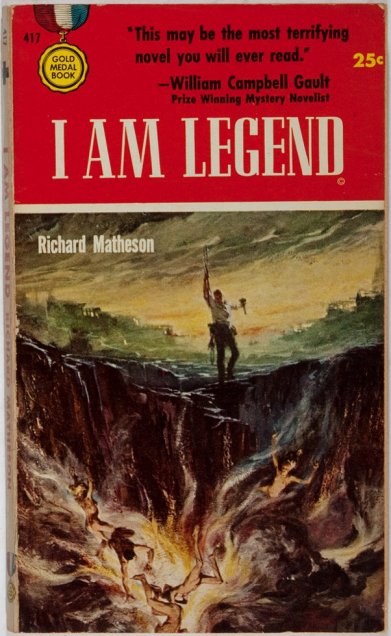
I Am Legend Gold Medal Books – 1954
I first read I Am Legend about 6 years ago. I remember absolutely loving it. I had seen the abominable Will Smith movie with the same title and had been terribly disappointed with that film’s optimistic ending. I could not say the same thing about the novel. I started this blog a year or so afterwards, and somehow never got around to reviewing the book. I read Shirley Jackson’s The Haunting of Hill House a few months back and decided immediately thereafter to read Matheson’s similarly titled Hell House. Just before doing so, I thought about revisiting I am Legend so that I could do a multi-book post on Matheson. I am extremely glad I did. I loved I am Legend the first time I read it, but I’m pretty sure I enjoyed it even more the second time around. I think it’s fair to say that this novel is one of my favourite books.
There was no sound now but that of his shoes and the now senseless singing of birds. Once I thought they sang because everything was right with the world, Robert Neville thought, I know now I was wrong. They sing because they’re feeble minded.
This is the violent, dark and crushingly bleak story of Robert Neville, the last man on a vampire ridden Earth. For a novel with so little hope, Matheson does an impressive job of pushing the disappointment. The dog! Oh Jesus, the dog! Come on Richard, why would you do that to your protagonist? Everything always gets worse. I don’t want to spoil how the book ends, but holy shit, that last paragraph, that last sentence, is phenomenal. This is what I want from a horror novel. It’s well written too, really enjoyable stuff. Both times I’ve read it, I’ve finished it in less than a day. Damn, this book is awesome. Seriously, if you’re into horror at all, you should really check this one out.
Hell House Viking Press – 1971
I don’t know much about the writing of Hell House, but I believe that it’s a fact that Shirley Jackson’s The Haunting of Hill House had a pretty big influence. The set up for both tales is almost identical – a scientist and two psychics are sent in to study a haunted house. While Jackson’s book relies on subtle, psychological terror, Matheson’s goes for an all-out onslaught of horror.
The title of this book is an apt one. This is a blasphemous, perverted, blood and guts, kinda haunted house. Matheson doesn’t shy away from getting gritty, but the pacing, characterisation and general decent standard of writing prevent this from feeling exploitative. The nastiness in here is effective too; this is quite a scary book.
Hell House is almost twice as long as I Am Legend, and I don’t think it packs quite as much of a punch, but its drawn out descent into Hell is effective in its own way. This is definitely worth reading if you like horror.
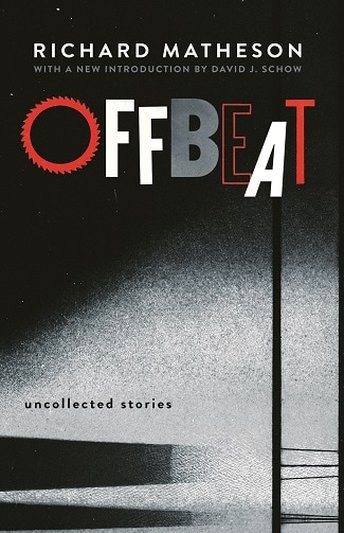
Offbeat Valancourt Books – 2017 (Originally published 2002)
Offbeat is a collection of Matheson’s stories that had not been previously collected in an anthology. Matheson wrote a lot, and these stories’ failure to be included in other collections was not due to their quality. (One of these tales is actually featured in Penguin’s The Best of Richard Matheson.) Still though, I was a bit underwhelmed by a few of the stories in the collection. The twist endings of a couple of them seemed very predictable. My favourites were ‘And Now I’m Waiting’, ‘Maybe You Remember Him’ and ‘Phonecall from Across the Street’. I didn’t enjoy this book quite as much as the novels I had read beforehand, but I certainly don’t regret reading it. If you were already a fan of Matheson, I reckon you’ll enjoy this.
The Best of Richard Matheson Penguin Classics – 2017
When I found out that Penguin had recently put out a “Best of Matheson” collection, I realised I had done things backwards. I should have read this first and Offbeat afterwards. That being said, it is a testament to the quality of the tales in Offbeat that I started reading another collection of Matheson’s stories directly after finishing that one. I didn’t know quite how prolific Matheson had been, and I didn’t know how well I already knew his work. He wrote a bunch of stories that turned into episodes of the Twilight Zone. I’ve never watched an episode of the The Twilight Zone, but I’m familiar with the plots of some of the episodes from the times the Simpsons parodied them. Also, this collection contains ‘Duel’. I remember watching the movie version of this with my dad when I was a kid. I had no idea it was based on a Matheson story.
Honestly, this collection is a much, much better place to start if you haven’t read any of Matheson’s short stories before. These stories are quality. There’s one near the end called ‘Mute’ that I particularly enjoyed. It’s not really a horror story, but it contains some pretty interesting insight on language. This Matheson was a smart guy.
The Shrinking Man Bantam Books – 1969 (Originally published 1956)
I had no great desire to read this book, but it was discussed at length in Stephen King’s Danse Macabre, so I thought I’d better read it and get it into this post. It’s the story of Scott, a man who gets hit by a radioactive wave that causes him to shrink exactly one seventh of an inch every day. I had this pegged as more of a science fiction novel than a horror novel, but, as Stephen King points out, there isn’t much science in here at all.
I actually want to talk about the science, or lack thereof, because it really annoyed me when I was reading this book. This chap doesn’t shrink a certain percentage of his body height every day. He shrinks the same amount every day. If you think about this, it’s pretty ridiculous. If a 6’4″ man shrinks 1 seventh of an inch in a day, he is losing approximately 0.2% of his overall height. If he keeps losing the same amount every day, after another 529 days, he will only be 2 sevenths of an inch tall. By the next day, he will have lost 50% of his height. By then he will be one seventh of an inch tall and will continue to lose 100% of his height in one day. This doesn’t make sense. I’m not a scientist, but I feel that I know enough about the basic laws of reality to state that this rate of shrinkage is a physical impossibility.
Ok, I am going to discuss the ending of the book, so skip to the next paragraph if you haven’t read it yet. The book ends with the protagonist entering a microscopic existence. It is a weird upbeat ending full of optimism. This doesn’t make sense. Ok, maybe it’s possible he was a teeny tiny little bit taller than 1 seventh of an inch and that it will take another day for him to completely shrink out of existence, but that isn’t what the book suggests. Matheson suggests that the protagonist will continue to shrink interminably. But he can’t keep shrinking at the same rate! This would only work if he had been shrinking a percentage of his height, not a fixed amount. Things can always get a little bit smaller, but they can not decrease their size by more then their size. The other option that Matheson had to end this novel was for Scott to find himself in some kind of opposites universe of anti-matter or something where he actually finds himself growing larger every day. Sure the science is ridiculous, but at least that would work mathematically (which is more than can be said for the ending as it stands).
Really, this is more of an adventure story than anything. While half of the novel describes the shrinking process and its unpleasant effects on Scott’s life, the other half details his struggles with a spider after getting locked in his cellar alone. The spider stuff is exciting, but the real horror lies in Scott trying to come to terms with his inevitable disappearance. My favourite part was when a pervert thinks the shrinker is a kid and tries to diddle him. It’s obviously a horrible, horrible thing to happen, but the dialogue was pretty funny.
Silence a moment. Then the man said. “Women. Who come into man’s life a breath from the sewer.” He belched. “A pox on the she.” He looked over at Scott. The car headed for a tree.
This book was fine, but it was definitely my least favourite of Matheson’s novels.
I Am Legend is absolutely crucial. You should definitely check out the Best of short story collection too. If you like those, check out the others listed above. Matheson has plenty of other books, but I reckon I’ll give it a while before I seek those out. (5 books by one author over the course of 3 months was a lot for me.) This guy had a huge effect on the horror genre, and it’s not surprising. These books are imaginative, well written and sometimes truly horrifying. Richard Matheson was a cool guy.
The Fog – James Herbert NEL – 1980 (First published 1975)
A poison cloud erupts from under the ground and causes the people who inhale it to go crazy. As it spreads it becomes more powerful, and it goes from driving a few isolated individuals to acts of sadistic violence to bringing the city of London to an apocalyptic hellscape.
Maybe that doesn’t sound like a particularly clever idea for a horror novel, but while reading it I was surprised at how clearly influential this book must have been within the horror genre. Every book by Harry Adam Knight, Simon Ian Childers and John Halkin I have read draws clear influence from this. I haven’t read Herbert’s The Rats yet, but I have a pretty song suspicion that this book combined with that one provided the blueprints for all of the horror fiction published by the aforementioned authors.
The Fog isn’t all that great though. The main problem is that it’s far too long. Harry Adam Knight’s The Fungus has a remarkably similar story, but being 100 pages shorter, it’s a more concise, enjoyable book.
The Fog is a novel driven by violence and destruction, but there’s complicated relationships too. I wasn’t terribly interested in them; the main characters in here are fairly dull. There’s also at least one overly graphic sex scene. This one wasn’t rapey or violent or anything, but it went on for ages. I didn’t see the point. I hate to sound like a prude, but I don’t really want this level of romantic detail in a novel about a cloud of maddening virus.
The sheer carnage in this book was pretty impressive. I hadn’t read anything by Herbert before this, and I was genuinely shocked at the brutality in here. This book came out in the mid 70s, but parts are as sickening as anything the “splatterpunks” put out a decade later. There’s one scene near the beginning of the book in which a crowd of schoolboys turn on two of their teachers. It involves a gang rape and garden shears. I sat dumbfounded after reading this part. I’ve made it sound bad, but I haven’t conveyed quite how sick it really is. I wouldn’t want to ruin it on you!
Also, although I wasn’t hugely impressd with the novel overall, it does include my favourite chapter of any novel ever. The poisonous fog affects people to different extents; some go on bloody killing sprees while others just hang themselves. One of those affected merely runs around his village kicking his neighbours up their bums. This part of the book is a seriously brilliant piece of writing. I laughed so hard. Genius.
Otherwise this was quite a clunky read. Herbert has the annoying habit of skipping ahead a bit of the story and then going immediately back to fill in the details. He seemed to think this was a cool narrative technique, but I found it annoying. Also the speed at which doctors in this book manage to create a vaccine is laughable, if not downright insulting, to anyone reading it in 2020.
The Fog is not a great book, and James Herbert is not a great writer. This isn’t without its charms though, and I’m planning to read Herbert’s Rats trilogy and The Spear in the future.
The Body Snatchers – Jack Finney Dell Books – 1955 (Originally serialised 1954)
I have known of the Invasion of the Body Snatchers movies and had an idea of what they were about for as long as I remember, but I have never actually seen either of them. I didn’t know they were based on a book until I saw this novel being discussed in Stephen King’s Danse Macabre, a history of horror. If you haven’t read The Body Snatchers already, let me tell you a bit about its history before you rush out to buy a copy. I wish somebody had told me this before I read the book.
The Body Snatchers was originally serialised in Colliers Magazine in 1954. The first whole edition came out in 1955. The movie, Invasion of the Body Snatchers came out in 1956. After this, reprints of the book bore the film’s title. In 1978 another film version was made, and Finney updated his novel to coincide with the release of the new movie and to make the book more appealing for a younger generation
The changes in the revised text, as far as I can tell, were minor. The revised version is actually set in the 70s, the place names are switched around a bit, and there’s a few paragraphs that are moved around/added/deleted. I didn’t conduct a detailed cross examination or anything like that. I was reading from the original text, but when I was preparing dinner, I switched to an audiobook version on youtube that turned out to be a reading of the revised text. I only noticed that the texts were different when I had to switch between the two and found myself searching for phrases from one that were different in the other. I looked online (very briefly) to see if anyone else had listed off the differences, but I found nothing. I think the story is basically the same in both.
I mentioned the two film versions, but there have actually been 4 Hollywood movies based on the book and countless others inspired by it. References to this story pop up everywhere, and I knew what to expect in general terms of plot. I had been surprised to see Stephen King list it as one of the most important works of horror. Influential sure, but horror? I thought this was science fiction. After reading this (and a few more of the books that King recommends in Danse Macabre) the utter silliness of the notion that literary science fiction is inherently separate from horror has become apparent. Even if you know what to expect, The Body Snatchers is a surprisingly creepy story.
So what’s going on in here? Well, the locals of a small American town have started noticing their relatives acting strange. They look the same, talk the same and largely act the same, but they’re clearly not the same. Things get worrisome when a couple find a surprisingly plain looking corpse in their house. Then weird vegetably pods start popping up in people’s cupboards, and it becomes apparent that these pods are the source of the bizarre uncooked bodies that are assuming the forms and minds of the villagers while discarding their souls. Weird and cool.
The only thing that disappointed me about this book was the ending. The story is horrendous; what’s happening is truly nightmarish, and Finney does a great job of making his readers feel the surmounting inevitability of the doom of all humankind. In the final chapters, when the protagonists are caught, you realise that there is no way out. This isn’t going to be pretty. Personally, I love a horror story with a bleak ending. As this tale draws to a close, it looks like the entire human race is going to get their souls torn out and their bodies drained of life. Hell yes. That’s the perfect ending for a horror novel. Unfortunately, the last few pages of his book actually describe the antagonists suddenly changing their mind and abandoning their mission, leaving the vast majority of humanity unmolested.
I felt swindled.
I thought that the ridiculously fortuitous turn of events at the end of the book might have been to please a 1950s’ audience, but then I remembered that Richard Matheson’s I am Legend, a novel with as bleak an ending as any, was also first published in 1954. Maybe Finney’s publisher insisted on a positive outcome. I might just be speculating, but the turn of events which leads to humanity being spared is so sudden, unexpected and quick that it made me think that Finney might originally have had different plans for ending this novel.
Even with the dumb ending, this was an enjoyable book. There are genuinely creepy moments, and its such an important work within the horror genre I’m glad to have read it.
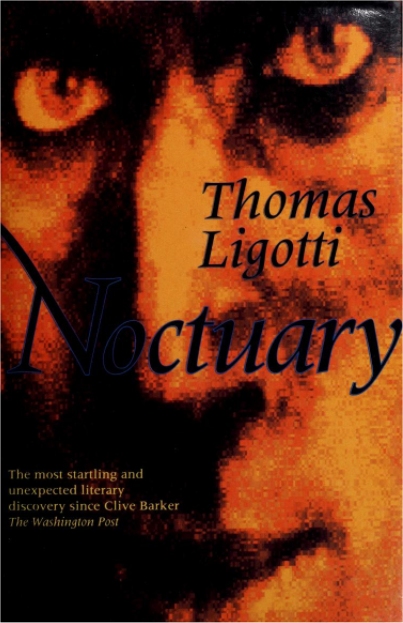
Noctuary was the first Thomas Ligotti book that I read, but by the time I got around to starting this blog a year later, I had forgotten the whole thing. I’ve reviewed quite a few of Ligotti’s books recently, and I wanted to go back to reread this one.
I have to say, I enjoyed this collection less after having read Ligotti’s other stuff. A few of the stories are so weird that they went over my head, and some of them are so abstract that I found them boring. What the hell is ‘The Medusa’ about? I read it, and I understand all of the words and sentences, but I still feel like I don’t get it. Weird? Yes. Scary? No.
I think the atmosphere of these texts is far more important than their plots, and while I do appreciate some good atmospheric horror, I felt like this was a bit much. I reread Noctuary over the course of a very stressful week last month, and that might well have affected my enjoyment of the book, but I seemed to remember Ligotti’s Teatro Grottescocollection being a little more to the point and quite a bit more satisfying.
There’s a compilation of very short works at the end of the book called “Notebook of the Night”. Some of these were fairly dull, but this section also contains my favourite piece in this collection, ‘The Premature Transfiguration’. This is a relatively simplistic tale about people turning into lobsters and then begging to be killed. LOL!
I’m being a bit negative here. I did actually like this book, but I seemed to remember enjoying it more the first time I read it. It took me less than 24 hours to finish it that time, but more than a week this time around. If you’re already a Ligotti fan, then check this out, but I don’t think it’s the best starting place if you haven’t read his stuff before.
The Cryptoterrestrials – Mac Tonnies Anomalist Books – 2010
Aliens are real and they do abduct people, but they’re not from a different planet. I have encountered this idea before, but Mac Tonnies, in The Cryptoterrestrials, takes this concept one step further and claims that the reason we think that these aliens are extraterrestrial (from space) is because they have deliberately been misleading us.
A species or race of highly intelligent beings has been running a disinformation campaign against the human race so that they can avoid detection. These beings are probably not, as others (Whitley Strieber, John Keel and Kewaunee Lapseritis to name a few) have suggested, inhabitants of another dimension who occasionally cross over to ours. They are just as likely the descendants of a tribe of Asian people who went to live in a cave system hundreds of thousands of years ago. Their technology is more advanced than ours, and they can use it to send telepathic messages and to induce hallucinations.
Why should we believe this? Well, an awful lot of abductees claim that they were abducted for the purpose of creating a human-alien hybrid, but if you think about this for any amount of time it seems absurd. Dogs and cats are physically very similar and share common ancestors, but they can’t breed. How could a human possibly breed with a lifeform that evolved on a different planet? Nope, if these visitors are actually trying to breed with us to replenish their population, they must share a fairly recent common ancestor with us. Oh yeah, I forgot to mention that they are slowly dying out as we destroy the planet. That’s why they need our DNA to reproduce.
The afterword in the book suggests that the author did not take the ideas in this book to be literally true and that this book was more an attempt to get people to rethink the UFO and abduction phenomena rather than to provide a definitive and factual explanation for these phenoma. There’s certainly some interesting ideas in here, but ultimately I think the book goes a bit overboard with its speculations.
When faced with the question of the existence of extraterrestrial aliens who abduct innocent human beings, most people will pick one of two explanations. Either they accept the notion of little men coming down in a spaceship and kidnapping/violating innocent farmers, or they dismiss it and assume that the farmers who gave the accounts were crazy and/or mistaken. There are of course other possible explanations, but if these explanations are no simpler than the two already mentioned then we can use Occam’s Razor to slice them off our list of considerations. Accepting the existence of extraterrestrials is already the more challenging option, and complicating this notion further by positing that the beings are actually Earth dwelling cryptids with a penchant for trickery is a step too far for this to remain a sensible line of reasoning.
I’m not saying that all abductees are wrong or that there isn’t weird forms of life that we don’t understand. I just think that the idea that these beings are deceiving us in such a complicated manner is too unlikely to take seriously.
Mac Tonnies died in 2010 when he was only 34. He was a fellow blogger, and he wrote a book about aliens being cryptids. It seems to me that he was probably a real cool guy. RIP.
The Hellbound Heart – Clive Barker Crossroads Press – 2013 (First published 1986)
After years of eyeing the video box in my local videoshop after mass on Sundays, I finally saw Hellraiser on the Halloween night after I turned 19. After that much anticipation, I was inevitably a bit underwhelmed. I rewatched it in June this year, and I enjoyed it far more second time around. I had just finished Clive Barker’s Cabal, and I guess I was in a Barkery kinda mood. A few weeks later, over the course of on afternoon, I listened to an audiobook version The Hellbound Heart, the novella that Hellraiser is based on. (Crossroads Press produced two audiobook versions of The Hellbound Heart. One is narrated by Barker himself, but that one is abridged, so I went with the other one.)
In case you don’t know, this is the story of a man who summons a crew of S&M loving demons to his house. (They’re into the bad kind of S&M… the really bad kind.) Things don’t work out very well for this chap and his family. This is a horror classic, and I liked the book quite a lot. I read it so soon after seeing the movie that I was able to pick out their differences.
The main change is that Kirsty is Rory’s friend in the book whereas she is his daughter in the movie. I think the story works better when she’s his daughter. It’s harder to imagine the characters’ motivations when these two are just friends.
In the book, the Cenobytes are less threatening or maybe just a little more distracted than in the movie. When they first appear, they try to make sure Frank knows what he’s getting himself into before they work their magic on him. This is a bit confusing as when Kirsty summons them later on, they tell her that they can’t leave without taking the person who summoned them. Why does Frank get a chance to back out but Kirsty doesn’t?
In the book, the female cenobyte seems to be more of a group leader than Pinhead. She’s the engineer in the book, but that title goes to the weird wall monster in the film. Oh, and there’s no pet store or tramp in the book. Aside from these few differences, the book and movie are pretty much the same. If, like me, you enjoyed the movie, give the book a go. It’s fun to do both.
This is the third of Barker’s works to appear on this site in 2020. The Hellbound Heart (1986) came out right after the Books of Blood (1984 – 1985), and aside from it being slightly longer, it wouldn’t feel out of place with the tales in those collections. (I saw recently that there’s a Books of Blood TV series coming out in October.) I definitely liked The Hellbound Heart better than Cabal (1988) as it’s more horror than fantasy. I reckon I’ll read Barker’s The Damnation Game (1985) next.
The Black Art – Rollo Ahmed Senate – 1994 (Originally published 1936)
In 1935, right after The Devil Rides Out was published, Dennis Wheatley’s publisher asked him to write a non fiction book about the occult. Wheatley claims he was too busy at the time (he did eventually publish one in 1971), but he recommended that his publisher get in touch with his yoga teacher, a peculiar character named Rollo Ahmed. Rollo Ahmed claimed to be an Egyptian expert on the occult, but he was actually from Guyana, and while he certainly knew a bit about the occult, much of this knowledge was probably acquired as a means to make his business seem more legitimate. Ahmed, you see, was a conman. He told stupid people he would counter black magic curses that had been put on them for money. He also told old women that spirits had instructed them to loan him a bunch of money. He was arrested and charged for doing this kind of thing on at least 3 occasions, and he served at least one month’s imprisonment with hard labour.
Mr. Ahmed
I bought a copy of Ahmed’s book on black magic more than 5 years ago. It cost me one Canadian cent. I started reading it at the beginning of May this year, but it was so boring that it took me 3 months to get through its 280 pages. I finished 30 other books in the same period, forcing myself to read a few pages of this trash when I was between novels. This book is the reason that this blog has seen so little non-fiction in 2020.
But did this book really suck, or have I just read too much of this kind of crap to get any enjoyment from it? Maybe it was a little bit of both.
This is supposed to be an overview of the history and practice of black magic. Ahmed did a good bit of research for this book, but he doesn’t provide any sources for most of what he is saying. This book might be of interest to individuals who are researching what people believed about black magic in the 1930s, but I wouldn’t want to rely on it as an accurate historical account.
There’s 21 chapters in here. Some are specific to time frames (pre-history, the dark ages, modernity…), some are specific to areas (India, China, Greece, Rome…), and some are specific to occult phenomena (werewolves and vampires, necromancy, alchemy…). There’s no organisational principle behind this structure, and the chapters themselves are often just lists of descriptions of practices that Ahmed either took from other texts or made up himself. I’ve come across a lot of these stories and descriptions in other books, and the stuff that was new to me wasn’t terribly interesting. Around the same time that I bought this book, I reviewed the similarly titled The Black Arts by Richard Cavendish. That book covered much of the same information that’s presented here, and Cavendish managed to cite his sources. I’m not saying that you should go out and read that one either, but it was probably better than this pile of garbage.
Similar title, cover and contents
Another obvious point of comparison here is Montague Summers’ work. Summers and Ahmed moved in the same circles, and they both were acquaintances of Dennis Wheatley and Aleister Crowley. Despite his apparent credulity, Summers’ books are the measuring stick against which all other 1930s occult histories should be compared. In the course of my research for this post, I discovered evidence that strongly suggests that Ahmed plagiarized Summers when he was writing The Black Arts.
For me, the most interesting part of this book was the chapter on the magic of Great Britain and Ireland. There is an account given of a vampire priest in Ireland that sparked my curiosity, perhaps because this is one of the only parts of the book where Ahmed cites his source. He claims that he read the story in the October 1925 edition of The Occult Review, an old occult periodical. I was intrigued by this and decided to consult the source material. It turns out that the October 1925 edition of The Occult Review contains no such story. R.S. Breene’s ‘An Irish Vampire‘ article was actually published a month later in the November edition. Big deal, anyone could make that mistake, even an expert. Well, it turns out that an expert did make that mistake. In his 1929 book, The Vampire in Europe, the Reverend Montague Summers quotes Breene’s article in full, but he mistakenly cites it as coming from the October edition of The Occult Review, 7 years before Rollo Ahmed makes the exact same mistake in his book. Coincidence? No way. It’s been a long time since I read any non-fiction by Summers, but I would be surprised if further research didn’t show more instances of Ahmed plagiarizing his work. (Here is a scan of the original story for anyone interested in the Irish priest turning into a vampire.)
Summers’ Vampire books were later retitled. I own both, but have only read the first one.
Dennis Wheatley knew both Summers and Ahmed, and there are multiple theories about characters from Wheatley’s books being based on these men. I have written several times about the Canon Copely Syle from To the Devil – A Daughter and how this character is clearly a mix of Summers and Crowley, but some people have pointed out that the evil Canon has a frightening Egyptian manservant who is probably based on Ahmed. If this is so, I reckon Wheatley understood the relative importance of both men to the annals of occult history.
“a manservant of a type that one would hardly have expected to find in an Essex village. He wore a red fez and was robed in a white burnoose. His skin was very dark, but only his thick lips suggested Negro blood; and C. B. put him down at once as an Egyptian.”– This description (presumably based on Ahmed) might seem a bit racist today, but by Wheatley’s standards it’s really not bad.
I want to include a quick note on my sources here so that I don’t seem like a hypocrite. The biographical details I’ve included are from Chris Josiffe’s articles on Rollo Ahmed in Fortean Times 316 and 317 (July and August 2014). The stuff about Ahmed’s influence on Wheatley’s characters are from this article on Wheatley’s site. All of my other sources are self evident.
I’ve been reading and reviewing books on the occult for a long time now, and my interest seems to have waned a bit recently. I believe that this is largely due to wasting my time reading so many awful piles of boring nonsense written by idiots. The Black Art wasn’t as bad as some of the shit I’ve read, but it contained little that I haven’t come across before. I ask you, my dear readers, can any of you recommend me occult/Fortean non-fiction books that are strange, interesting and preferably widely available? I’m happy to read about Black Masses and alien abductions, but I’d like a new slant on things. Maybe a Black Mass performed by aliens? Please leave a comment, tweet me or email me if you can think of anything that would fit on this site. (Remember, you can skim through my index page to see what has already been reviewed here.) Thanks!








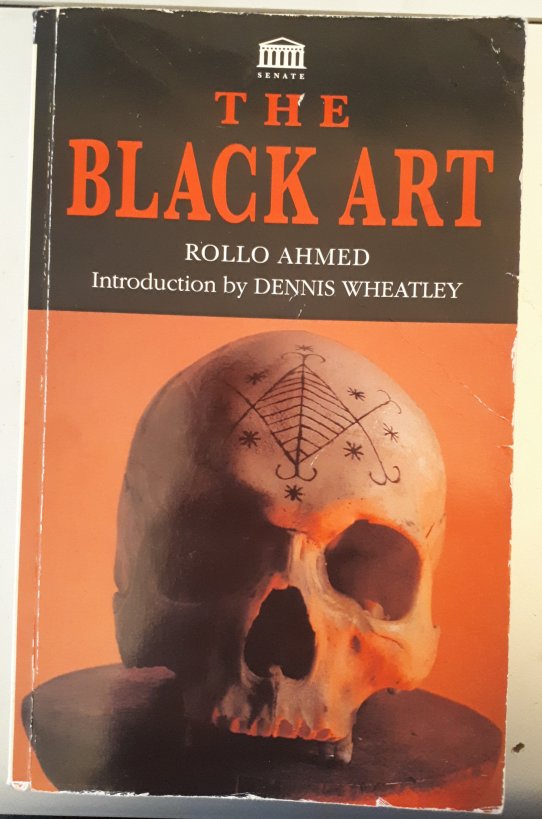

 Similar title, cover and contents
 Summers’ Vampire books were later retitled. I own both, but have only read
 Nocturnal Revelries