Zanoni – Edward Bulwer-Lytton

2015-08-27 20.54.58
P.F. Collier – 1892

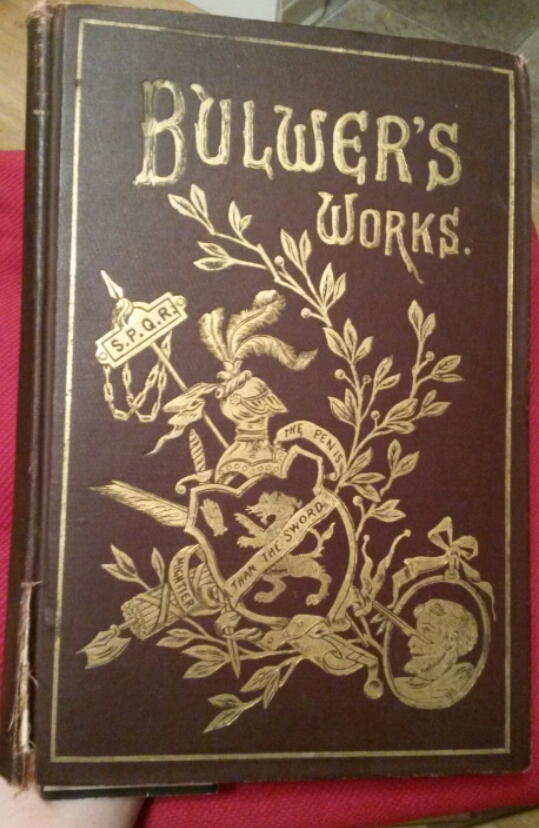
Last year, I ordered a set of books by Edward Bulwer-Lytton. It’s a 9 volume set of his most popular works. All the books are double-paged, and each volume contains a few different works.  I have a pretty big reading list, and it took a few months to get around to any of these battered old tomes, but almost as soon as I started reading, I knew this set had been a wise purchase. If you find a cheap copy of these books, buy them immediately. I spent about three times the cost of the books on the postage, but it was still worth it. (UPS are a dirty shower of thieving bastards!)

2015-08-27 20.52.31A pretty cool cover. N.b. the fasces and the obscenity.

20150814_013506LOL

These books were published in 1892, and it shows. The spines are all cracked and the binding is falling apart. I had to sit down at a desk and carefully turn each page so as not to cause further damage. Now one might think that this would have been detrimental to my enjoyment of these texts, but that couldn’t be further from the truth. I felt so cool, patiently leafing through the pages and inhaling their aged musk. One can only imagine my delight on finding that the text that I started reading was about a ciphered manuscript given to the author by a mysterious Rosicrucian whom he had met in an esoteric bookshop. All my dreams were coming true at once!

2015-08-27 20.51.35The frontispiece of Zanoni. It depicts Gaeto Pisani and his daughter, Viola. (I think.)

The manuscript tells the tale of Zanoni, an immortal sorcerer and member of an extremely exclusive secret society consisting of only two people. He tries his best to help out a pair of young lovers, but he fails miserably and ends up making their lives incredibly difficult. The youngfella thinks that Zanoni is really cool, and tries his best to be like him. Zanoni is fairly chuffed, and invites him to join his club. Unfortunately for everyone, Glyndon, the young man,  doesn’t get past the initiation ritual for the order, and ends up spending the rest of his days getting stalked by a particularly nasty entity called ‘the dweller of the threshold’.

Lytton was a hugely popular writer in the 19th century, and apparently the theosophists were big fans of his. Helena Blavatsky introduced a version of the dweller of the threshold into her teachings. She described it as an extension of one’s astral body that results from the remnants of past lives. Other occultists have appropriated the dweller in other equally silly ways. Van Morrison, everyone’s favourite adept of easy-listening, had an interest in the occult at some stage, and he used one of these bastardized versions of the dweller for the topic of one of his songs. Before I go any further, I want to declare my extreme and utter hatred for Van Morrison. I remember being a kid and having the tape of Van the man’s greatest hits playing in the car every fucking time my parents took me on a drive. I didn’t know what it was called, but I referred to it as ‘sweaty music’ because that’s how it made me feel. I actually listened to his song a few times before I wrote this review, and it made me want to vomit and shit diarrhea at the same time. Anyways, the lyrics to Morrison’s song are about some kind of benevolent source of spiritual inspiration. Bollocks to that. In Lyttons book, the dweller is a seriously nasty piece of work:

Its form was veiled as the face, but the outline was that of a female; yet it moved not as move even the ghosts that simulate the living. It seemed rather to crawl as some vast misshapen reptile; and pausing, at length it cowered beside the table which held the mystic volume, and again fixed its eyes through the filmy veil on the rash invoker. All fancies, the most grotesque, of monk or painter in the early North, would have failed to give to the visage of imp or fiend that aspect of deadly malignity which spoke to the shuddering nature in those eyes alone. All else so dark,—shrouded, veiled and larva-like. But that burning glare so intense, so livid, yet so living, had in it something that was almost HUMAN in its passion of hate and mockery,—something that served to show that the shadowy Horror was not all a spirit, but partook of matter enough, at least, to make it more deadly and fearful an enemy to material forms. As, clinging with the grasp of agony to the wall,—his hair erect, his eyeballs starting, he still gazed back upon that appalling gaze,—the Image spoke to him: his soul rather than his ear comprehended the words it said.

“Thou hast entered the immeasurable region. I am the Dweller of the Threshold. What wouldst thou with me?”

Deadly, isn’t she?

I won’t say much more about the plot, as I don’t want to ruin the story on you. Being honest though, this is not a great book. There are some fairly big flaws here; it seems a bit like the author was making up the plot as he went along, and the detailed parts on the French revolution are neither interesting nor particularly relevant. Some editions use the subtitle; ‘A Rosicrucian tale’, and this is fairly apt: there’s probably a lot of symbolic and esoteric meaning between the lines that will only become apparent to patient students of hermeneutics, but I’m not really concerned with that shit. This is an old book about wizards, spirits, demons, and babes with heaving bosoms, and I thought it was deadly.

The Bible

2015-08-22 16.05.29

I grew up in a Catholic household, and I went to mass every Sunday until I was 17 years old. I tried to read the Bible as a child, but I got a few pages into Genesis and stopped. I’ve since renounced my faith and made some sinister pacts with you know who, but in my reading I kept seeing references to this book and I decided to give it another go. I’m also an extremely petty person, and I enjoy knowing more about Christianity than most Christians. I started reading the Bible about 2 years ago, and I only recently finished the whole thing. It’s about 900 double pages long, so I took my time with it; reading a book here and there in between other texts. Parts of it are incredibly tedious, but some of it is really interesting. I remembered a lot of the New Testament stories from my church going days, but the Old Testament is filled with awesome bits that they never tell you at mass. I am quite certain that most ‘Christians’ would abandon their faith if they actually took the time to read and think about this awfully silly book of utter nonsense. Any person who reads and acknowledges all of the stories in this book as true is an utter imbecile.

One thing that surprises me about the Bible is the ignorance that surrounds the book. Most people (including Christians) don’t know what the Bible is. It seems that many people think that it is a book of rules. The Bible shouldn’t really be seen as a book. It is a library of arbitrary texts that were written by savages in the iron age . Some of them are instructional, many of them are historical and some are philosophical. The instructional books are intended for people living in the iron age, and any modern human who relies on these texts for guidance is a stupid fucking pig. The historical and philosophical books are still rather interesting, but it is extremely obvious that the people who wrote these books did not have the same standards of historical accuracy as we might hope for. Several of the books in here tell the same stories but give very different accounts of the same incidents.(Did Judas hang himself or did God blow him up?) I was walking through town yesterday and I saw a book entitled “The Juice Bible”. That is an idiotic title for a book that is comprised solely of juice recipes. To compose a true “Juice Bible” one could compile the top 50 results of a google search for the words “juice blog”, regardless of their content and reliability. Maybe that’s a silly analogy, but my point is that the Bible is basically a incoherent collection of assorted crap that was written and compiled without any sensible authority.

My favourite books are Genesis, Exodus, Judges, Job, Ecclesiastes, Ezekiel and Daniel. Isaiah and Jeremiah are soooooooo boring. The Gospels, Acts and Revelation are the juicy bits of the New Testament; the letters and epistles are all absolute gick.

This certainly won’t be my last post on the Bible. I’m going to do a post on my top 5 favourite Bible stories fairly soon. I assure you that my sermon will be most enlightening. Also, I have yet to read the apocrypha and pseudepigrapha, so expect posts on them at some stage too. I read some of the books on different websites and copied my notes into a hard copy that I stole from a hotel room. I didn’t stick to one translation, but the copy I work from is New American Standard. It’s one of the Gideon’s. I make a point to either steal or desecrate every hotel room Bible that I encounter. I encourage you to do the same. Don’t use reason or logic: Christians don’t understand those things! Be as childish and disrespectful as possible, and remember to have fun and be creative!
bible 1  bible 3bible 2

Mysteries of the Unknown – Time Life (Part One)

2015-08-21 21.17.48I didn’t want to review these until I had read all of them, but that will probably never happen. This is a 33 volume collection of books on the ‘mysteries of the unknown’. Some of the books are very cool, but a lot of them are extremely lame. (I’d say about half of them are about psychics.) They contain a nice mixture of essays and articles, and they’re all full of fancy pictures. It’s a really nice set to have, and I got mine for fairly cheap. I find that they’re quite good if you read them as primers before getting stuck into more difficult/older books on the same topics. I’m going to briefly review three of them today, and I’ll do some more in a few months. 20150821_210412The full collection

Ancient Wisdom and Secret Sects
2015-08-21 21.53.15
I read this one a good while ago. It’s probably the best introductory book on secret societies that I have read. That’s not saying much really, as I have only read three such books. What I am trying to say is that this is a far better introduction to secret societies than Arkon Daraul’s piece of shit. It goes into detail on the assassins, the masons, the Rosicrucians and the Golden Dawn. I thought it was pretty enjoyable.

2015-08-21 21.15.52
This is some bullshitty Golden Dawn picture from the book. The bird at the bottom has serious attitude and the lad at the top is wearing a wiggy.

Speaking of the Golden Dawn, I went to the Yeats exhibition last time I was in Dublin, and I took some pictures of his occulting stuff. Here they are:
2015-08-21 21.45.09
Sorry William, but that Angel is fucking lame.

2015-08-21 21.45.54 2015-08-21 21.46.17
Another notebook and some dodgy tarot cards.

Transformations
2015-08-21 22.07.50
This one was pretty good too. It’s mostly about vampires and werewolves. It discusses the potential causes of vampirism and lycanthropy without getting too bullshitty. There was also a nice section on Vlad the Impaler, and it has lots of cool pictures, including this saucy snap of Theda Bara.
20150821_211030What a babe!

Mysterious Creatures
2015-08-21 22.07.32

This one mainly focuses on Bigfoot and the Loch Ness Monster. I like the fact that these books give fairly objective accounts: They don’t try to disprove anything, but they don’t feel bullshitty either. I don’t believe in the Loch Ness monster at all, but I do think that Bigfoot COULD exist.
2015-08-21 21.16.30
This lad also made a brief appearance. He is wrecked.

My lovely wife and I recently celebrated our wedding anniversary in Harrison, British Columbia. Harrison is a bigfoot hotspot and home to Sasquatch Park. We didn’t see one while we were there, but it’s a really nice place. I would definitely recommend going if you get the chance.
IMG-20150817-WA0010

20150817_173920The entrance to our suite

20150817_234336 20150817_234130 20150817_234200
These were in our hotel room. They give some background information and tips on what to do if you encounter a Sasquatch.


A History of Secret Societies – Arkon Daraul

2015-08-12 21.21.10
Citadel – 1997

I’m not really interested in secret societies. There’s a few interesting ones, but they’re mostly pretty boring. A few months ago,  I saw this book for sale on craigslist for fairly cheap. I wasn’t really bothered, but I was reading the Illuminatus! Trilogy at the time, and when I saw it mentioned therein and recalled the craigslist ad, I took it as a sign that I should buy it. (Coincidences don’t exist.)

2015-08-10 18.34.14
Why I bought this piece of trash. Note the misspelling of the author’s name.

I decided to read the book because I am currently reading Zanoni by Bulwer Lytton, and as that book is about Rosicrucians, I thought this would complement it well. It’s certainly as fantastic; in fact, there are more references in Lytton’s work than there are here. Arkon Daraul is full of shit.

This book is garbage. It doesn’t seem reliable at all. Daraul’s choices of which secret societies to discuss are completely arbitrary. There is a lengthy chapter on peacock worshippers in modern England, but there’s no chapter on the freemasons. Admittedly, I was relieved that I didn’t have to read the same crap about freemasons that I have already read in 10 other books, but it did seem a little odd that the most famous secret society of all were barely mentioned in this “historical account”. Also, Daraul doesn’t really bother to distinguish between secret societies and cults.

I don’t really have much else to say on this book. It was crap. The cover (Is that Satan?) makes it look way better than it is. There were some interesting parts, but there are lots of other books on the same topic that are much better. I reviewed a shitty little book on this kind of crap before that covered more ground and was way less bullshitty.
Don’t bother reading this one.

prayer
The best part about this book was this prayer leaflet that the previous owner had left in it.

Le Fanu’s Short Stories – Madam Crowl’s Ghost and In a Glass Darkly

2015-07-07 16.49.31
Sheridan Le Fanu – Madam Crowl’s Ghost & Other Stories / In A Glass Darkly
Wordsworth Editions – 2006 and 2008

Here are two collections of short stories from one of my favourite writers. I would recommend the Oxford edition of In A Glass Darkly, as that one contains nice notes at the back. Wordsworth editions are bare bones and rarely contain annotation. They are cheap however, and I own quite a few of them.

In A Glass Darkly is the better of the two collections. It’s been a few years since I read it, but I distinctly remember the joy I felt when the evil monkey appeared the first story. It’s also great because it contains lesbian vampires in a vampire story that predates Dracula. I think my favourite story in here is the novella: The Room in Le Dragon Volant. It’s not as spooky as the others, but I really like Le Fanu’s writing

Madam Crowl’s Ghost is a nice collection of ghost stories compiled by none other than M.R James. I read this one more recently, but I read the first two stories on a transatlantic flight and didn’t end up enjoying them as much as I would have were I to read them on the couch at midnight with a cup of peppermint tea. The stories in here are collected from different sources, and the quality and tone varies quite a bit. Some are great though, and most of them are set in Ireland. You can imagine my sheer delight on finding a story in here about a man from my hometown who shares my name. I loved this book, but the other collection is probably a better place to start if you haven’t read Le Fanu before.

Elvis Presley Speaks – Hans Holzer

elvis
New English Library – 1981

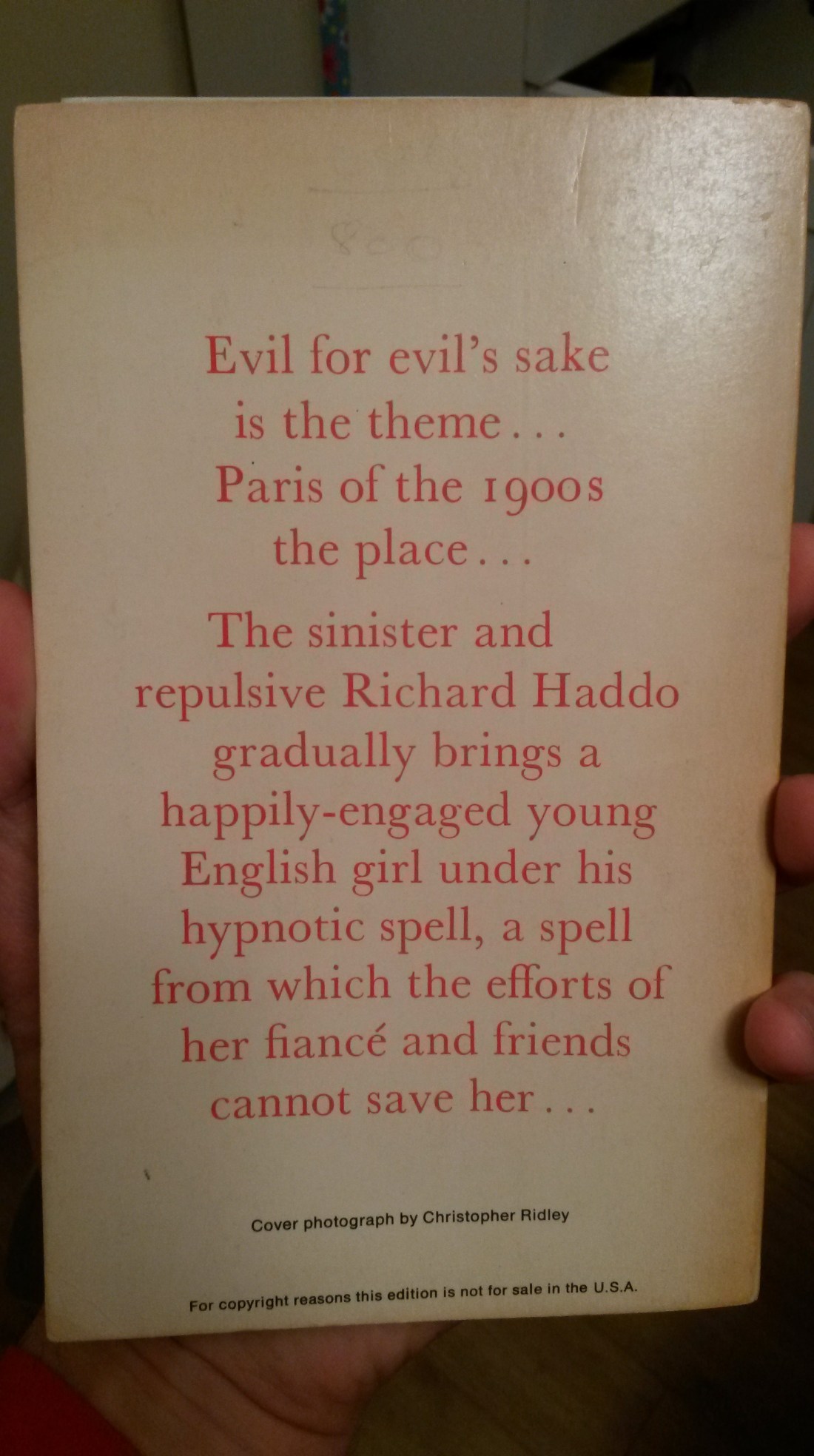
This book was not my first encounter with the work of Hans Holzer. Some of you may remember my review of Gothic Ghosts. If you have read that review, you will probably wonder why I bothered to read another book by this chump. (If you haven’t read that review, I strongly suggest that you do. It’s one of my personal favourites.) Well, after reading that utter piece of shit, I needed somewhere to direct my hate, and so I did a google image search for the author. An image of this book appeared, and I simply could not help myself. I bought a copy immediately.

This is a book about a woman named Dorothy who believes that the spirit of Elvis Presley exists in an Astral realm between earth and heaven. This realm is peopled by souls awaiting reincarnation, and it is managed by a mysterious bearded figure named Matthew. (My first guess was that it was the gospelly Matthew, but this is neither confirmed nor denied in the book.) The astral residents spend their days going to school, attending jam sessions and sometimes making contact with the living.

Elvis descends from the astral realm and appears to this woman for two reasons.
1. They have been soul mates in many previous lives, but because of some heavenly error, they ended up apart in their most recent incarnations. (Dorothy was a housewife from New Jersey; Elvis was the king of rock and roll.) This separation was partly to blame for the untimely death of Elvis. After death, Elvis’s soul realizes what he has been missing and decides to spend all of his time watching over this woman.
2. Elvis wants Dorothy to contact the famous parapsychologist, Dr. Hans Holzer so that he can send a message to the world. His message is that there is existence after death and that dead souls can get quite lonely.

So what is the ghost of Elvis like? Well, he’s a weird creep. He gets annoyed about impersonators, worries about his family and tries to ruin a woman’s marriage. At one point he climbs on top of Dorothy when she is in bed with her husband and asks her if she wants to “fool around”. There’s not much insight into Elvis’s character here that wouldn’t be available in other biographies or interviews. Let’s remember that Elvis is one of the most famous people to ever walk the earth, and it would probably be a challenge for Elvis himself to give any additional insight on his character. Given that, I have to say that Dorothy Sherry’s portrait of the king is incredibly underwhelming.

This is a very poorly written book. It’s mostly repetition, and Holzer has no interviewing skills whatsoever. As soon as Elvis starts answering any of his questions, Holzer will immediately interrupt him with another unrelated question. I don’t know if Dorothy Sherry even existed, but if she did, I wonder how much of this book is based on her own subjective experiences and lies and how much is based on Holzer’s personal agenda. It seems a bit odd that Elvis Presley, the most famous entertainer in the world, would come back to substantiate personally the claims of a fiddeldy-dee parapsychologist. I got the impression that Dorothy was being led on by a manipulative cadger, anxious to profit from the unfortunate woman’s mental instability.

Obviously the book is completely stupid and unbelievable, but the most annoying thing about it is Holzer’s sense of self importance. He mentions several times that Elvis had read many of his books and that Elvis wanted Holzer to deal with this case personally. The book is about  a famous musician, and Holzer can’t help but announce that he too is a professional musician. At one point in the book he offers to write music for new Elvis songs. Later Dorothy recounts a vision of a past life in ancient Egypt. In this life she was a slave, but she was able to alleviate the misery of servitude by basking in the glory of a noble and intelligent teacher figure. This teacher was none-other than an early incarnation of Hans Holzer himself. Why did Holzer include this vision in a book about  the ghost of Elvis?

Hans Holzer, you are an arsehole.

This book is shite. Pure shite. I found myself questioning my own intelligence when I was reading it. In the hours that it took me to read this garbage, I could have tidied my bedroom or gone for a walk. Sometimes I justify reading stupid books to myself by viewing the activity as an exercise in critical thinking. This book provided no such exercise. The critical thinking involved in the reading of this book was limited to my evaluation and immediate repudiation of the book’s subtitle, “The astonishing evidence of spiritual contact with Elvis from beyond the grave”. This book is scraping the bottom of the barrel, and the only good that can come from reading it is the contrast of quality that you will immediately notice in whatever book you read after it. I doubt that I will be reviewing anything this bad for quite a while.

The Worship of the Serpent – The Rev. John Bathurst Deane

worship serpent
Health Research Books – ?

I’m not entirely sure how this book ended up on my wanted list (I think I came across the title when researching the Ophite gnostics), but I spent a few months last year trying to find an affordable copy.  The book was originally published in 1833 and text is available online, but I don’t like print-on-demand books and I ended up ordering a copy that was supposedly published in 1970. The publishing company is called Health Research Books, and there is a website url given on the back cover of the book. Strange for a book from 1970 right? The cover looks like shit; I don’t know what that fucking picture is supposed to be, but inside is a decent facsimile copy of the original book.

The idea behind the book is rather interesting. The author claims that the events in the Book of Genesis are literally true, and that all of humanity can trace its origins back to Noah’s family on the ark. He notes that all mythologies feature serpents or serpent-like creatures in some form or another, and he argues that all mythological serpents have their origins in the serpent of Eden. The fact that so many myths and stories contain serpents is intriguing, but the argument here is pretty weak. Deane spends most of the book discussing the etymologies of the names of different mythological serpents and gods and showing how these names could have originated in different words for snake. It was enjoyable enough, but at no point did I feel remotely convinced in what Deane was saying. Some mythological serpents are representatives of evil, but others are benevolent creators. Deane’s thoroughly protestant response to this is to claim that any culture in which the serpent has become a positive force must have been made up of savages.

Mankind’s obsession with serpents is fascinating; we just can’t get enough of those slithery fucks. Why do so many cultures incorporate snakes into their mythologies? This is a legitimately interesting question, but I don’t believe that the answer lies in-a-gadda-da-vida. This book’s responses to this question come from within a Christian paradigm, and the book ultimately serves as an example of the phenomenon it discusses rather than as an answer to the question it poses. The worship of the serpent  is a damn cool topic, but this book is only going to be useful to a psychology student interested in studying the egocentrism of 19th century Christian clergymen.

This picture of Medusa’s minging face was one of my favourite parts of the book.mingin

Maldoror and Poems – Le Comte de Lautrémont

Maldoror

Penguin – 1978
The full title of this work is “Les Chants de Maldoror”, and it is supposedly a collection of “songs”  written by an extremely nasty individual. Imagine all of the bad guys of gothic literature rolled into one and you’ll get an idea of what Maldoror is like as a person. He’s equal parts Manfred and Melmoth, but he also has a little Dracula and Curval in him too. He hates man, god and almost everything else. Sounds pretty cool right? Well some of it definitely is. The parts where he recounts his crimes and insults god are  damn sweet. He isn’t just a little bit naughty either; he’s full on evil. He boasts about brutally torturing people and he’s a bit rapey too. I’m surprised more metal bands haven’t used the name Maldoror. I can only find one black metal band from Italy with the name, and they look absolutely shit.

This wasn’t a book that I rushed through. I enjoyed the protagonist’s horribly nihilistic outlook, but I read the book in July, and it felt wrong to sit down with it when the sun was shining. I had to wait until the hour of 12 before delving into this hateful work of misanthropy. Also, the prose is quite dense, and it was a bit of a chore to get through. Some of the sentences are ridiculously long (the narrator comments on this himself), and there’s no underlying plot to the book, so it can be difficult to follow.

Nobody knows much about Le Comte de Lautrémont, but his real name was Isidore Ducasse, and he died at 24, only a few years after this book was written. I would imagine that parts of this book are autobiographical and reflect the author’s outlook. There are brief incidents in the text where a hitherto unknown character appears and is treated as if he has been part of the story all along. These parts struck me as probably having meaning to the author alone; perhaps they are masked accounts of his own experiences. That’s one of the difficulties with surrealist writing though; the author is under no obligation to explain himself.

And this book is quite surreal. There are some truly mental parts in it. Some of them are entertaining; I particularly enjoyed Maldoror’s dalliance with a shark, but many are confusing and are made downright unenjoyable by frustratingly convoluted prose. This confusion is not accidental though, and the difficulties facing the reader of this book are undoubtedly deliberate. One of the opening lines of the book reads; “It is not right that everyone should read the pages that follow; only a few will be able to savour this bitter fruit with impunity.” Maldoror does not want his readers to enjoy these songs; he wants them to suffer. This is basically a deliberately discordant black metal album in the form of a book.

I wanted to like this book more than I did. It’s a cool idea; I just don’t think it was executed as well as it could have been. In saying that though, this is a translation, so maybe the fault lies with Paul Knight. Then again, maybe I just didn’t get it. This is definitely a book that you have to ‘get’ to enjoy. It’s surrealist fiction, so a load of it is utter bollocks that makes no sense. I would say that the grisly parts make it worth reading, they’re gross, funny and metal as fuck, but don’t expect to enjoy the whole thing. If you find yourself having a great time while reading this book, you are definitely doing it wrong.

This edition also contains Lautrémont’s poetry. Apparently he had gotten all of this negativity out when he wrote Maldoror, and his poems are supposed to focus on more positive things. I didn’t read them. I probably never will. The edition that I am reviewing also has a deadly cover. It’s from part of this painting by Anton Wiertz.wiertzL’Inhumation précipitée

The Legend of the Sons of God – T.C. Lethbridge

2015-06-24 17.12.46
Arkana – 1990

This books contains some of the choiciest bullshit I have ever come across. Did you know that the rocks of Stonehenge are from Tipperary? Were you aware that the craters on the moon are the results of an interstellar nuclear war between the Martians and Venusians? Had it ever occurred to you that Jesus was a ghost alien from the future? I can’t say I had ever wondered about these things before reading this book, but now I am convinced that they are all entirely true.

T.C. Lethbridge doesn’t even bother to present his ideas as fact. He openly admits that the bulk of this book is conjecture. He reminds his reader that there are gaping holes and inconstencies in our accounts of history. The standard scientific approach to solving these mysteries is to use proof and evidence. This method doesn’t quite satisfy Lethbridge though, and he suggests that it would be more productive to make up ridiculous stories and then look around for evidence of the events that we imagined. This book was written by a grown man playing make-believe.

“Although much of what has been written so far is not strictly orthodox, the present chapter is far worse and deals with matters which are fit really only for the television plays called ‘Doctor Who’.” Thus opens the seventh chapter of this masterpiece.

This book came out at roughly the same time as Von Däniken’s Chariot of the Gods, and it contains some similar ideas, but this one is definitely more enjoyable. It’s short, the writing is engaging and the claims herein are silly enough to be thoroughly entertaining. This is a must read.

Transcendental Magic, Its Doctrine and Ritual – Eliphas Levi

2015-07-06 20.53.53
Senate – 1995

This book is a load of bollocks. I’ve seen it mentioned in other books, and I thought that I should check it out. In fairness, I was probably underwhelmed because I have come across these ideas in so many other books (Although they were bollocks in those books too.) There is a story that the secrets disclosed herein were once the private knowledge of a secret society to which Levi belonged*, but I think it would be unfair to blame anyone other than Levi for this stinking garbage heap of nonsense. Levi links the usual ancient traditions together and adds a bunch of his own bullshit into the mix to create a completely incoherent mess of esoteric diarrhea.

This is actually two books in one. The first is a book on the dogma of magic, the second is a book on the rituals. The chapters in each book correspond to each other, and if I were to read it again, I would read the corresponding chapters in pairs. I am almost definitely not going to read this book again though. The first ten chapters in each text are on numbers. For example, the second chapter is on the number two. For this chapter, Levi thinks of all the things that exist in pairs, and occults them. Cain and Abel represent the Yin and the Yang. Yin is the Angel Lucifer, but Yang is the Angel Michael. Yin depends on Yang, so death (Lucifer) depends on life (Michael). Death is a penis, but it is also life, therefore a penis is actually a vagina. Now this is of course corroborated by the two pillars of the temple of Solomon: they enclose the tree of life and the tree of knowledge, duhh! It’s all so obvious!

So each book starts off with ten chapters of that kind of crap. It’s only after the number chapters that Levi gets into necromancy and witchcraft. Those chapters are alright. There are some fucked up rituals described in detail. My favourite is the ritual that requires the necromancer to somehow put themselves in a position whereby they are assisting a priest in the celebration of mass on Christmas Eve. They must help the priest until the host is consecrated and then  interrupt the ceremony by yelling ‘LET THE DEAD RISE FROM THEIR TOMBS!” After this they run from the church to the graveyard, continually screaming. Wouldn’t it be amazing to see that happening? Levi also gives detailed instructions on the steps you need to take to become master of the Gnomes of the earth. Yep, this is all fairly pragmatic stuff…

The translator, A.E. Waite, provides lots of footnotes, most of which criticize Levi’s nonsense in a manner so harsh that one would wonder why he bothered with it at all.  Waite, who wasn’t exactly the most rational man in the world, describes Levi’s ideas as ‘fantastic’, ‘without authority’, ‘idle nonsense’, ‘incredibly bad’ and ‘made up out of his own head’. I also own his translation of Levi’s History of Magic, a book that I now doubt I will ever read.

The illustrations are cool though. The Sabbatic goat on the cover is quite deadly, and there’s a fair few images in here that I’ve seen elsewhere.  That’s the thing about this book; it has been used as a source for lots of other books that explain its contents far more clearly than it does itself (I would recommend Cavendish’s The Black Arts to anyone who’s interested.)

I was also delighted to find a brief reference to the tarte Bourbonnaise of Panurge. The Borbonesa tart is a dessert mentioned in Gargantua and Pantagruel. It is a “filthy and slovenly compound, made of store of garlic, of assafoetida, of castoreum, of dogs’ turds very warm, which he steeped, tempered, and liquefied in the corrupt matter of pocky boils and pestiferous botches” This is Rabelais’ description, not Levi’s. Levi only mentions the tart in comparison to the smell that might emerge from one of the potions described in the chapter on charms and philtres.

If you want to read a mess of mystical bullshit about the astral plane and tarot cards, then this is the book for you. Otherwise, skip to the chapters on necromancy, witchcraft and the Sabbath, and leave it at that.

*My source for that information was Wade Baskin’s Dictionary of Satanism, so it’s almost definitely untrue.

Please share the below image, and let’s hope somebody takes the challenge!

necromancer challenge