My Work Is Not Yet Done – Thomas Ligotti

My Work is Not Yet Done ligotti.jpgMy Work is Not Yet Done – Thomas Ligotti
2002 – Virgin

I read a lot of books, but in truth, there are relatively few authors whose books I savour. I actually hold off on reading Thomas Ligotti because I don’t want the day to come when I have already read all of his books. His low opinion of humanity is both tragically hilarious and brutal, and while I don’t necessarily share the outlook of the narrators of his stories, I find his pessimism the perfect vehicle for horror. The message that our existence has no worth is perhaps the most disturbing idea that an author can offer to 21st century humans.

My Work Is Not Yet Done is a novella and two short stories. All of these tales are about workers’ lives as part of a corporation. There’s a very Kafkaesque vibe running throughout, but Ligotti covers the bureaucratic angst with layers of supernatural horror and misanthropy and turns it into something far darker. The first act of the eponymous novella portrays a man who decides to go on a killing spree in his office after he’s unfairly dismissed from his job. I know Stephen King found himself in hot water for writing a novel about a school shooting, so I was impressed that Ligotti had done something so extreme. I won’t tell you what happens later on in the story, but I will say that it’s actually far worse than what you’d expect.

I know full well the misery of working for a company that you hate, and while I’ve only spent a little over a year working in an “office job”, I spent enough of that year fantasizing about murdering my boss to have thoroughly enjoyed this book.

Little things about the book stuck out to me. Characters have stupid names – coworkers are named Sherry, Terry, Mary, and Perry, and detectives are named Black and White. Also, the purpose of the corporations that these characters work is barely discussed – the nature of the work that the characters engage in is almost entirely passed over. Why does Ligotti omit these details? Why doesn’t he put more effort into naming his characters? Because that stuff doesn’t matter. Human beings are entirely interchangeable. You are no different to the people you hate the most. What corporations actually do doesn’t make any difference to their workers. Nothing fucking matters. Every living thing is going to die without having made any noticeable difference in the universe, a universe in which every single atom will eventually decay.

Oh, I forgot to mention that this is the first post of 2020. Happy New Year everyone!

“Generally speaking: Expect nothing but nightmarish obscenities to be born when human heads come together in intercourse.

More generally speaking: Whatever is born will ultimately grow into a nightmarish obscenity – in the grand scheme of things.”

There’s moody nuggets like this sprinkled throughout the book, but the closing lines of My Work Is Not Yet Done sum it all up. I don’t want to quote those here as it might ruin the effect when you do get around to reading it, but fuck me, they’re perfect. Please believe me when I say that this is a novella worth reading.

I’ve also reviewed Ligotti’s Teatro Grottesco and The Conspiracy Against the Human Race if you’re interested. I read Noctuary years ago too, but I haven’t reviewed that one properly yet. There’s a copy of the Penguin edition of Songs of a Dead Dreamer and Grimscribe on my shelf, but I’m waiting for a special occasion to allow myself the luxury of reading it.

2019, The Year in Review

2019 was the busiest year yet for this blog. There were more posts, words, books and traffic than ever before. (I know I said the same thing last year, but I’ve outdone myself again.) I put a lot of effort in this year, and almost all of my reading was dedicated to this blog. I only managed to read 4 non horror/occult books over the whole year. If you haven’t been paying attention, this post will guide you through what I covered in 2019.

I read some really cool novels this year. I was so excited to find a cheap copy of Kathe Koja’s The Cipher in a thrift store, and I’m happy to report that it lived up to its reputation. I posted about Edward Lee’s The Bighead right at the beginning of the year, and it was an extremely gross, funny and enjoyable read.  My copy of C.S. Cody’s The Witching Night had been on my shelf for years, but I loved it when I got around to reading it this summer. Bari Wood’s The Tribe also blew me away. There’s no wonder that it was recently rereleased. Flesh by Richard Laymon may not have been a brilliant novel, but I really enjoyed it. I ended the year reading two classics of weird fiction, Fritz Leiber’s Our Lady of Darkness and William Hope Hodgson’s The House on the Borderland. Both of these books were awesome.

I did a few short story collections this year too. I was delighted to get my hands on Montague Summer’s long forgotten Ghost Stories. I also really enjoyed rereading Lovecraft’s stuff. (Part 1, Part 2, Part 3 and Part 4.) In May, I reviewed Teatro Grottesco by Thomas Ligotti. I absolutely adored that book, and I was surprised to see how much traffic that post got. (I also just finished his My Work is Not Yet Done, so expect to see more Ligotti here soon.) In October, I did a lengthy post on the two Splatterpunks anthologies from the 90s. The stories in these were of varying quality, but they did put me onto some cool writers. I actually thought that I had reviewed more short story collections than this when I started writing this paragraph, but that’s because I have spent the last few weeks working through Clive Barker’s Books of Blood. I haven’t finished all 6 yet, so it’ll be another while before they show up here. (Barker is one of the authors that Splatterpunks convinced me to check out.)

Of course, this blog isn’t just about fiction, and this year, I got into some very weird esoteric books indeed. The one I was most excited about was Geoff Gilbertson and Anthony Robert’s The Dark Gods. Jesus, that book was mental. (I’m also happy to report that a pdf copy has been uploaded to the internet since my post was published, so you won’t have to go through what I went through to read this very rare and very odd book.) I was also proud to present a review of Robert Eisler’s Man into Wolf, a very peculiar book on lycanthropy. Dr. Alexander James McIvor-Tyndall’s (pre-Nazi) swastika adorned Ghosts: A Message from the Illuminati was another interesting book to track down and read. Allen H. Greenfield’s books on UFOnauts and the secret rituals of the Men in Black are amoungst the strangest I have ever read. I read three (1, 2, 3) dumb books on sex magic over the course of the year, and George Bataille’s book on Gilles De Rais was a very depressing look at that dirty satanist paedophile. On top of H.P.’s fiction, the aforementioned Lovecraft posts all deal with Lovecraftian grimoires too.

I also read a bunch of utterly idiotic grimoires that were written by morons. Highlights include Fascination by Master Count de Leon, The Black Grimoire by Angel Zialor and Secrets of the Black Temple by the Red Spider. This shit was DUMB.

Finally, I reviewed a little bit of porn in 2019. Satan was a Lesbian and The She-Devils did not live up to their titles, but Ann L. Probe’s Alien Sex series was exactly as good as you’d expect.

We’re soon to enter the twenties, and while this post only looks at the books I’ve reviewed in 2019, this blog has been around for half a decade now. If you’re interested in looking back, you can check my yearly review posts for 2018, 2017, and 2016. (I didn’t do one for my first year.) You can also look through my site’s index for a complete list of the 300+ books that have been reviewed here over the past 5 years. If you enjoy this blog, please share it with like-minded people. You can get updates on twitter or facebook, and I’m always happy to get recommendations for my next review.

I hope you have a great new year!

The House on the Borderland – William Hope Hodgson

house on the borderland william hope hodgson.jpgThe House on the Borderland – William Hope Hodgson
1908

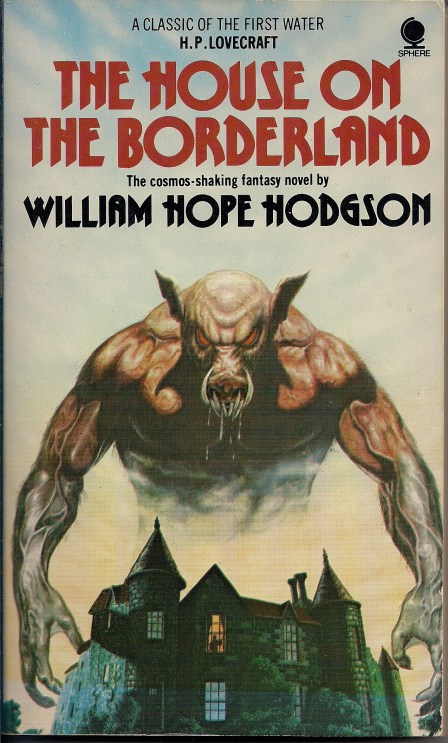
It’s coming close to the end of the year, and I have spent 2019 reading some absolute garbage. After reading and reviewing Fritz Leiber’s awesome Our Lady of Darkness last week, I really wanted to read another cool book. I’ve been meaning to read William Hope Hodgson’s The House on the Borderland for a couple of years, and when I found a free audiobook version last Sunday, I decided the time was right.

This was a very enjoyable piece of weird fiction. It’s about a strange man who lives in an old house in Ireland that seems to exist on the border of different dimensions. I spent the first half of the novel thinking it was basically just Night of the Living Dead with interdimensional pig-mutants instead of zombies, but the second half of the book has more in common with 2001: A Space Odyssey. (I just read Will Errickson’s review of this book and saw that he also made a 2001 comparison. Will, I swear this was coincidence!) There’s little wonder that H.P. Lovecraft was a big fan of this novel; there’s some very definite “the universe doesn’t care about you” vibes throughout.

I read William Hope Hodgson’s Carnacki the Ghost Finder stories a little under two years ago, and while I enjoyed them, I seem to remember them being a good deal more straight forward than this. One of those stories also includes evil pigs, and a couple of them are set in Ireland too. I reckon I enjoyed The House on the Borderland more, and I’m planning to read more by Hodgson in the future.

The only problem with reading good books, especially popular ones, is that I find myself at a loss for things to say when reviewing them. This one is cool, short and available for free in multiple formats. You might as well check it out.

Six Ghost Stories – Montague Summers


summers six ghost stories.jpgSix Ghost Stories – Montague Summers
Snuggly Books – 2019

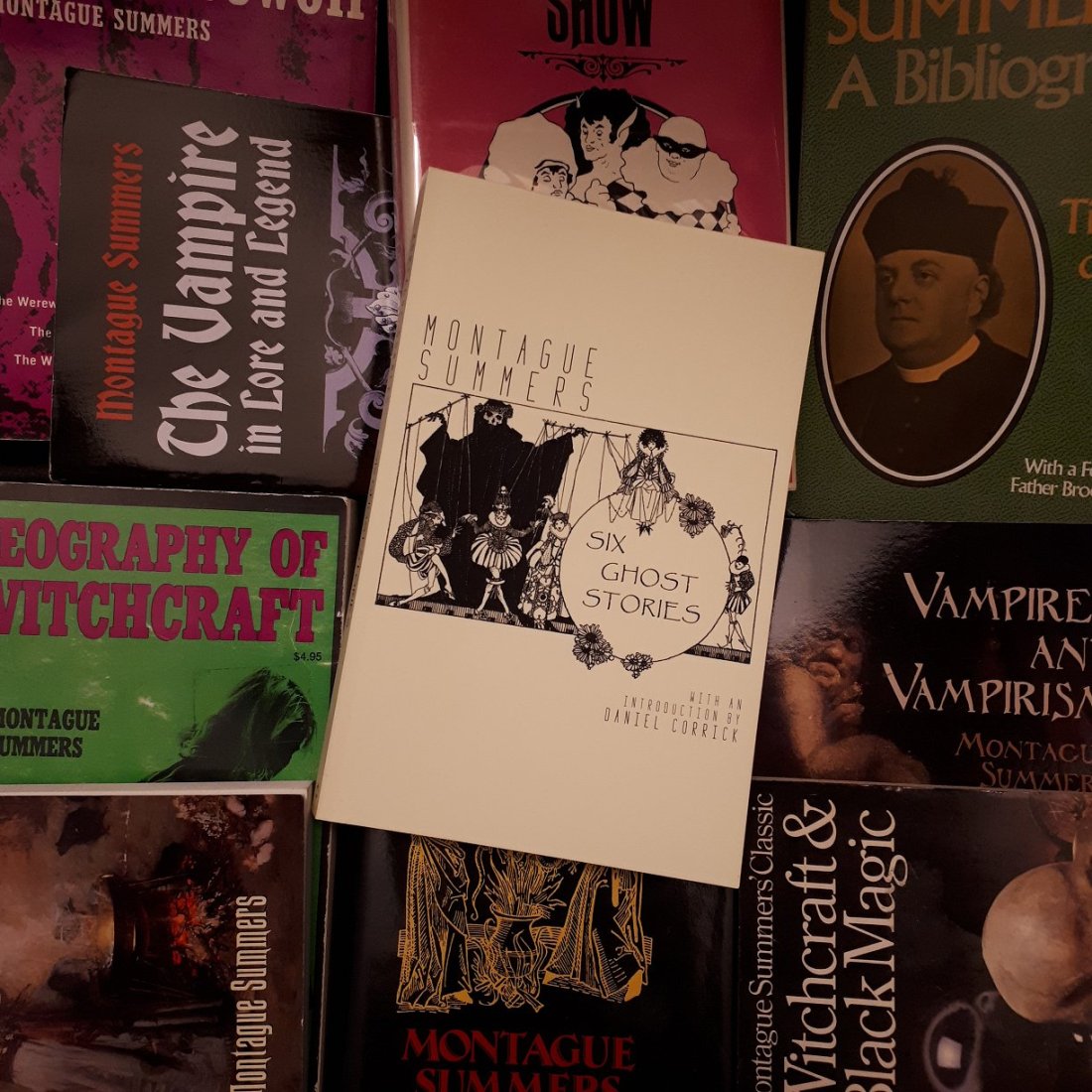
A few months ago, I got an email from my pal Sandy Robertson telling me that Snuggly Books were going to release a collection of short fiction by Montague Summers. I have long been aware that Monty had written a collection of short stories, but I knew that only a couple of these stories had ever actually been published and that it was difficult to find affordable copies of the books wherein these tales were collected. I’m a big fan and collector of the occult-related non-fiction books written and translated by Monty, and I am also a big fan of short horror fiction, so you will believe that I was very excited to hear that Monty’s ghost stories were finally being published. I ordered this collection for my birthday and read it last week.

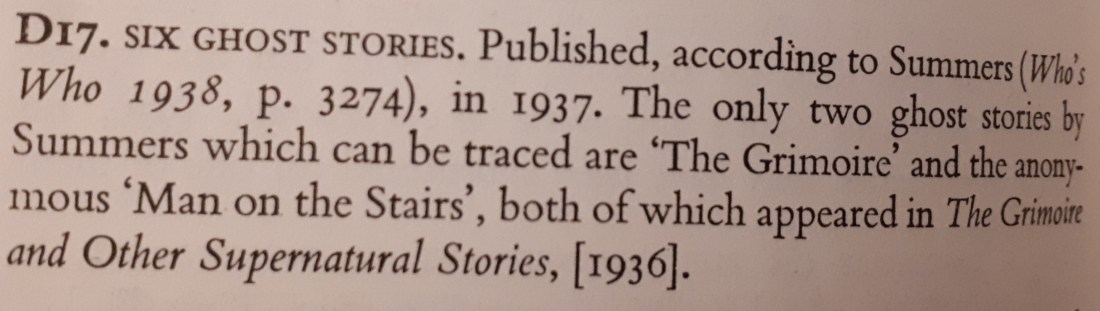
20191130_224224This is the note from Timothy d’Arch Smith’s bibliography of Summers where I first read of these fabled fables.

These six stories lived up to my expectations. They are mostly about people who some acquire some kind of peculiar haunted object that brings about visions and specters. The obvious comparison to make is to M.R. James, who apparently had the chance to read and commend these tales. Incidentally, Montague Summers, the man, has always reminded me of the characters in James’s tales.

The writing in here isn’t what you might expect if you have only read Summers’ books on witchcraft. There’s some very long sentences, but Monty seems self-aware when he’s being verbose, and this comes across as charming rather than tedious. My biggest criticism is probably that the tone of some of these stories remains too light-hearted for too long. Everything will be going fine and dandy for all of the characters, and then a ghost will jump out and scare a person to death right at the very end of the story.

My favourite tale in here was The Grimoire. This one has been previously published in different texts, and it’s not hard to see why it was chosen above the others. It’s the story of a bibliophile whose local dealer procures him an aged book of sinister black magic. When the collector translates a passage from this heinous tome, scary things start happening. (I can’t help but wonder if Sam Raimi read this tale before writing Evil Dead.) This one was particularly cool because it feels like Summers, an expert on books about black magic, could be the narrator.

While not all terribly original, these stories are competent, fun and generally pretty satisfying. I read one each night after my family had gone to bed, sipping a cup of peppermint tea and hearing the cold November breeze blowing through the willow trees our garden. It was great. I suggest you enjoy these tales in a similar manner.

These stories are entertaining in and of themselves, but there’s something very exciting about reading a collection of tales that were believed to be lost for more than half a century. Summers’ old manuscripts went missing shortly after he died in 1948, and they were only unearthed a few years ago. Snuggly Books put out this collection in October (I think this is the only book from 2019 that I’ll have reviewed in 2019.), and they are planning to put out a second volume of Summers’ fiction early next year. This collection will include a novella titled The Bride of Christ. Sign me up!

The Devil on Lammas Night – Susan Howatch

susan howatch the devil on lammas night.jpgThe Devil on Lammas Night -Susan Howatch
Ace Star -1970

A millionaire’s wife and his daughter, Nicola, are seduced by Tristan Poole, the charismatic and mysterious leader of “The Society for the Propagation of Nature Foods”. This society is actually a Satanic cult posing as a harmless group of new-agers, and Poole’s motives for seducing Nicola and her step-mom are less than gentlemanly. Oh, and to complicate matters further, Poole is living in Nicola’s ex-boyfriend’s house.

Things play out pretty much as you would expect.

This is primarily a romance novel. The Satanic antagonist’s main motivation is money, and while there is plenty of black magic in here, the story could still work if this element was switched with something else. That being said, I quite enjoyed the little bits of occultism sprinkled throughout. Howatch seems to have done her homework; the rituals here are documented, and the demons listed are all of the Solomnic tradition. There’s a part where a character shies away from explicitly describing the Osculum Infame and another bit where the author claims that the Satanist performed “unprintable” acts to his communion Eucharist. I knew that witches are supposed to kiss the devil’s shitterhole before reading this book, so I was able to fill in the blanks to the first omission by myself, but I can’t remember what unprintable acts are supposed to be performed on a Satanic Eucharist. Does the celebrant cum on them or rub them against his bumhole or something?

I’m not going to rush out to read Susan Howatch’s other books, but this one was fine.

Hell-O-Ween and The Manse

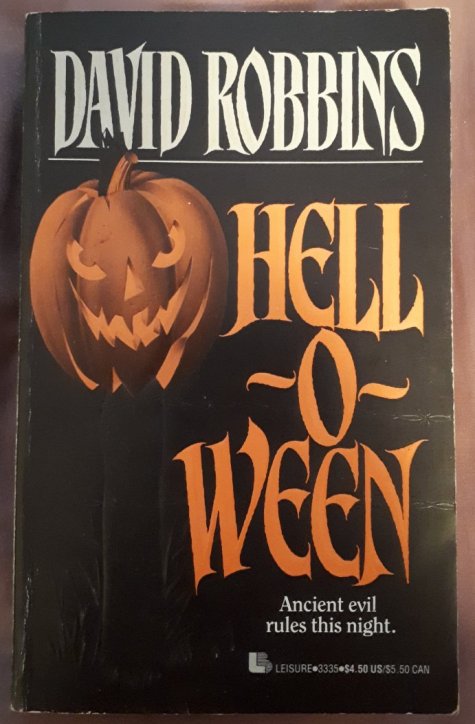
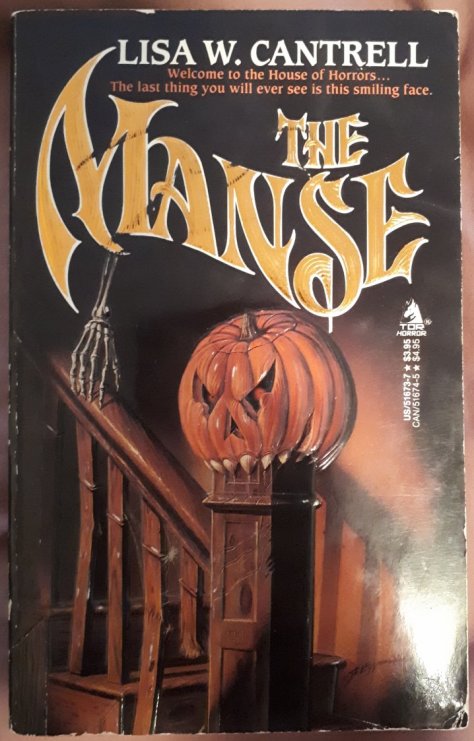
hell-o-ween the manse halloweenHappy Halloween. To celebrate my favourite holiday, I’m reviewing two Halloween horror novels that have pumpkins on their covers.

david robbins hell-o-weenHell-O-Ween – David Robbins
Leisure Books – 1992

Hell-O-Ween is a remarkably awful book. It starts off with the line; “Yo dweeb, are you ready to go monster hunting?”, and what follows is pretty much what you’d expect. This is an overwritten Goosebumps book with a little violence and a few (gross) mentions of sex thrown in. The following sentence appears n page 23: “She’d neck heavy and let a guy play finger tag with her box, but she refused to go all the way.” This isn’t a line of dialogue either; it’s the narrator’s voice. Finger tag with her box? Jesus.

Hell-O-ween is the story of a nerd, two sluts, 3 jocks (2 bad and 1 good), a geeky girl and a beautiful virgin. These painfully stock characters decide to explore a system of caves on Halloween night. There is a huge picture of an angry demon right at the entrance to the cave, and the astute reader will figure out exactly how the story is going to end after about 10 pages.

Very little happens in here that you wouldn’t expect. Perhaps the most interesting part was a lengthy passage in which one of the jock characters admits to his friend that he started selling cocaine in defiance of his liberal father. I’m sure the author was making a point here, but I can’t figure out what it was. Was it that liberals are irresponsible and can’t raise kids, or was it that non-liberals are piece-of-shit drug dealers? I sincerely don’t know.

This was a gruelling read that I regretted starting almost immediately. Do yourself a favour and give this one a miss.

the manse lisa wThe Manse – Lisa W. Cantrell
TOR – 1987

The Manse won a Stoker award for best 1st novel in 1987. Kathe Koja’s excellent The Cipher won this same award a few years later, so I was expecting a fairly high standard from this book.

I was disappointed, terribly disappointed. This is shockingly dull garbage. It’s the painfully boring story of a haunted house that becomes extra haunted on Halloween night. Actually, Will Errickson reviewed The Manse years ago, and said all of the things I feel like saying about this book. Read his review if you’re still interested. I don’t need to say anything more. Cantrell wrote a sequel, but I’m not going to waste my time on it. The Manse was a shitty, shitty pile of trash. It was poo in a baby’s diaper. Stay away!


Both of the books I reviewed for this post absolutely sucked. Actually, pretty much all of the books I reviewed this month absolutely sucked. This week marks a milestone for this blog, and I have a bit of an announcement about that.

For the last year, I have published (at least) one post per week. I have read some great books in the process, but I have also forced myself to read some utter crap to maintain the steady stream of reviews. After some consideration, I have decided that continuing at this pace isn’t really beneficial to me or to this blog. Look at some of the shit I’ve reviewed in the last year.


Sensible adults don’t read books like these.

Nobody cares about this nonsense, especially me. With this in mind, I want to let you know that I am going to cut back on posts for the next while. I’m going to be focusing on quality rather than quantity for a bit. This probably means 2 posts a month rather than the 5 you’ve been getting for the last year, but at least the newer posts will more than just “This book is pooey farty bumbum.” I want this blog to be something that I enjoy doing rather than something I feel obliged to do.

Have a safe and happy Halloween. Check out my previous Halloween posts while you’re here.

The Splatterpunks Anthologies: Extreme Horror and Over the Edge

splatterpunks extreme horror over the edge sammon.jpg
Splatterpunks: Extreme Horror – Paul M. Sammon (Ed.)
Xanadu – 1990

The first Splatterpunks anthology was published in 1990. It’s a collection of extremely violent stories, most of which had previously been published elsewhere. Some of the stories are quite enjoyable and some are fairly shit. The most remarkable feature of this collection is the editor’s attempt to delineate Splatterpunk as a separate entity from regular horror fiction.

Every review I have read of this collection has commented on the fact that most of the authors included herein reject the splatterpunk label. Sammon himself acknowledges this fact several times throughout his introductory notes. Let’s face it. Splatterpunk was never a revolutionary literary movement; it was a label created by David Schow to describe a small group of his writer friends who were writing gory stories. The authors in this anthology repeatedly refuse the splatterpunk label because it’s too limiting, and they feel that it would only apply to a small portion of their output. If we’re calling writers Splatterpunks because they’ve written a couple of gross-out stories, surely Stephen King fits the bill too. His story Survivor Type is easily as extreme as most of the stuff in this anthology. (My point is not that King should be included here; it’s that the editor’s posturing is ridiculous. In the next anthology he goes on to claim that Bret Easton Ellis, a writer who is parodied in this collection, is actually a Splatterpunk too.)

The book includes a lengthy epilogue that I was unable to finish. Paul Sammon’s attempts to make Splatterpunk seem like a really important cultural phenomenon were genuinely embarrassing to read. I was going to include a quote from the introduction here, but after rereading the first few lines of it, I found myself cringing too hard to continue. He literally compares his authors to Burroughs, De Sade and Baudelaire in the second sentence of this book. Some stories in here were decent, but I had forgotten most of them only two weeks after finishing the collection.

 
Splatterpunks: Over the Edge – Paul M. Sammon (Ed.)
Tor – 1995

The second Splatterpunks collection came out 5 years later, and this book is far, far worse than its predecessor. Actually, I really liked some of the stories in here, but there’s way more in this one, and some of them are absolute shit.

The really dislikeable part of this one wasn’t the awful stories or even Paul Sammon’s embarrassing introductions; it was the non-fiction pieces. Aside from Sammon’s bullshit, the only non-fiction piece in the first collection was an essay on ultra violent films. I watched most of the movies it mentions when I was a teenager, so I actually quite enjoyed reading this piece. Although it was about movies, it didn’t feel hugely out of place in a collection of ultra-violent stories. There’s an article in Spatterpunks II by Martin Amis on the movies of Brian De Palma. Martin Amis is not a horror author, and while De Palma has done a few horror films, those aren’t the movies being discussed in the essay. Sure, some of De Palma’s movies are violent, but they don’t compare to the other stuff in these collections. There is absolutely no reason for this essay to be in this collection other than having a famous author’s name on its cover. Fuck off Martin Amis.

There’s also an interview in here with Anton LaVey, the founder of the Church of Satan. My favourite pastime is reading about Satanic occult orders, but I skipped this section after about 2 pages. It was excruciating. Not only does LaVey come across as an embarrassing dildo, but the interview is performed by Jim Goad. Jim Goad, for those of you who don’t know, is just about the edgiest edge-lord in town. He beats women and believes that white people are oppressed. He also published a magazine in the 90s that included pages of rape jokes. When it was first published in this same magazine, the LaVey interview was followed with an interview with David Duke, former Grand Wizard of the Ku Klux Klan. Together, LaVey and Goad are unbearable. Again, this piece has absolutely nothing to do with horror, and can only have been included because Sammon saw it as edgy and in-your-face. (There’s also a particulary embarrassing “rant” from Goad’s wife. I actually felt sorry her after reading it. Total loser.)

And I think this edginess is the big problem with these collections. Times have changed in the last 30 years, and being edgy isn’t cool any more. Pushing the boundaries of taste isn’t a difficult task, and today’s teenagers throw about the phrase ‘edgelord’ with derision. These kids have grown up with the internet. By the time was I was finished school, I had seen video footage of executions, extreme S&M and tonnes of stuff that’s worse than the stories in this book. (Can you guys remember rotten.com?)  I don’t think it’s possible to make literary gore as shocking as what kids see on their phones every day. Brutal violence is fine and dandy when it’s used for effect, but it’s rarely interesting when it’s presented as the main attraction.

A lot of this crap is boring and predictable. Think about it:

How can you make a murder more offensive? Hmmmm, make the victim more innocent and vulnerable. Who are the most innocent and vulnerable members of society? Well, women are certainly more vulnerable than men, and there’s plenty of women dying in these books, but children are more vulnerable than women! Oh wait, one of these stories is about a child dying in a car accident. Yeah, but babies are more innocent than children. Sammon’s got you covered fam; one of these stories features a baby being sexually abused. Ok, hang on! Fetuses! Fetuses are even more vulnerable than babies! They’re the most innocent and vulnerable of all! But no author would ever have the balls to write about somebody killing fetuses, would they? Actually, yeah. quite a few of these stories involve people killing fetuses. A lot of Splatterpunk seems to involve this kind of punching down, and as I am no longer 13 years old, I have no interest in this kind of crap. I far prefer gore, brutality and violence when it’s directed at somebody who deserves it.

Also, just to amp up the cringe factor, Paul Sammon filled the last few pages of this book with a list of bands that he likes. I did the same thing with my homework journal when I was 15.

All this being said, there were some great stories in the second collection. Gorman Bechard’s Pig was deadly, and I quite liked the weird ones by Petoud and Koja. There are a few duds in here for sure, but just as it was with the first collection, this book would be far more enjoyable if it was just a collection of stories with no bullshit in between. Give me gore and brutality, but don’t try to make it seem clever when it isn’t.

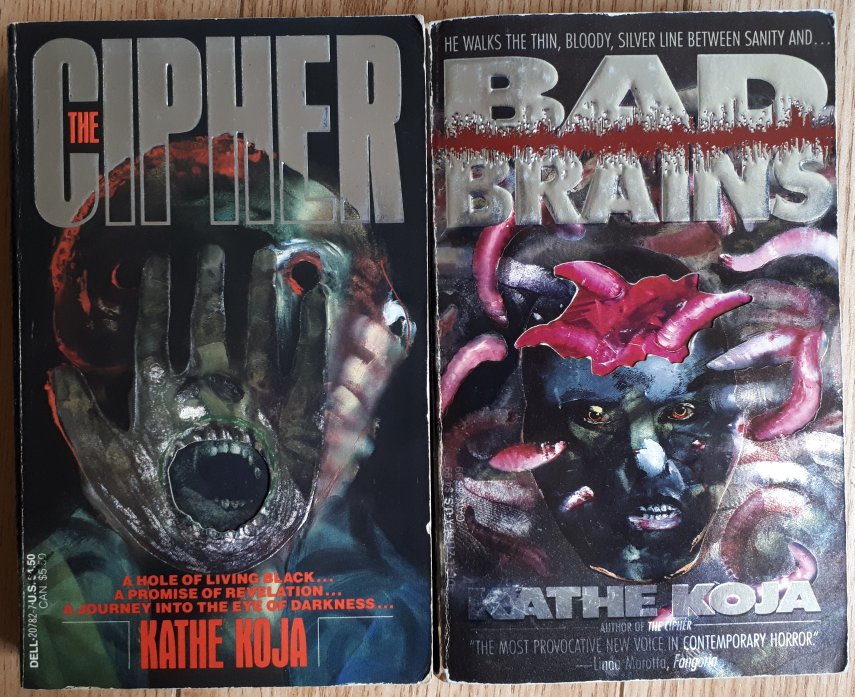
The Cipher and Bad Brains by Kathe Koja

koja cipher bad brains
My offering this week is a couple of books by Kathe Koja. These immediately went on my to-read list after I saw them in Paperbacks From Hell. It took me quite a while to find copies, but they’re so deadly that it only took me a few days to read them.

the cipher kojaThe Cipher
Dell Abyss – 1991
This is the story of a couple who find a weird hole in the corner of an unused maintenance room in their apartment building. The hole is weird because stuff that goes into it comes out quite different. Dead bugs come back to life and mutate. Human body parts that are inserted come out grossly disgfigured. When a video camera is lowered into the hole, the resultant video footage is so disturbing that it radically and permanently affects its viewers’ lives.

No sensible explanation of the hole is ever given, and the narrative is enhanced by this omission. The plot here is quite simple, and atmosphere is what drives this novel. It’s original title was ‘The Funhole’, and while that title definitely makes more sense than ‘The Cipher’, it might have made the book sound far less dark than it is. I don’t know why they went with ‘The Cipher’ though.

Nobody is happy in this book, and everything that happens is uncomfortable. It’s fairly long too, and while I enjoyed it immensely, it won’t be to everyone’s tastes. It’s very 90s, very dark and a little bit arty. If you like Nine Inch Nails’ early records, you’ll love this. (I can’t imagine a movie version of The Cipher that doesn’t end with Head Like a Hole playing over the credits. There were talks of a movie version, but I don’t think it ever happened.)

The Cipher is an original, exciting and disturbing horror novel, truly deserving of its reputation, but it has been out of print for a long time. I managed to find a copy at a thrift store for the price of a cup of coffee, but copies currently go for silly amounts online. Luckily for you, there’s an ebook version available, and Meerkat Press are publishing new hard copies next year. I can wholeheartedly recommend that all horror fans pick up this book; it’s seriously awesome.

kathe koja bad brainsBad Brains
Dell Abyss – 1992

Bad Brains is Koja’s second novel, and it has a lot of similarities with The Cipher. In this one, the protagonist trips over a curb, and smashes his head. The resulting brain damage fucks up his life. This book has nothing to do with everyone’s favourite Rastafarian hardcore punks.

Again, the plot is quite straightforward. It’s the slick, shifting prose and atmosphere that carry this novel. The text is fantastic, but I found the pacing a little uneven with this one. There’s a lot of build up to a very cool, but overly short ending segment. Also, the blurb on the back of the Dell edition gives away the most surprising element of plot, so don’t read it until after you’ve finished.

Bad Brains is certainly a horrible story, but it’s less of a horror story than The Cipher. Weird stuff happens, but the central character is so messed up that it’s impossible to know how much of what’s being described is hallucination and how much is real. The definite supernatural element here, the Dorian Grayesque alterations of the protagonist’s paintings, are background events that occur far away from where the story is unfolding. I reckon that the most frightening element of this book is the way it forces you to contemplate the fragility of the human brain.

If you enjoyed The Cipher, you’ll enjoy this. It’s a lot easier to find too.

impermanent mercies kathe kojaLoving that comic sans action.

I also read by Impermanent Mercies by Koja. It’s a short story featured in the second Splatterpunks anthology about an accident involving a kid’s pet puppy. It’s fairly bizarre. I’m planning a post on the 2 Splatterpunks anthologies for the near future. Stay tuned.

Aside from her books, Kathe Koja is pretty cool. She doesn’t eat meat, and she doesn’t like Donald Trump. I plan to read more of her books in the future.


The Old Ones were, the Old Ones are, and the Old Ones shall be – Lovecraft’s Legacy, Part 4

the book of old ones - scorpio.jpgThe Book of Old Ones – Scorpio
Finbarr – 2002

Truly, there are terrible primal arcana of earth which had better be left unknown and unevoked; dread secrets which have nothing to do with man, and which man may learn only in exchange for peace and sanity; cryptic truths which make the knower evermore an alien among his kind, and cause him to walk alone on earth. Likewise are there dread survivals of things older and more potent than man; things that have blasphemously straggled down through the aeons to ages never meant for them; monstrous entities that have lain sleeping endlessly in incredible crypts and remote caverns, outside the laws of reason and causation, and ready to be waked by such blasphemers as shall know their dark forbidden signs and furtive passwords. – from The Diary of Alonzo Typer

When I read a book on Lovecraftian magic, I want to learn about the aforementioned dark forbidden signs and furtive passwords. Unfortunately, this is never what these books contain. The one I’m reviewing today, Scorpio’s The Book of Old Ones, might well be the silliest of all the Lovecraftian grimoires I’ve read.

Imagine what a grimoire would read like if its author had absolutely zero understanding of magic. It’d probably contain powerful spells that are quick and easy to perform and unfailingly effective regardless of whether the person performing them believes in them or not – ‘say this magic word under your breath, and the girl beside you on the train will become your sex slave’ kinda crap. Take 20 pages of that garbage, add a few Lovecraft references and some stories about pathetic losers trying these rituals and then becoming rich, sexy and succesful, and you’ve got Scorpio’s Book of Old Ones.

Much like The Necronomian Workbook, this book shows little understanding of the total apathy of Lovecraftian entities towards human beings. The Old Ones are bigger and older than us. Their children made us for the sake of their amusement. Cthulhu is not concerned with the affairs of mere mortals. He’s plotting revenge on the elder things that imprisoned him. I doubt he’s interested in watching over you as you go on sea voyage, and I really struggle to imagine him helping you find a girlfriend.

cthulhu love spell.jpg
Seriously?

This book is stupid. The author understands neither magic nor Lovecraft’s mythos, but he has written a book combining them. This Scorpio guy seems like a real moron. Then again, this was published by Finbarr, so I’m not quite surprised.

I have made fun of the authors published by Finbarr Publications quite a few times at this stage, and I had initially planned this week’s post on two grimoires written by another of their authors. After doing a little bit of research though, I discovered that this guy actually has a learning disability and has suffered tremendously with his mental health. I’m not being facetious. I decided against reviewing his books, as he uses his real name, and I don’t want to cause any suffering for a person with serious mental problems. I mention it here only to highlight the remarkably low standard of stuff that this publisher puts out. I didn’t find out much about this Scorpio guy, but he’s clearly an imbecile too.
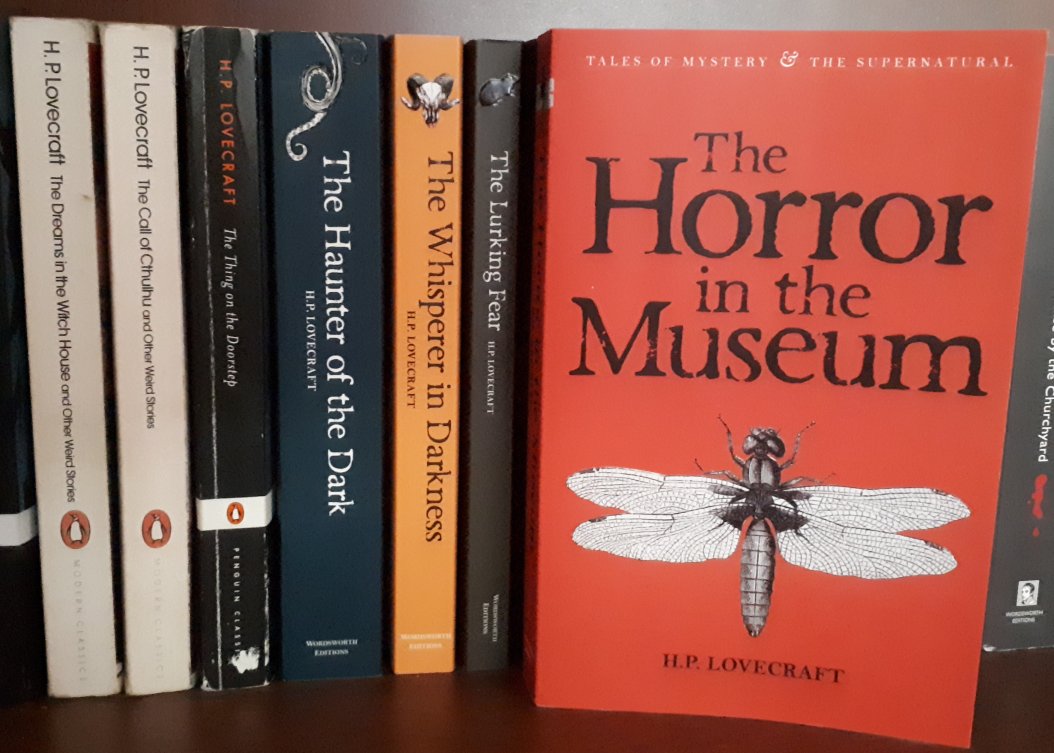
 

lovecraft horror in the museum.jpgH.P. Lovecraft – The Horror in the Museum
Wordsworth
This is the second entry in Wordsworth’s Lovecraft series, and it is comprised of works that Lovecraft worked on with other authors, only one of which I had read before. Most of the stories in the other 3 Wordsworth entries are included in the Penguin editions which I read and reviewed years ago, and after a year of rereading tales I had previously encountered, it was really cool to dive into a fresh batch of unread terror. The quality here is pretty high, and I enjoyed most of the stories in here more the fantasy stuff in Volume 3 and the odds and ends in Volume 4. Picking favourite stories from this collection is quite difficult. The tales in here are really good, and many of them flesh out the Cthulhu mythos – there’s references to Yog-Sothoth and Cthulhu every few pages.

This volume contains the following stories:
The Green Meadow, Poetry and the Gods, The Crawling Chaos, The Horror at Martin’s Beach, Imprisoned with the Pharaohs, Two Black Bottles, The Thing in the Moonlight, The Last Test, The Curse of Yig, The Elecrtic Executioner, The Mound, Medusa’s Coil, The Trap, The Man of Stone, The Horror in the Museum, Winged Death, Out of the Aeons, The Horror in the Burying Ground, Till A’ the Seas, The Disinternment, The Diary of Alonzo Typer, Within the Walls of Eryx and The Night Ocean
(Imprisoned with the Pharaohs appears in the Penguin collections as Under the Pyramids.)

Some of these tales are fairly racist. The word ‘nigger’ is thrown around quite a bit. One of the stories, Medusa’s Coil, is particularly nasty. It’s about a very evil woman. I was quite confused when I finished reading it. In this edition, the last line reads; “It would be too hideous if they knew that the one-time heiress of Riverside… was faintly, subtly, yet to the eyes of genius unmistakenly the scion of Zimbabwe’s most primal grovellers.” I wasn’t entirely sure what to make of this, so I looked up a summary, and it seems as though the editor at Wordsworth actually cut the final line of the story. The original text ends: “No wonder she owned a link with that old witch-woman—for, though in deceitfully slight proportion, Marceline was a negress.” The final revelation of tale is that the anatagonist is a bit black. This is not made very clear in the Wordsworth edition. In 1944, August Derleth anthologised this story and altered the final line to say “though in deceitfully slight proportion, Marceline was a loathsome, bestial thing, and her forebears had come from Africa.” At least Derleth’s version kept the meaning. The redacted Wordsworth edition makes the ending confusing rather than ugly. This is obviously a horribly racist ending to a horribly racist tale, but I’m pretty disgusted that Wordsworth thought it acceptable to censor it. I absolutely hate when publishers do that. If you choose to publish a dead racist’s work, don’t pretend he wasn’t a racist.

So why do I devote so much of my time to reading and reviewing books by and about this horribly bigoted individual? Well, it has a lot do with passages of writing like this:

These scribbled words can never tell of the hideous loneliness (something I did not even wish assuaged, so deeply was it embedded in my heart) which had insinuated itself within me, mumbling of terrible and unknown things stealthily circling nearer. It was not a madness: rather it was a too clear and naked perception of the darkness beyond this frail existence, lit by a momentary sun no more secure than ourselves: a realization of futility that few can experience and ever again touch the life about them: a knowledge that turn as I might, battle as I might with all the remaining power of my spirit, I could neither win an inch of ground from the inimical universe, nor hold for even a moment the life entrusted to me. Fearing death as I did life, burdened with a nameless dread yet unwilling to leave the scenes evoking it, I awaited whatever consummating horror was shifting itself in the immense region beyond the walls of consciousness.

Come on. That is brilliant. This is from The Night Ocean, the last story in the collection. Of all the stories in here, this one is the least explicit in its horrors, but the sense of gloom and despair that pervades the narrative is perfectly effective. Lovecraft may have been a horrible racist, but damn, his work does a damn fine job of expressing the futility of life. Interestingly enough, the author of The Night Ocean (Lovecraft was mainly an editor for this one) was gay. He was also an anthropologist, and was actually one of William Burroughs’ professors at Mexico City University.

There’s another curious little tale in here called Till A’ the Seas that I really liked. It’s about the last human on an Earth that has overheated. It’s set in the distant future, but by now it could believably be set 60-70 years from today. You should definitely read the full story (link above), but if you’re too lazy, just read this:

And now at last the Earth was dead. The final, pitiful survivor had perished. All the teeming billions; the slow aeons; the empires and civilizations of mankind were summed up in this poor twisted form—and how titanically meaningless it all had been! Now indeed had come an end and climax to all the efforts of humanity—how monstrous and incredible a climax in the eyes of those poor complacent fools of the prosperous days! Not ever again would the planet know the thunderous tramping of human millions—or even the crawling of lizards and the buzz of insects, for they, too, had gone. Now was come the reign of sapless branches and endless fields of tough grasses. Earth, like its cold, imperturbable moon, was given over to silence and blackness forever.

God damn, that’s beautiful.

Originally, the second collection of Lovecraft’s work put out by Wordsworth was titled The Loved Dead, but this story was removed from this collection after the people at Wordsworth decided that Lovecraft’s influence on that tale was only minor. Also, Through the Gates of the Silver Key is curiously absent from this collection despite being a collaboration between Lovecraft and E. Hoffmann Price. Through the Gates… is the only story to appear in the Penguin editions of Lovecraft’s work that is missing from the Wordsworth collections. I’m planning a fifth and final post in this series on the few tales by Lovecraft that are missing from this series, so keep an eye out for that in the near future.

Edit: For convenience sake, I’m including the links to all of the posts in this series for anyone who’s interested. (Part 1, Part 2, Part 3, Part 4, Part 5)

J.N. Williamson’s Martin Ruben Series: The Ritual, Premonition and Brotherkind

martin ruben seriesHere’s three books by prolific horror author, J.N. Williamson. I had never read any of his books before reading these, and it is highly unlikely that I will ever read anything else by him again. The description of Brotherkind in Paperbacks from Hell ensured that I was going to track it down and review it here, but after buying it, I discovered that it was part of a series of 3 books: The Ritual, Premonition and Brotherkind. Naturally, I had to read all of them.

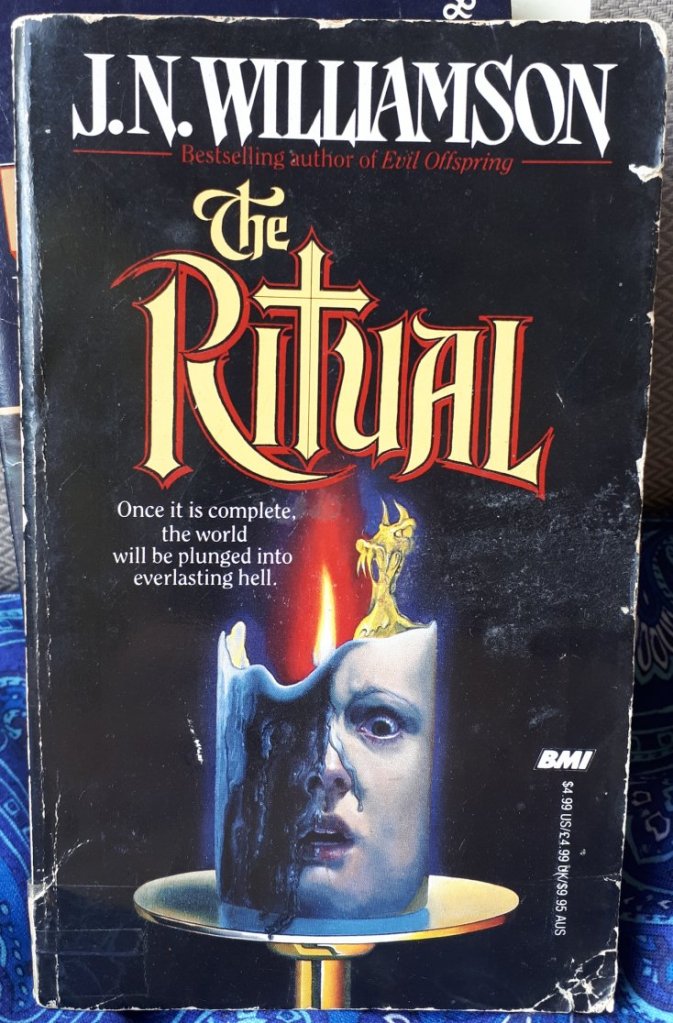
the ritual j. n. williamson
The Ritual – J.N. Williamson
BMI – 1987 (First published 1979)
A young boy turns out to be the Antichrist. His body becomes possessed by the spirits of Napoleon, Hitler Aleister Crowley and Genghis Khan, and he goes on a spree of rape and murder. Other people in his town also go a bit mad and start misbehaving. A local university professor and expert on the occult, Martin Ruben, is called in to deal with this issue. With the help of a priest, a police officer and one of his students, Ruben tries stop the Antichrist. This is just a shit version of The Omen.

If you don’t want spoilers, skip the next paragraph.

This book is really surprisingly shit. Most of the text is taken up with Ruben’s squad attempting to exorcise the kid through hypnosis, but in the end they just kill him. What a damn waste of time!

There’s no suspense, no mystery and no likable characters. This book also contains what might just be the worst line I’ve ever seen in a horror novel: “what Greg was doing had nothing to do with love or marriage and a great deal to do with rape.” Yuck. There are a couple of needlessly brutal rape scenes in here. I guess that’s what you have to resort to when you have no interesting ideas on how to scare people. I was looking forward to finishing this junk after only a few pages.


brotherkind j. n. williamsonBrotherkind – J.N. Williamson
Leisure Books – 1982

In J.N. Williamson’s brief profile at the back of Paperbacks from Hell, both Brotherkind and the Premonition are said to acheive an accident “lunatic grandiosity”, so I was hoping they’d be more fun than The Ritual. They are a little better, but they’re not good books.

The description of Brotherkind in Paperbacks from Hell makes it sound awesome. Bigfoot and a gang of aliens gang rape a woman in the first step of a plot to subjugate mankind, but their plans are eventually foiled by the rock’n’roll music of KISS. I mean, maybe that sounds unsavory to some, but probe my ass, it sounds amazing to me. Read that description again though. It took me a single sentence to give you all of the cool parts of this 283 page novel. Unfortunately, there’s nothing else in here of any worth. This is long, overwritten and surprisingly boring.

The book, while fiction, actually serves to expound Williamson’s sincere theories about the UFO phenomenon. He thinks that UFOs and their pilots are beings made of anti-matter that are actually from Earth. He thinks that they are contacting us to try to help up develop the side of our brains that we don’t use as much. I picked up Brotherkind right after finishing The Dark Gods by Anthony Roberts and Geoff Gilbertson, so my patience for bullshit theories about aliens was already wearing thin. Williamson lays out his ridiculously stupid ideas in great detail. This slows everything down and makes for a tedious reading experience. Between chapters, he includes lists of quotations from crackpots and alien researchers, including himself, and he actually ends the book with a page of quotations from The Eternal Man, one of the sequels to Pauwels and Bergier’s Morning of the Magicians. I’ve had that book on my shelf for many years, but I’ve avoided picking it up because I know how incredibly shit and dumb it will be.

The plot of Brotherkind is ridiculously  trashy, but it could have been awesome if Williamson had acknowledged this and gone with it. Instead, he absolutely ruins the book by trying to make it thought provoking and clever. What a waste.


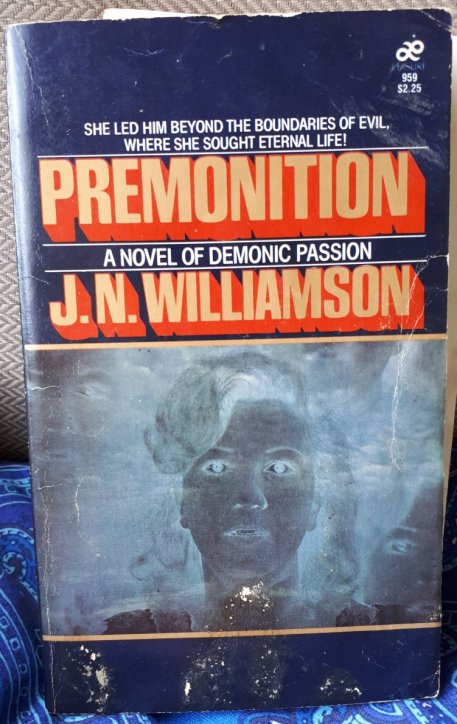
premonition j. n. williamson

Premonition – J.N. Williamson
Leisure Books – 1981

By the time I got around to reading Premonition, I was well and truly sick of this series. I didn’t want to read this at all, and I ended up mostly skimming through large sections of the book. This method actually enhanced my enjoyment of the story greatly, and I reckon that this book and Brotherkind would have greatly benefited if 100 pages had been cut from each. The stories in these two are mental enough to be entertaining, but they get bogged down in boring details. I know publishers used to charge more money for longer books, so maybe these were originally good stories that Williamson ruined for some extra cash.

Brotherkind had a mental storyline, but I reckon Premonition is probably the wackiest of this series.

Ruben goes to work for Solomon Studies in an abandoned amusement park on an isolated island. It turns out that his boss is the reincarnation of King Solomon, and her company is secretly trying to develop a way to prolong life indefinitely. Unfortunately, the island where they have their headquarters is also home to a sex demon that is made of cancer. Also, one of the doctors working there, a former Nazi, has cloned a pterodactyl. Eventually this pterodactyl teams up with a magical hermaphrodite midget to put a stop to the cancer demon. I’m not joking.

Like I said, I flicked through this one pretty rapidly, mainly just skimming for the important points of the plot. There was one passage that jumped out to me though. It’s a scene in which a hospital worker is verbally abusing an elderly patient to prove to Ruben that the old man is in a catatonic state. He shouts, “you’re a useless piece of excrement on life’s shoals, a chunk of fleshy shit caught on the rocks”. I laughed heartily at that, both when I read it and again when I was typing it out. Think about what that would look like. For a shit to be described as ‘fleshy’, it would have to have some girth to it. You wouldn’t use the word fleshy to describe a stringy little turd. It’s the next deductive step that provides the big laughs though: for a shit to be girthy, the person who did it must have had a stretched anus. The hospital worker is telling the man in a vegetative state that he is a big poo from a big bumhole. This made the book worth reading.

premonition williamsonThis is the image from the cover, un-negatived. I wonder who she is.

These books share a central character, but they’re not much of a series. The timeline is all messed up. Aside from Martin Ruben, there is one other character who appears in all three books, but he actually dies in the first one. In terms of publishing, The Ritual came first, then Premonition and then Brotherkind, but the timeline of the actual stories is quite different. Premonition comes first, and then The Ritual and Brotherkind take place at the same time. There’s a single mention in Brotherkind of the stuff that’s happening in The Ritual, but Williamson didn’t have the foresight to include events from the unwritten Brotherkind in The Ritual. The characters must be incredibly talented at compartmentalizing their lives. They simultaneously save the world from the Antichrist while also preventing an invasion of alien rapists, and they do so without letting one event even remotely interfere with the other.

All in all, this series was terrible. There’s some silly ideas in here that could have been entertaining, but these books are boring and unpleasant to read.