Nox Infernus: The Book of Black Amber – A. W. Dray

a.w. dray nox infernusNox Infernus – The Book of Black Amber – A. W. Dray
Dark Harvest Occult Publishers – 2011

Ever wanted to become a vampyric sorcerer but didn’t know where to start? Complete with instructions on self burials, self harm, feeding your shadow and choosing a spooky name, A.W. Dray’s Nox Infernus is the book for you!

Most of this book is about using your imagination to make yourself think you’re a vampire. Part of the central idea here is that if you dream about being a vampire, you will be a vampire. I thought people grew out of thinking like that at about 8 years old, but Dr. Dray claims to be well over one hundred. Hahaha.

Speaking of retarded mental development, A.W. Dray is self admittedly stuck in the anal phase. He prefers bum love over everything else, claiming that “Sexual union between a vampire and servant is best done through anal copulation and with the proper use of the corresponding qlipphottic tunnel energies.” I’m not one to judge people on their sexual proclivities, but Dray’s preference is a peculiar one. It’s not men’s anuses or women’s anuses that he’s after; by his own admission, it is the essence of anus itself. Without the risk of coming across as homophobic then, it can be stated that A.W. Dray is, in fact, an anal intruder. He is a bumbum man.

a.w. drayI likes to frown and my dick is brown.

Now if all A.W. Dray wanted to achieve with this book was getting dumb goth girls to go ass with him, I’d tip my fedora in his direction, but this book contains some far nastier ideas. I know this is supposed to be a book of black magic, but yikes, some of this is quite scary.

At one point, the author suggests making friends with a person who suffers from an addiction of some kind. Prospective vampires are then told to lead that poor individual back and forth to their addiction and to nourish themselves on the ensuing suffering and misery. A.W. Dray, what the hell is wrong with you bro?

Later on, when discussing ways to live on after death, the author suggests transferring the soul of a vampyric sorcerer into the body of an unborn baby. The baby is then to be raised where the vampire lived and exposed to all the conditions of their former life. When you picture the kind of low-life morons who could possibly swallow this nonsense and then seriously consider the results of these idiots heeding this advice, it is difficult to imagine a resulting scenario that does not involve serious child abuse. Bury yourself in a box and cut yourself up to your black heart’s desire, but don’t mess with kids, you delusional fucking creep.

This book is cringeworthy twoddle. Despite being a book of evil black magic, the single biggest influence on the ideas in here is Carlos Castaneda, the father of new-age, dream-voyaging, chakra-ass nonsense. This book reads like the result of a smelly hippy watching Twilight after being dumped by his girlfriend.

Books of Qliphothic Black Magic

thomas karlsson Qabalah, Qliphoth and Goetic MagicQabalah, Qliphoth and Goetic Magic – Thomas Karlsson
Ajna – 2009 (First published 2004)

Before picking this up, I had read an introductory book about Qabalah/Kabbalah/Cabala and encountered the topic in many more general books on the occult, but I had never fully got my head around the concept. Years ago, I heard somebody say that this was a good book on this stuff, and I was hoping that reading it would clear things up.

It didn’t. Honestly lads, this is rubbish.

Qabalah is a complicated way of trying to provide unintelligible answers to impossible questions. It’s based on the naive assumption that the human mind can grasp and comprehend the divine. Human beings, Kabalists and wizards included, are little more than machines that turn food into shit. To believe that they can comprehend the true nature of anything is pathetic. Our brains and mind are structured to ensure the survival of our species, that’s all. Just as a hamster’s mind is incapable of understanding the concept of dramatic irony, neither can the mind of a human being possibly comprehend the emanations of God. The arrogance required for a person to take this stuff seriously must be monumental.

There was a chapter on the nature of evil that I found a bit hard to stomach. There was also a bit on Goetia. Heap of shit if you ask me.
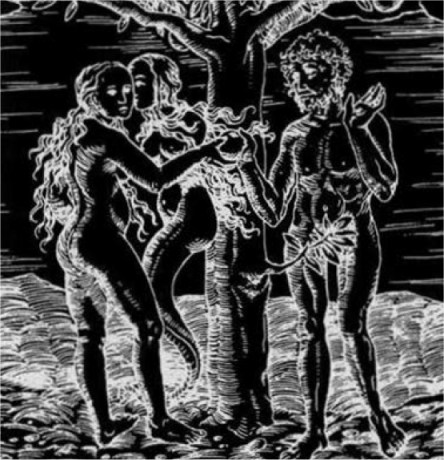
adam eve lilithPart of the appeal of this book was that it was written by a guy who is involved in heavy metal. Thomas Karlsson has been the lyricist for the symphonic metal band Therion for more than 20 years. Therion used to play death metal, but they have since put out some of the worst music that I’ve ever heard. Seriously, watching this makes me feel like doing a poo.

book sitra achraThe Book of Sitra Achra (A Grimoire of the Dragons of the Other Side) – N.A-A. 218
Ixaxaar – 2011
Jesus fucking Christ, this one was another slog. Written by the same individual who wrote Liber Falxifer, The Book of Sitra Achra is “the first complete and completely Qliphothic Grimoire”. What that means, I have no fucking idea.

I consider myself a reasonably intelligent person, but this book was completely over my head. As a sensible explanation of an esoteric order’s set of beliefs, the Book of Sitra Achra is useless, but I suppose it might be enjoyable if you were to approach it as a book of abstract philosophic poetry. There’s lots of dark imagery in here, but none of it makes any bloody sense. The sentences are hilariously long and complicated, occasionally taking up entire pages, and I feel like I understand less about the Qliphoth than I did before reading it. Are they monsters or ghoulies what? Honestly lads, what is this bloody mumbo jumbo!?

You might read other reviews of this book that speak of how incredible it is. Let me tell you something though. There’s a few different editions of this book out there, and they currently go for anything between 1000 and 21,000 dollars. Anyone who spends that kind of money on a book is either going to write a glowing review of it or look and feel like a stupid tit. I feel embarrassed enough admitting I wasted my time reading a pdf of it.

So the lad who writes Therions lyrics wrote Qabalah, Qliphoth and Goetic Magic , and the lad who wrote lyrics for Dissection wrote The Book of Sitra Achra. I like Dissection a whole lot more than I like Therion, but one book was just as bad as the other. Qliphothic black magic is a load of wishy-washy rubbish. The only times these books will ever come in useful is as props for when you’re dressing up as Voldemort for your local cosplay convention.

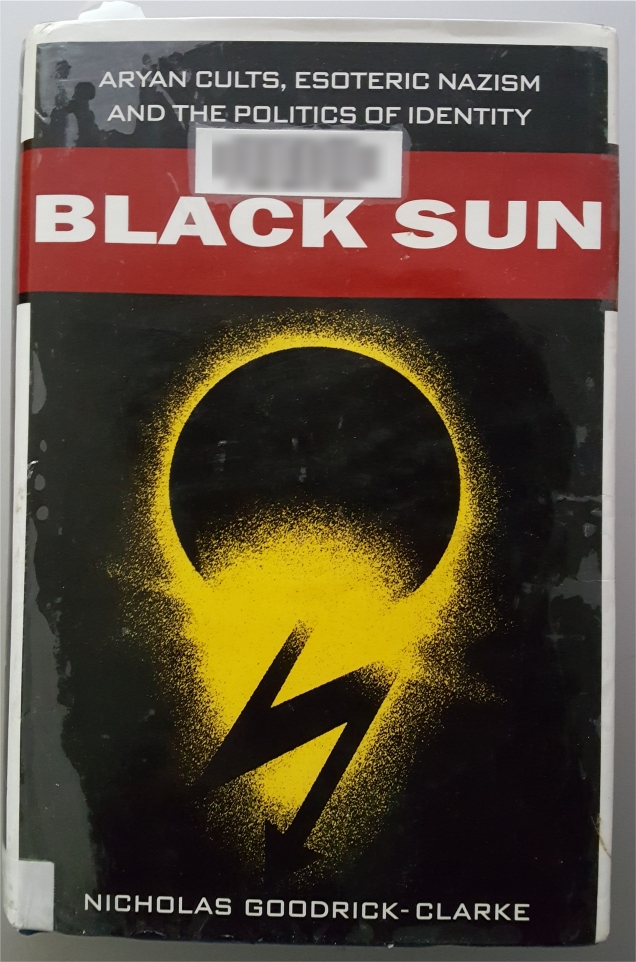
Black Sun – Nicholas Goodrick-Clarke

black sun nicholas goodrick-clarke
Black Sun (Aryan Cults, Esoteric Nazism and the Politics of Identity) – Nicholas Goodrick-Clarke
New York University Press – 2002
Nicholas Goodrick-Clarke’s The Occult Roots of Nazism was one of the first books I reviewed on this blog. It was a good book, but I remember being mildly disappointed with the type of occultism I was encountering in it. I had read stuff on the internet about Satanic Nazis and Hitler’s UFO fleet, but this book was about Theosophy and Runes. The author had written a book about the actual Occult roots of Nazism and confined the silly conspiracies that developed after the war to a short discussion at the end of the book.

Black Sun, published 17 years after The Occult Roots of Nazism, is the same author’s account of the neo-Nazi conspiracies and ideologies that arose after WWII. They are mind-bogglingly insane. Featuring folks who think Hitler was a manifestation of God, groups who think that “the Jews” are an evil alien race that have willfully displaced the real Hebrews (who are actually the Aryans), and more flying saucers than you can shake a stick at, this book is overflowing with insanity.

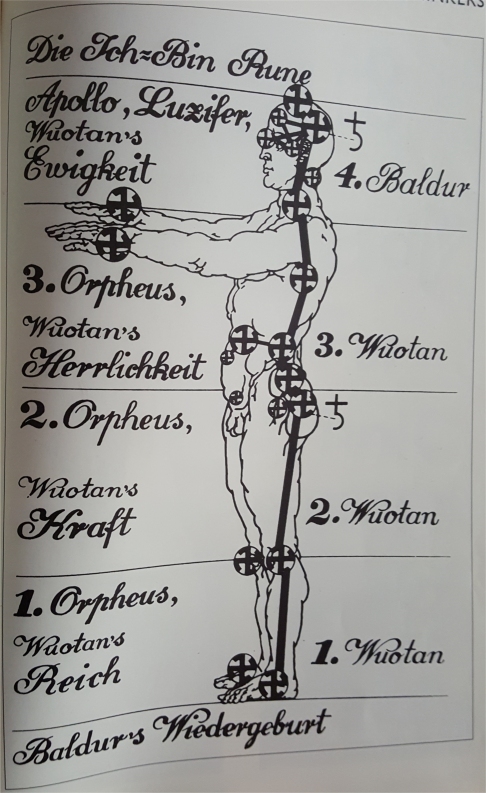
esoteric hitlerism serranoThis dude has Swasti-chakras on his ass.

Unlike many of the books about insane topics that are reviewed on this site, Black Sun is actually a well written and researched piece of work. Goodrick-Clarke explains the theories; he does not espouse them. Another crucial difference between this book and most of the others I review is that the ideas contained in here are not just bizarre; they are vile, hateful and extremely dangerous. While the material is off-the-wall and genuinely fascinating, this book will probably leave you feeling worried and uncomfortable. After a detailed look at various racist organizations and the ways in which these groups rationalize and manifest their hate, the book ends with this chilling sentence:

From the retrospective viewpoint of a potential authoritarian future in 2020 or
2030, these Aryan cults and esoteric Nazism may be documented as early
symptoms of major divisive changes in our present-day Western democracies.

donald trump

I try not to get overly political on this blog, and I know that lots of Trump supporters will probably roll their eyes at this allusion, but here is a video of one of the hate groups described in Black Sun campaigning for Trump’s election. I don’t believe that all Trump supporters are neo-Nazis, but the amount of neo-Nazis that support the current president of the United States should be concerning to everyone. If this book had been written 15 years later, it doubtlessly would have had a chapter on the alt-right and the Cult of Kek.

I’m planning another post that will discuss some of the specific issues that come up in this book, so I’ll leave this post quite short. Black Sun is definitely one of the best non-fiction books I’ve reviewed, and I don’t need to pick it apart like I normally do. I strongly recommend reading it for yourself. I was fascinated to read about the lengths that neo-Nazis have to go through to rationalize their hate. Hating a person because you believe that they’re the descendant of an evil satanic alien is far sillier than hating them because you’re not used to how they look and speak and because you’re afraid that they might take your stuff. If you’re going to be a racist piece of shit, at least be honest with yourself.

Spawn of the Devil (Inpenetrable) – A Quaint and Curious Volume of Forgotten Porn

The most exciting part of Francis King’s Sexuality, Magic and Perversion was doubtlessly a passage towards the end of the book where King is discussing how magic has been portrayed in works of pornography. He points out that most of the occult-themed porn that had appeared at the time that he was writing his book had been written by people who had no real knowledge of occultism. He mentions one exception to the rule, referring to a book titled Inpenetrable (the spelling mistake is neither mine nor King’s), a pornographic novel that features the Order of the Golden Dawn invoking demons, worshipping Satan, and indulging in buggery, rape and psychic murder. According to King, the author of this intriguing text actually seemed to have had a decent amount of occult insight.

francis king on inpenetrable
After reading this passage, I had to find the book it’s describing.

In a footnote, King claims to have traced 3 separate printings of this intriguing book. One printing credits a Joel Harris as the author, one credits an Aristotle Levi, and the last seems to have completely withheld the author’s name. King points out that the text in all three editions was produced by photo-lithography, suggesting that all three derived from a previous edition that he has never seen. He also believes that the texts he had seen were published in 1970 or 1971.

I spent a few days trying track down a copy of Inpenetrable, but I could only find one other reference to it. Ellic Howe briefly alludes to it in the penultimate paragraph of his 1972 book The Magicians of the Golden Dawn. He claims that this peculiar work of pornography had recently been brought to his attention by a friend. Judging by the details Howe gives (or lack thereof) and the year that his book was published (the year after Sexuality, Magic and Perversion), I’d be surprised if Howe’s friend hadn’t been Francis King. Howe provides no extra clues about the origin of this peculiar text.
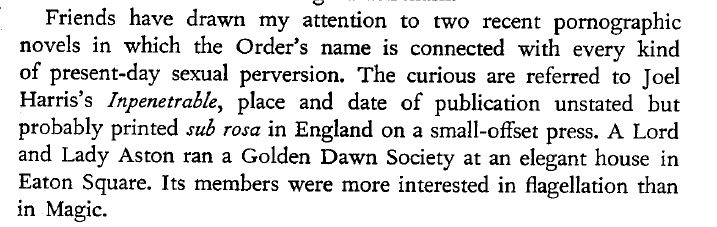
ellic howe inpenetrable
The title of the book, Inpenetrable, didn’t yield any other results, so I decided to search up the name/s of the author. “Joel Harris” led to a dead end, but there are a few, scant mentions of Aristotle Levi online. It seemed as if this guy wrote two other books, Spawn of the Devil and In the Devil’s Power, but there was no other mention of Inpenetrable anywhere. It turns out though, that Spawn of the Devil was translated into Danish and published as I Djævlens Magt, which translates as “In the Devil’s Power” – the two titles were a result of my browser’s automatic translator. There was only one book. Spawn of the Devil (and its translation) came out as part of the Svea Book series, a pornographic series that was published in Denmark in the late 60s and early 70s by a porn company called Nordisk Bladcentral. Some sources credit the work of this Aristotle Levi to a woman named Erica Schoeb, but Erica holds the copyright for all of the books in the Svea series, so it seems likely that she was the series editor or publisher rather than the actual author of any of its texts.

After several hours of searching with these clues, I found an index of science-fiction pornography that gives the following summary of Spawn of the Devil; “Maureen Graille, a seventeenth century witch, is reincarnated in the present.” Bingo! King had mentioned “Maureen Graille, the heroine of the book” in his brief discussion of Inpenetrable. I realised that Spawn of the Devil and Inpenetrable could potentially be two entries in the same series, but judging by the genre I was dealing with, I assumed it more likely that they were just different titles for the same work.

Ok, so I hadn’t been able to find a copy of Inpenetrable, would Spawn of the Devil prove any easier to track down? Like I said, there were very few (maybe 5) mentions of Aristotle Levi or his work online. I don’t want to give away my book-finding techniques to my competitors, but I’ll say that after quite a bit of searching, wrangling, infiltrating strange facebook groups and google-translating, I managed to obtain a single copy of Spawn of the Devil from a dusty, second-hand bookshop somewhere in the Middle-East.

spawn of the devil - aristotle levi
Spawn of the Devil – Aristotle Levi

Svea Book – 1969

Let’s start off with the physical book itself. There’s a few scratches on the cover, but nothing you wouldn’t expect on a book published in 1969. There’s no cover image or blurb on the back. There’s nothing inside other than the story itself – no details on the author or advertisements for other books.

The text is peppered with typos, but the standard of the writing is pretty good. I imagine that the writer probably wrote other, less smutty, books under a different name. In fact, some of the sex scenes in this book seem so sudden and unnecessary that I would be surprised if the author hadn’t originally had loftier aims for this work. This might well have been intended as an occult thriller that was a little too sexy for respectable publishing houses. Maybe after a few refusals, the author took his manuscript to a smut house and was told that instead of being too sexy, the text wasn’t sexy enough. Perhaps he cried into his typewriter as he reedited his manuscript and filled it with “hot cock-sticks”, “quivering quims” and “tight little shitholes” as a last resort to get it published. I’ve read other occult based porn in which the standard procedure was one sex scene per chapter, but this isn’t quite the same. Spawn of the Devil frontloads the smut – once the story gets going, the sex takes a backseat. There’s a few chapters towards the end with barely any riding at all.

And some of the sex scenes are absolutely ludicrous. I’m by no means an expert on literary pornography, and I know that different people get off on different things, but many of the sex acts described in here come across as vulgar and hilarious rather than titillating and sexy. I can’t deny the fact that I greatly enjoy vulgarity though, and I will admit that the following two page description of a disgusting incestuous liaison made me laugh so hard that I cried.
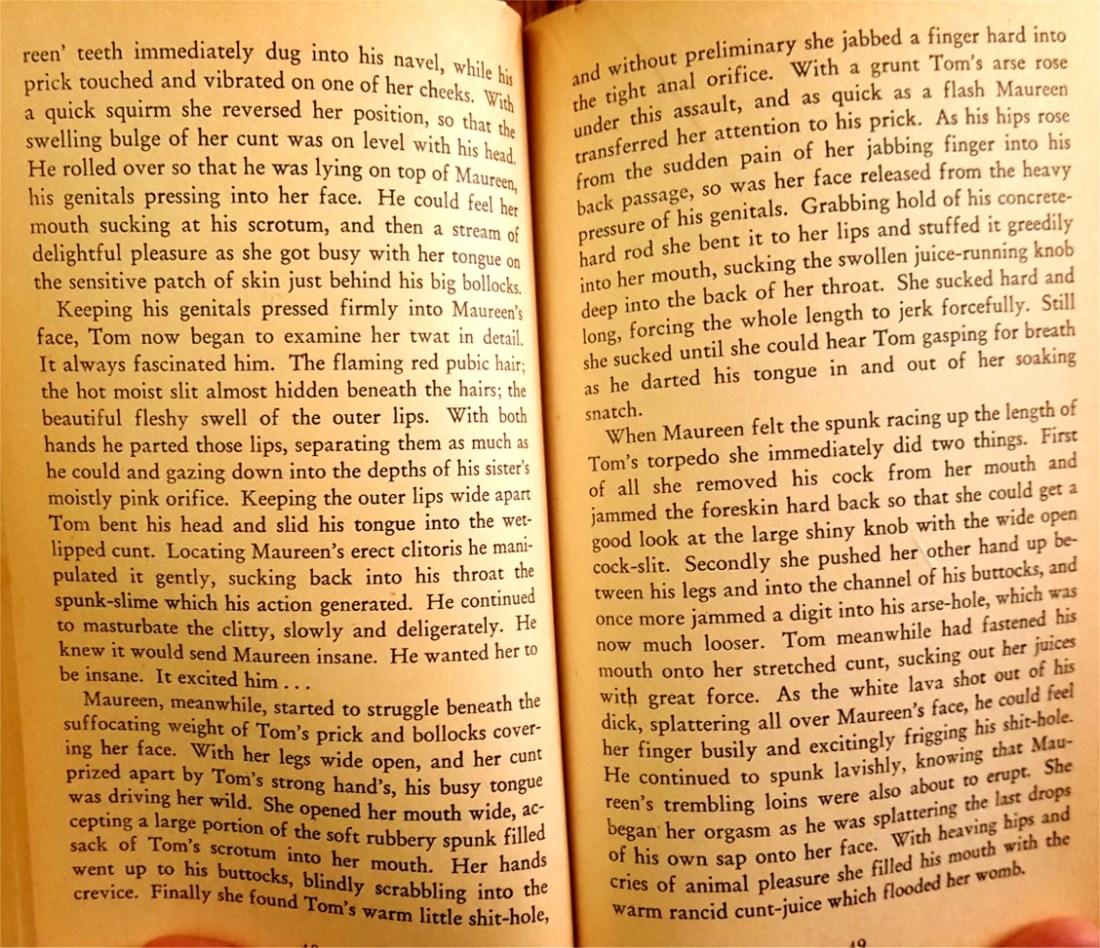
spawn of devil erotica
Please read both pages (higher res image here). It gets better and better. LOL.

Looking back, one of the main reasons I wanted to read this book was Francis King’s assessment of the author as a knowledgeable student of the occult. The occultism herein is largely of the Dennis Wheatley variety, but, like Mr. Wheatley, Mr. Levi clearly has a basic understanding of what he’s greatly exaggerating.

spawn devil inside coverI presume the pseudonym is a mix of the Greek fella and Eliphas Levi.

This book is super rare. If you plan on hunting down a copy, good luck to you. If you’re not pushed, here’s a summary of the story:

The story starts off with Maureen, a witch, observing an orgy in the forest. She isn’t partaking, just watching. When she leaves, she is apprehended by an angry mob of villagers who presume she had just finished up early and was heading home. The mob go on to capture all of the revelers.

All of the revelers are burned at the stake along with Maureen and her husband, Tom. Just before they are set alight, Maureen promises Tom that they will live again.

300 years later, a pair of twins that regularly have been having sex with each other since they were children both feel a sudden urge to go and dig a hole in a certain part of their village. They discover a strange ring. The sister, who is named Maureen, puts it on.

Soon thereafter, Maureen is having lunch in a fancy restaurant. By chance, she meets a lady called Celia Aston. It turns out that Celia is one of the leading members of a magical secret society called the Golden Dawn. She invites Maureen and her brother Tom to her house where she shows them her magical book collection and introduces them to her husband.

Maureen gets it into her head that she wants to be in Celia’s position. To put a curse on Celia, Maureen and Tom perform a gruesome black-magic sex ritual:
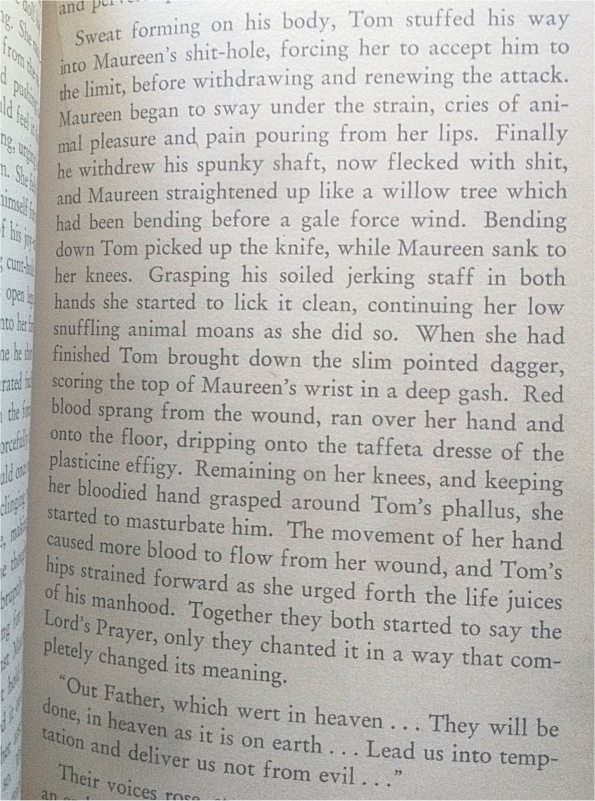
sex ritual curse
Yuck, but also Hahahaha.

The ritual is successful and Celia dies soon thereafter. Using mind control, Maureen convinces Celia’s grieving husband to marry her within a matter of months.

Later on, during a Golden Dawn orgy, Maureen manages to summon a spirit. It’s either Pan or Satan, or maybe both. Only Maureen and a crucified prostitute that Maureen had hired for the occasion actually see the spirit. The prostitute goes insane afterwards. While this is all happening, one of the other members of the Golden Dawn, a lady named Nona, simultaneously gets raped and senses that Maureen is a bad apple.

After this night of black magic and debauchery, Nona and her boyfriend visit a very powerful old witch named Kyleen to see if anything can be done about Maureen. They don’t know it, but Maureen was actually watching them do this by means of black magic.

Maureen summons the spirit of Pan to kill all three of them. She is successful in doing so, but unfortunately for her, Kyleen had been able to do some summoning of her own. Shortly afterwards, Maureen and Tom are killed when their ship sinks during a cruise. Just before they die, Maureen reassures Tom that they will meet again.

The book ends in the future. In the year 2236, a set of twins are born, a boy and a girl.

Spawn of the Devil isn’t the greatest occult-thriller in my collection, but it’s nowhere near the worst. Its combination of black magic and silly synonyms for genitalia pleased me immensely, and I can’t imagine a book more appropriate for this blog. Moreover, the process of reading about it in King’s book, researching it, tracking it down, waiting to see if it would ever actually arrive, and then reading and reviewing it a few months later has been rather exciting. When I started this blog and began reading books by people like Montague Summers, Timothy D’Arch Smith and even Francis King himself, I was jealous of the depths of their research and of the discoveries they had made in the realms of occult literature. It may not seem like a big deal to most people, but I found it immensely satisfying to solve part of a mystery posed by one of these individuals 47 years ago.
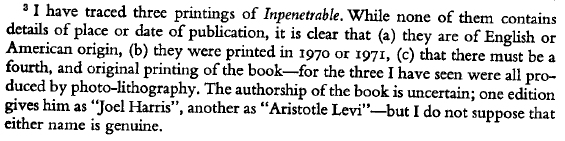
francis king inpenetrable footnote

Inpenetrable was first published by Nordisk Bladcentral as as Spawn of the Devil, a novel by Aristotle Levi. Unfortunately, I can’t claim to know who Aristotle Levi (or Joel Harris) was. My reading suggests that he probably wrote other books (under a different name) in the late 60s/early 70s. He clearly had an interest in the occult. His repeated use of the word bollocks means that he was almost definitely British. This book was published in Copenhagen and translated into Danish, so it is possible that he had some other link to Denmark. Does this description sound familiar to anyone? I wonder if there’s anybody alive today who knows his true identity. If anyone has any further information on Aristotle Levi, Joel Harris, Inpenetrable or Spawn of the Devil, please, please, please, leave a comment or email me to let me know.


Sexuality, Magic and Perversion – Francis King
This post was originally intended for Saint Valentine’s day, but I made some startling discoveries whilst writing it and had to postpone its publication until things were sorted out.

sex magic and perversion francis kingSexuality, Magic and Perversion – Francis King
Citadel Press – 1974 (Originally published 1971)

I hadn’t read anything by King when I bought this book based on its title alone (I’ve since reviewed his Secret Rituals of the O.T.O.), and I was expecting something rather trashy when I made the purchase. This book, however, isn’t very trashy at all. It’s a relatively sensible overview of how sex has been used in magical practice throughout history. It’s pretty good.

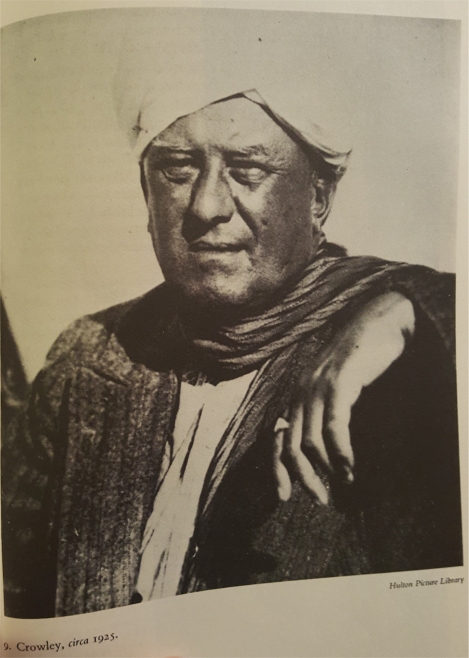
I didn’t follow some of the stuff on tantricism at the beginning, but the chapters on the more modern occultists were very interesting. I’ve seen Charles Leadbeater’s name come up in loads of books that discuss Theosophy, but I didn’t know he was a dirty, boy-touching bastard until I read this one. The stuff on Crowley was entertaining too. Apparently ol’ Aleister liked getting bummed as crowds of his friends watched.
aleister crowley bugger

Sexuality, Magic and Perversion was insightful, well researched and it made me want to read more books. The writing was neither overly academic nor flagrant nonsense. I’m looking forward to reading more of Francis King’s work in the future.

Yes, this post is considerably shorter than my regular output, but don’t be dismayed. I’ve held back on the really interesting discovery that I made whilst reading this book. Said discovery is so exciting that I’m giving it its own separate post. (I’ll post it tomorrow!) If you’re at all interested in Sexuality, Magic and Perversion (the book) and/or sexuality, magic, perversion and the activities these concepts entail, I guarantee, you’ll want to read what’s coming up next.


Robert Anton Wilson, the Last Great Irish Modernist?

James Joyce and Albert Einstein are drinking in a pub together when a panicked man rushes into the bar. Jimmy, Albert and Sir John Babcock, the man claiming that he’s being pursued by a devil, leave the bar and go to Einstein’s apartment where Babcock recounts the mysterious occurrences that have led him to this point. His narrative is interspersed with questions, observations and pontifications from Joyce and Einstein. This is Masks of the Illuminati, Robert Anton Wilson’s 8th novel.

robert anton wilson masks illuminatiMasks of the Illuminati – Robert Anton Wilson
Dell Trade Paperback – 1981

The story is full of ideas that fans of Wilson will be familiar with, and there are references to half the authors that have been featured on this site. Not only do the names and works of writers like Lovecraft, Wilde, Charles Maturin and Philip Jose Farmer pop up throughout, but the story itself directly borrows from and repeatedly references Robert W. Chamber’s King in Yellow, Arthur Machen’s The Great God Pan, and Edward Bulwer Lytton’s Vril. Oh, and Aleister Crowley turns out to be behind most of the plot’s mischief, so a basic understanding of his work, life story and personality is probably necessary for readers of this book. I felt pretty cool reading through and patting myself on the back every time I came across a reference that I recognized.

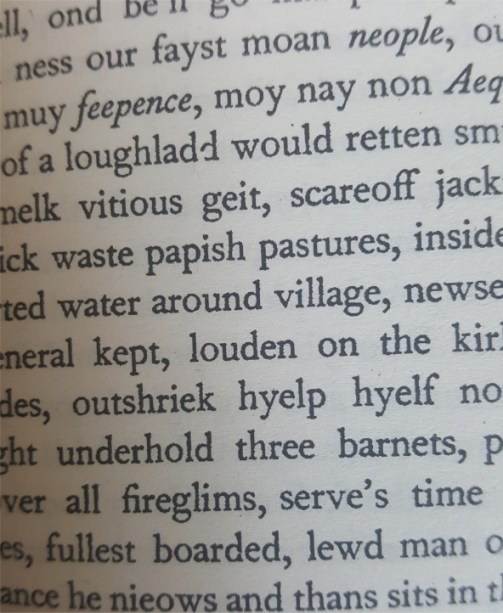
James Joyce is not only one of the main characters in this book; he’s also a huge stylistic influence on the writing. Lots of the people following this blog are probably just here for the Satanism and aliens, and these unfortunates might not have much of a background in Irish modernism, so I’ll just briefly state that James Joyce was a genius writer whose books about life in Dublin city got progressively more mental and complicated as he got older. His final novel, the infamous Finnegan’s Wake, is 600 pages of dense, indecipherable nonsense. (I watched a lecture by RAW on youtube a few years ago in which he described a means of using Finnegan’s Wake as a form of telling the future. Masks of the Illuminati is set pre Ulysses though, so there’s no overt discussion of FW in here.) For most of Masks of the Illuminati, the Joycean influence is mild, and only the sections describing characters’ dreams are truly loopy.

finnegans wake nonsenseI got about 6 pages into Finnegan’s Wake before giving up.
While Joyce is clearly an important influence on the writing of Masks, it’s hard to tell how much of the Joyciness in here is direct Joyciness and how much is Joyciness à la O’Brien. Some might think that Samuel Beckett is the next greatest Irish modernist after Joyce, but for my money, that title goes to Brian O’Nolan, better known as Flann O’Brien. (Beckett worked as a translator for Joyce as he was composing Finnegan’s Wake, and while his own writing was clearly influenced by the avant-garde nature of his master’s, O’Brien’s work is more overtly Dubliny than Beckett’s and so its weirdness is a bit more noticeably Joycean.) While the literary techniques in Joyce’s Ulysses vary from chapter to chapter, At Swim-Two-Birds, O’Brien’s equivalent masterpiece (and crucial companion to Ulysses in my opinion) tells its story through the repeated use of a selection of literary gimmicks.

Nature of gimmicks: various modes of information presentation: notes, poems, lists, etc.

Descriptions of things within the narrative of At Swim are labelled as if they part of a medical or judicial report. In a very similar manner, much of the description of characters and events in Masks of the Illuminati is presented in the form of questions and answers. Several portions of the narrative are also presented in the form of a screenplay. Joyce had done similar things in Ulysses, writing one chapter entirely as question and answers and one as a closet drama, but the way Wilson goes back and forth with these methods throughout the novel instead of keeping them in separate chapters makes his book read more like an O’Brien novel than one of Joyce’s.

That Wilson was a fan of O’Brien is common knowledge. He not only described O’Brien’s The Third Policeman as one of the greatest Irish novels; he also included De Selby, a recurrent character in O’Brien’s work, as a character in some of his own fiction. This recycling of fictional characters is distinctly Flannish; most of the characters in At Swim-Two-Birds are borrowed from other stories due to the narrator/author’s belief that there are already too many characters in the canon of literature.

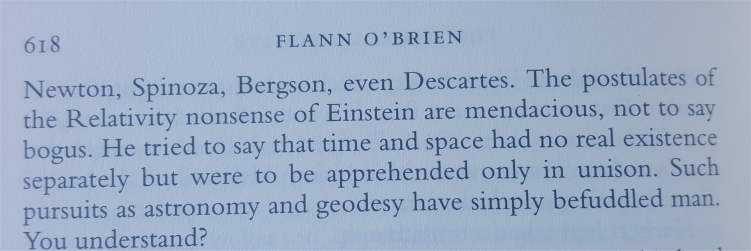
flann o'brien einstein

So the ways in which Wilson tells his story and chooses his characters are undoubtedly similar to those of O’Brien, but it is his choice of characters that most clearly highlights the Flannish influence on Masks of the Illuminati. James Joyce appeared as an important character in O’Brien’s Dalkey Archive 17 years before Masks was published. Dalkey Archive was also heavily influenced by O’Brien’s interest in Einstein’s work (Alana Gillespie wrote a doctoral thesis addressing this influence), and at one point in the narrative, DeSelby (the character to later appear in Wilson’s fiction) directly critiques Einstein’s theory of relativity. Much like the fnords, Flann O’Brien’s influence on Masks of the Illuminati may not be immediately obvious, but it is present on every page.

I find it hard to imagine enjoying the work of either Joyce or O’Brien without having visited Dublin at least once. That might sound obnoxious, but if you’ve read the books, you’ll know what I mean. Soon after Masks of the Illuminati was published, Wilson and his wife moved to Ireland for six years. He later claimed that, “Dublin, to me, is a James Joyce theme park.”

james joyce statue

In a way it’s slightly ironic that Wilson was so inspired by the likes of Joyce. Ulysses, Joyce’s masterpiece, is a mock-epic. It takes the banal, vulgar events of an ordinary day in Dublin city and fits them into the structure of Homer’s Odyssey while simultaneously threading the narrative through every literary technique imaginable. A huge part of the appeal of Joyce’s writing is his ability to see and depict the fantastic in the ordinary. While Joyce wrote about everyday life, Robert Anton Wilson is most famous for his books about absolutely insane conspiracy theories. I love Robert Anton Wilson, but his approach of using bizarre writing techniques to write about bizarre topics is probably responsible for how relatively unpopular his writing is. He was clearly a very intelligent man with a passion for literature, but his fiction (or at least 4 out of the 5 of his novels that I have read) is remarkably inaccessible. The deliberate esotericism doubtlessly prevents squares from reading his books, but it gets nerdy, Irish weirdoes like me hot, bothered and horny for more.

That being said, I didn’t actually like how this book ended. I get that it’s supposed to be a mental book about mental topics, but the last chapter both goes and stays off the rails for a little too long. Showing a Joycean influence is cool, but going full on Finneganean is a bit embarrassing. The last 30 pages or so felt like watching a modern punk singer trying to pull a GG Allin – watching a copycat punch themself in the face and then roll around in their own feces isn’t shocking or transgressive anymore; it’s just a lad making a smelly mess of himself.

Overall though, Masks of the Illuminati is quite an interesting book. My review has focused on its Irish influences, but there’s lots more to the book. I’m sure that twice as much could be written about the Crowleyean influence and content, but I’ll leave that to somebody else. While Robert Anton Wilson was undeniably an American writer, it’s worth pointing that he spent almost one third the amount of time living in Ireland that James Joyce did, and so I can think that Ireland can take at least partial credit for his genius.

masks of the illuminati robert anton wilson

July 23rd is International Robert Anton Wilson day, so if you haven’t read any of his books, today would be a great time to start. If you’re already a fan, you should check out my RAW day post from last year, a review of his first novel, the Sex Magicians. It’s definitely one of the better posts on this blog.

Grimoires: A History of Magic Books – Owen Davies

grimoires owen daviesGrimoires: A History of Magic Books – Owen Davies
Oxford University Press – 2009

Normally, when I review an occult book or a book on occult books, I spend most of the review criticizing the book’s claims and/or the author. Grimoires by Owen Davies is a no bullshit history of magical books, and thankfully, I don’t have much to criticize. This book was clearly very well researched, and it never gets bogged down in speculations on the efficacy of the books its discussing. This is an academic work, but don’t let that scare you. The actual history of grimoires is almost as interesting as the ridiculous back stories that these books so often include.

I’ve read and researched a few of the books discussed in here (The Lesser Key of Solomon, The Grand Grimoire, the Abramelin text, the Faustian Grimoires, the Necronomicon, the Satanic Bible) so some of this was revision for me, but there’s also a tonne of stuff that I had never heard of. I added a few books to my to-read list while reading this.

I thought I’d have way more to say about this one, but I don’t. It’s pretty good though. I’m quite sure I’ll be referencing my copy again in the future. If you want to read a book about the history of books of magic, this is yer only man.

The Peculiar Tale of Jack Parsons

I’ve read several autobiographies, but there are very few people that I find interesting enough to want to read somebody else’s account of their life. In fact, prior to my reading for this post, the only biography I had ever read was Henry M. Pachter’s Paracelcus: Magic into Science, and I only ever read that because I had nothing else at the time. While Paracelsus played an important role in distilling science from magic, the individual that I’ve been researching recently traveled in a very different direction on the same path. Jack Parsons, a man who played a key role in putting men on the moon, was a black magician in his free time, applying the scientific method to his magical rituals.

jack parsons

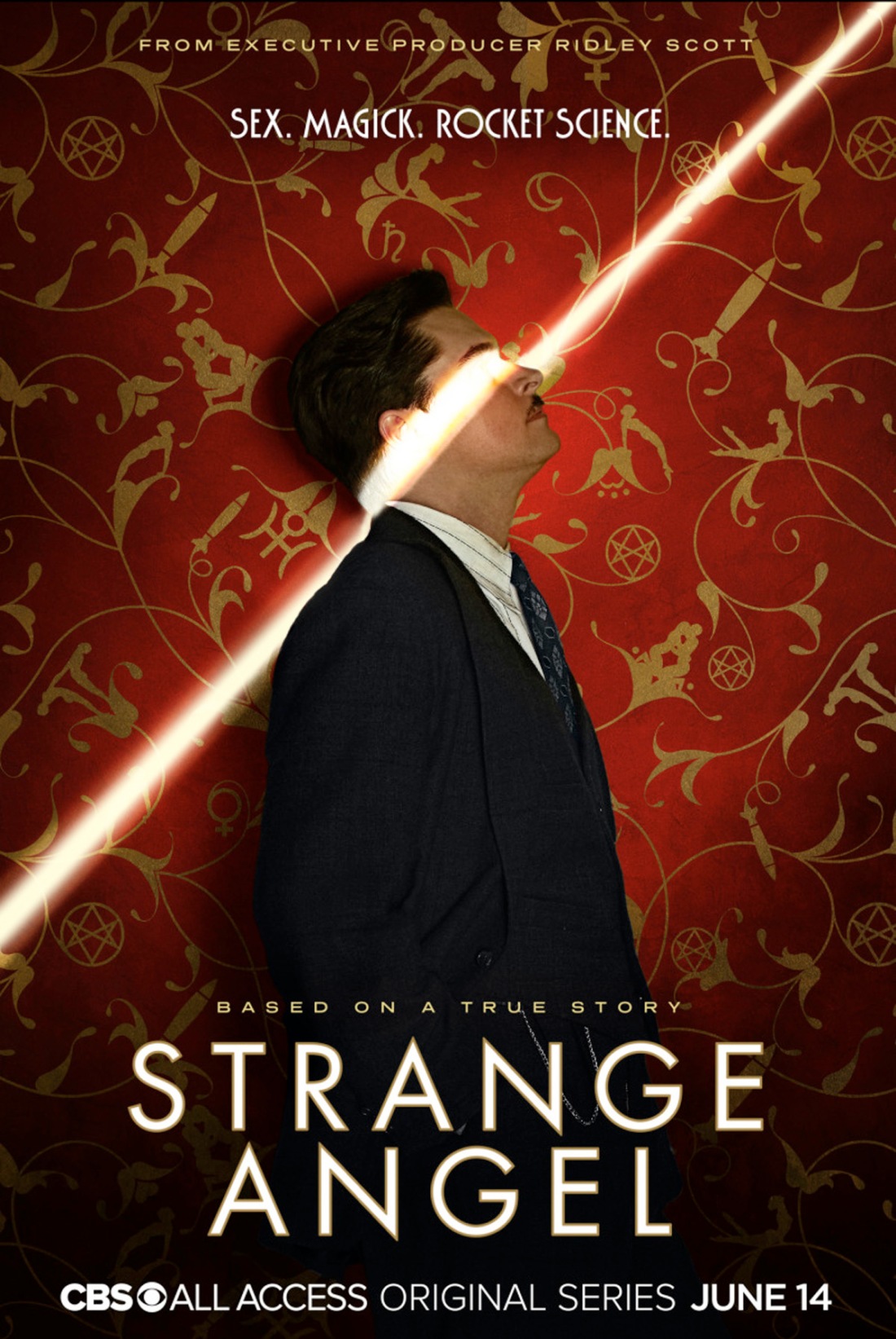
I first heard of Jack Parsons in Sorcerer of the Apocalypse: An Introduction to John Whiteside Parsons in the first Apocalypse Culture book. (Incidentally, Adam Parfrey, the editor of that book and publisher of Sex and Rockets, died recently. RIP.) After that, I encountered Parson’s name in a bunch of places, notably in Disinformation’s Book of Lies and the ramblings of Robert Anton Wilson (who wrote the introduction for Sex and Rockets). In truth, I had been planning to read these two biographies for ages, but the upcoming CBS series based on Parson’s life convinced me to finish them quickly so that I can be a cool guy when it comes out.

I’ve read so many biographical accounts of Parsons recently that I don’t want to create another one. Suffice to say that he was heavily involved in/with rocket science, science fiction, Aleister Crowley, black magic, sex magic and the founder of Scientology. A crater on the dark side of the Moon is named after him, and he died in a mysterious explosion that may have been a murder, an accident, a suicide, or a demonic summoning gone wrong. Jack Parson’s was a pretty cool guy.

sex and rocketsSex and Rockets: The Occult World of Jack Parsons – John Carter
2004 – Feral House

strange angel pendle parsonsStrange Angel: The Otherworldly Life of Rocket Scientist John Whiteside Parsons – George Pendle
2005 – Orion

I read Sex and Rockets first because it was written first. I enjoyed reading it, but it gets a bit bogged down with Thelemic mumbo-jumbo. Honestly, who cares about that rubbish? This book reads like a list of facts about Jack Parsons that were put in chronological order.  This being the second biography that I had ever read, the author’s approach seemed reasonable to me when I was reading it, but this approach makes this book less enjoyable than Strange Angel. Even though it’s mostly the same information being presented in both books, Strange Angel feels more like a novel. It begins with the climax and then goes back in time, and there’s more focus on the atmosphere and storytelling. It does not surprise me that the new TV show is based on this one. I’m glad that I read both, but I would definitely recommend Strange Angel to anyone who only has the time and/or interest to read one.

parsons black boxI wonder what’s inside!

The one notable piece of information in Sex and Rockets that’s not included in Strange Angel is the suggestion that Jack Parsons had sex with with his mother and his dog. There was a black box, covered in magical symbols, found in the apartment Jack died in. Carter notes that, “The odd box was found to contain home movies of Parsons and mother having sex, not only with each other, but also with Ruth’s “big dog.” According to reports from Pasadena police, passed down to their friend Harold Chambers, we now have circumstantial evidence that John Parsons indeed fulfilled his goal to “exteriorize [his] Oedipus complex.”
Parsons was a creep. He got off on incest (he had a long affair with his first wife’s little sister), and he seemed to like being cuckolded. Riding his ma and his dog is a bit much though. I’d have difficulty liking a person who’d do that. It’s hard to find any more evidence on this though, so I’m going to assume he didn’t.

The most important magical project of Jack’s life was the Babalon working. This involved him and L. Rob Hubbard, founder of Scientology and all-round piece of shit, going into the desert and jerking each other off with the aim of summoning the Whore of Babalon (a deliberate misspelling of Babylon) to bring about the apocalypse. After finishing the lengthy ritual in 1946, Jack believed that he and Hubbard had achieved their aim. Pendle notes that “He [Parsons] believed that Babalon, in the manner of the Immaculate Conception, was due to be born to a woman somewhere on earth in nine months time.” If Jack was right, this means that the Whore of Babalon would have been born in 1947. Think of the most powerful women in the world and then guess which one was born in 1947. That’s right, good ol’ Hillary!

Obviously, I don’t believe that Hillary Clinton is the Whore of Babylon, but it turns out that I’m not the only one to have noticed the coincidence. There’s already several loopy videos and blogposts claiming that she is the Moonchild of Jack Parsons.

Strange AngelAn Irish actor is playing Parsons too. I’ll definitely be watching.

Parsons was friends with some of the most important science fiction writers of the early 20th century, and he both inspired and was inspired by several of the characters in their works. Sci-fi is slightly outside of this blog’s jurisdiction, but I think I’ll make an exception and do a second post on Parsons about these works. Stay tuned.

H.P. Lovecraft and the Black Magickal Tradition – John L. Steadman
h.p. lovecraft black magickal tradition - john lH.P. Lovecraft and the Black Magickal Tradition – John L. Steadman
Weiser – 2015

H.P. Lovecraft was a horror writer who did not believe in the supernatural. Despite his clear declarations of the contrary, some people believe that Lovecraft’s horrors were real. This book examines both the beliefs of those people and the beliefs of other occultists that have some similarities to the ideas in Lovecraft’s fiction.

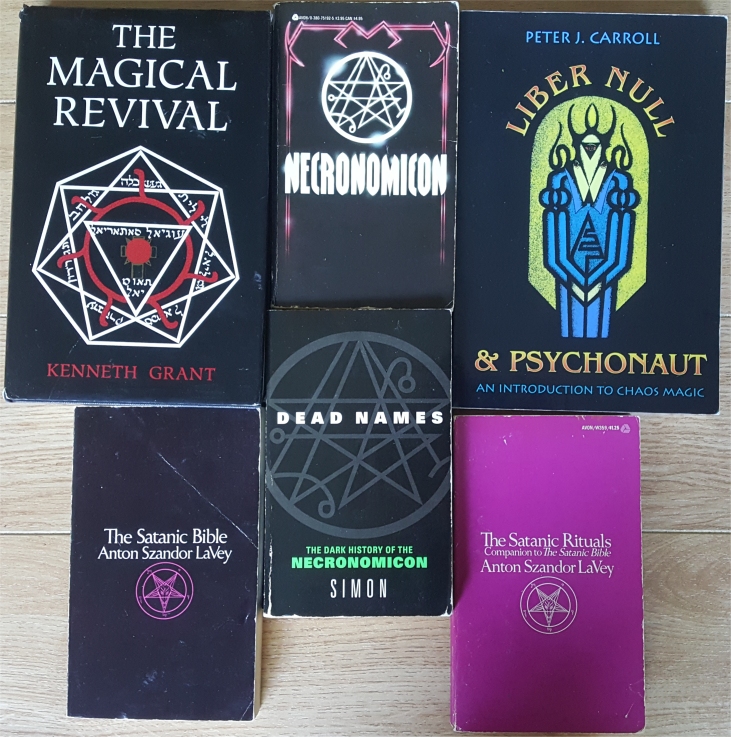
Let’s start with the first group, the nutjobs that believed that Lovecraft was psychic. Both Simon and Kenneth Grant believed that Lovecraft had channeled his horrors from another dimension. I’ve talked plenty of shit about those lads before, so let’s just say that Grant was mental and full of crap, and “Simon” is a con-artist. Steadman, the author of this book, spends paragraphs defending the legitimacy of the Simon Necronomicon, but in a note at the end of the book he concedes that Simon might just be Peter Levenda. Also, Steadman, while discussing Simon’s work, refers to Michael Baigent as “a reputable scholar”. When I was reviewing Dead Names, the book in which Simon referenced Baigent, I called him out for referencing a bullshit artist. Dead Names might best be described as a work of pseudo-non-fiction though, so a reference to a bullshit artist doesn’t really make it any less enjoyable. Steadman’s book, however, is presented as an academic work. How could any person hoping to be taken seriously refer to the author of Holy Blood, Holy Grail as “a reputable scholar”? Come on.

lovecraftian occultistsThe authors of these occult texts were clearly influenced by Lovecraft. It’s a pity they’re all garbage.

There are also chapters in here on Chaos Magicians and LaVey’s Church of Satan. Like Simon and Grant, these lads deliberately brought Lovecraftian elements into their belief systems, and although I wasn’t hugely interested in the precise ways in which they did so (I’ve already read lots of the original literature being summarized here.), I can’t complain about their inclusion in this book.  This stuff on the Lovecraftian occultists was fine. The chapters on Wicca and voodoo were not.

Wicca and voodoo have nothing to do with Lovecraft, but Steadman spends chapters trying to show how these belief systems are similar to some of Lovecraft’s ideas. There is no reason to believe, nor has anyone ever suggested, that Lovecraft was responsible for the foundation of Wicca or Voodoo, and I thought that the purpose of these chapters was to show how Lovecraft’s ideas resembled parts of these foreign belief systems in an attempt to suggest that he was psychically in tune with their practitioners and/or spirits. However, in the conclusion to the book, Steadman claims, “I have shown that Lovecraft has had an indirect, though clearly definable, influence on current Vodou and Wiccan practices.” That’s not what I got out of what he has written at all. In saying that, I have to admit that I found it extremely difficult to pay attention to these boring, lame chapters.

Steadman goes into quite a lot of detail on the beliefs and practices of wiccans, voodoo practitioners, members of the Typhonian O.T.O., and Satanists. I’m so sick of reading this kind of rubbish that I found myself skimming large passages of it. I suppose it’s my fault for choosing to read another book on the occult.

lovecraft collectionsI’ve been meaning to go back over Lovecraft’s own work for a while. It has been about 10 years since I last read some of these stories. I’m going to use the Wordsworth editions next.
H.P. Lovecraft and the Black Magickal Tradition is not a good book; it’s actually quite unpleasant to read. It’s the literary equivalent of Nickelback writing an album about a Morbid Angel song. The academic presentation combined with the author’s willful naivety is infuriating. There was a part in here where Steadman tries to make it seem that it’s common knowledge that the Knights Templar were Satanists. If he’s trying to get away with rubbish like that, who knows what other falsehoods he has slipped in here. I’d be a bit meaner, but this book is only a few years old and the author has an internet presence, so he might see this review. John L. Steadman, if you’re reading this, I’m sorry, but your book is handicapped.


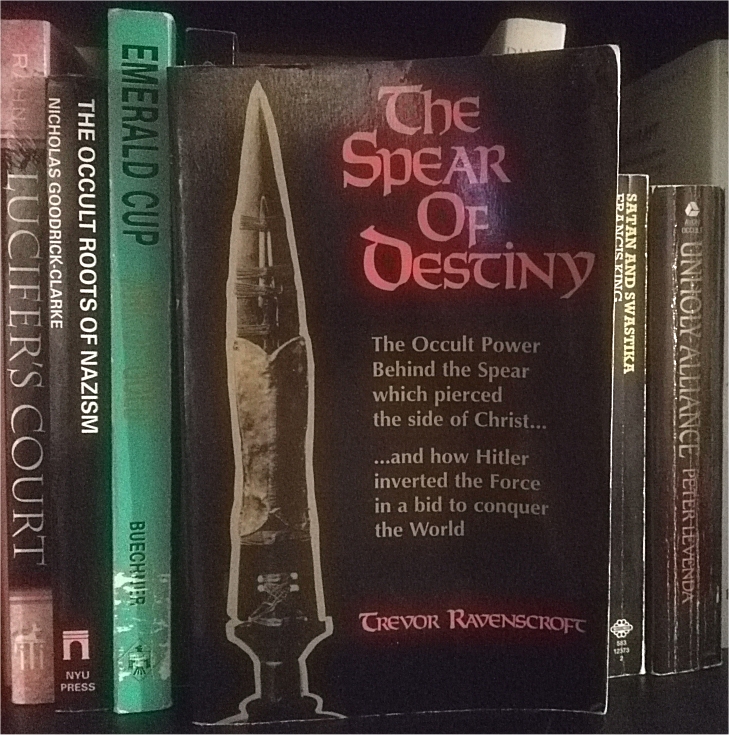
The Spear of Destiny – Trevor Ravenscroft
spear of destiny ravenscroftThe Spear of Destiny – Trevor Ravenscroft
Weiser Books – 1997 (First published 1973)

I’m going to have to summarize this one before I comment about it.

In the late 50s, the author of this book, Trevor Ravenscroft, met a lad, Walter Johannes Stein, who had spent years researching the Holy Grail and the Spear of Destiny. Stein was going to write a book about the stuff he had learned, but he was dying, so he gave all of his information to Ravenscroft so that he could write the book instead. The Spear of Destiny, or the Spear of Longinus, is the spear that pierced Christ’s side when he was on the cross.

One morning, when he was a young man, Stein woke up and started reciting entire paragraphs of Wolfram von Eschenbach’s Parzival, one of the seminal Holy Grail texts. Fascinated by his strange new ability, he decided to buy a copy of Parzival, presumably to compare with the passages he was reciting. Well, the copy he bought had some interesting notes in it. He tracked down its previous owner through his bookseller. The previous owner was Hitler. Hitler and Stein became friends (kinda). Together, they went to a museum in Austria to see a spearhead that some had claimed was from the Spear of Longinus.

When they were standing in front of the spearhead, Hitler started to glow and Stein realised that his friend was being possessed by Satan.

You see, Hitler was interested in the grail and spear because he thought they could provide him with access to the Akashic records. The Akashic records, for those of you who don’t know, are the imaginary library of memories of every human experience ever experienced by anyone. Hitler wanted access to these records for the purposes of gaining power, but he didn’t want to spend a lifetime of meditation to get there so he took a bunch of hallucinogenics in a black magic ritual to speed up the process. Unfortunately, while tripping on peyote, Hitler became possessed by the Devil. The Devil is actually one of the negative powers that came into being after some of the species that lived on the lost city of Atlantis evolved from stretchy mutants into Aryans.

Oh, and Heinrich Himmler was a zombie.

Ok, so Ravenscroft goes into a lot more detail than that, and I’ve left out all of the stuff about psychic time-travellers, but the above is a pretty fair summary of this book.

There are many, many issues that a student of history might take with Ravenscroft’s account, but there are two facts that are especially worth considering.

  1. The Hofburg Spear, the actual, physical spear that the events in book revolve around, is definitely not the Spear of Longinus.

The Hofburg Spear is of medival origin. It didn’t exist until hundreds of years after the death of Christ. This single fact obliterates nearly all of Ravenscroft’s claims.

  1. Ravenscroft never actually met Walter Johannes Stein, the supposed source for nearly all of his information.

Ravenscroft starts his book off telling his reader that Walter Johannes Stein, his good friend, deserves most of the credit for writing this book. The first chapter of this book describes, in detail, the pair’s first meeting. A few years after this book was published, Ravenscroft admitted that he never met Stein in person. He said that he had only ever been able to talk to his spirit through a medium.

When you take away the subject and the source, there’s really nothing left. It’s hard to find a footing for any meaningful criticism of this book. It’s too stupid a book to bother pointing out where it’s factually inaccurate. Ravenscroft is clearly attempting to be a part of the fantastic realism movement started by Pauwels and Bergier, but his book is one step stupider than the stuff they put out. While they encouraged speculation, Ravenscroft just tells lies. In Arktos, Joscelyn Godwin describes The Spear of Destiny as “the ultimate degradation” of the Frenchmen’s work and “blood-curdling work of historical reinvention”. A fair assessment.

Some have claimed that this book was originally meant to be a novel but that Ravenscroft’s publisher convinced him to write it as non-fiction so that it would sell more copies. I’ve no idea if that’s true or not. The book is so inflated with shockingly boring details that have little relevance to the story that it’s hard to imagine how it would have turned out as a novel. The story here is rather anti-climactic too, so I’d hope that Ravenscroft would have come up with something better for a work of fiction.

As a work of non-fiction, this is seriously one of the worst books I have ever read. I know I say that kind of thing more often than other people, but this really was a turd. The Spear of Destiny was written in an era when it was considerably more difficult for people to fact check an author’s claims, but much of the stuff that Ravenscroft tries to get away with is so clearly rubbish that I can’t imagine anyone being able to believe this shit. This book makes Holy Blood, Holy Grail seem like a serious academic study written to impeccable standards. Batshit crazy books can be entertaining, but this one wasn’t. It was tortuous.

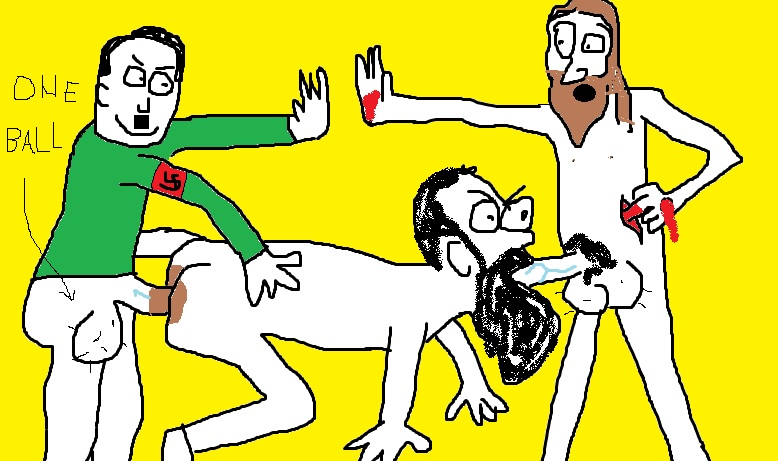
The Spear of Destiny is a surprisingly popular book (my copy is from the 9th printing!), and you’ll find plenty of other articles online that do a better job of discussing its specific inaccuracies. I liked this one, in which the author worries about how to write about this book “in a way that was not plain sneering.” I hold myself to no such standards, so here is a picture I made of Jesus and Hitler spit-roasting Ravenscroft:

jesus hitler