Dracula vs. Hitler – Jon Ruddy’s The Bargain

thebargainfrontcoverThe Bargain – Jon Ruddy
Knightsbridge – 1990
Although it’s disguised as a novel, Jon Ruddy’s The Bargain is likely the most historically accurate account of the sinister proceedings that brought an end to the second world war that has ever been published. This is the true story of how Count Dracula used an army of vampire whores to bring and end to Third Reich.

It took me approximately one minute to order a copy of this book after seeing an image of its cover online. I don’t regret my purchase. The cover is phenomenal, and the book itself is actually fairly enjoyable. There’s lots of sex, swearing and gore, and it really wouldn’t be fair to expect anything more from a book with that cover. To use Ann Radcliffe‘s distinction, this book is very much a horror novel rather than a tale of terror, and sometimes some straight forward horror is just what I need.
thebargainbackcover
Dracula never died, but he got really annoyed when Hitler invaded Romania, so he  made a bunch of vampire prostitutes and got them to fuck/infect/kill German soldiers. This is very much a Dracula versus Hitler story, and while that is obviously super cool, I was hoping that it would be more of a Dracula and Hitler (up a tree) story. I feel like that these boys would probably like each other, and instead of reading about their rivalry, I’d prefer to see them going out for a beer together. Holy shit, imagine how entertaining it would be if Dracula and Hitler had a weekly podcast where they just shared their stories and opinions. I mean, it would be evil as fuck, but I would definitely listen to it.

I had a fairly similar complaint when I read Dennis Wheatley’s They Used Dark Forces.  That book is about Hitler and black magic, but the dark forces in question are largely being used against Hitler. If I’m reading a novel about Hitler, I want him to be the main bad guy. I want to read allegations of him being a vampire or a black magician. I want a book that explains how Adolf Hitler would drink the blood of a virgin, then sprout wings and fly into the night sky to pay homage to Lucifer, his lord and master. If anyone knows if such a book exists, please let me know!

This book was still pretty sweet though. Read it.

Elizabeth Gaskell’s Gothic Tales of Mystery and the Macabre

elizabethgaskell
Tales of Mystery and the Macabre – Elizabeth Gaskell
Wordsworth Books – 2008
Long ago, I got a goodreads recommendation for Elizabeth Gaskell’s Gothic Tales collection published by Penguin. In April 2013, I ordered a copy. It never arrived. Later that year, when I went home for Christmas, I found a short story collection by Gaskell in the Wordsworth Tales of Mystery and the Supernatural series. This collection was called Tales of Mystery and the Macabre. It was nice and cheap, and I presumed it would be the same as the book that I had previously ordered, so I bought it. It lay on the shelf for nearly 3 years.

I started reading Gaskell in September. I checked to see if this edition contained the same stories as the Penguin edition. The Ghost in the Garden Room goes by a different title; it’s The Crooked Branch in the Penguin edition, but they’re the same story. Apart from that, these texts are the same. The Penguin edition may well have notes and a better introduction, but I doubt those would make this book any more enjoyable.

The stories are not mysterious, and only a few of them are remotely spooky. They’re mostly about innocent young women and mistaken cases of identity. Within a week, I had read all but two of the tales, but then I started working in a factory and binging on Stephen King, and I lost all interest in Gaskell. I forced myself to go back and finish it last week, and I’m glad I did. The last story I read, The Ghost in the Garden Room, is surprisingly miserable; it was great, especially the ending. The rest of the stories range from decent (Lois the Witch and The Old Nurse’s Story) to stupidly shit (Curious, if True). I started on Gaskell right after I finished reading Varney the Vampire, another book in the Wordsworth series, and that may have had something to do with how little I enjoyed this one. My patience threshold for Victorian fiction seems to be about 1000 pages.

Overall, Gaskell’s Gothic tales are not absolutely horrible to read, but this was not a book that I ever looked forward to opening. Also, the cover is fucking stupid. I’ve given out about the covers for this series several times before, but dear Christ this one is ridiculous. There’s no mention of planets or standing stones in any of these stories, and that cover makes this book look better than it is. The image needs to be replaced for the next edition, and out of the goodness of my heart,  I have designed for a cover that far better suits the content of his book:

better-coverIf anyone working for Wordsworth sees this, please spare the niceties and just send a cheque. Thanks.

LUDOVICO MARIA SINISTRARI: PART TWO (Demoniality)

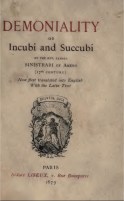
demoniality-liseux-version
To quickly summarize what I’ve already written about Ludovico Maria Sinistrari: he was a Franciscan Friar who wrote a book that was basically a list of all of the sins that he could imagine. I wrote a lengthy blog post explaining Sinistrari’s beliefs about sodomy, and while I believe it was an informative and insightful post, it may have seemed slightly out of place in this blog. I mean, isn’t this supposed to be a blog about Satan and the paranormal and spooky stuff? Surely sodomy isn’t very spooky? Well, no, but the chapter on Sodomy from Sinistrari’s De Delictis is one of the two sections from that book that is widely available in translation, and I don’t like half-assing things. The other, more infamous section, which we are going to look at today, fits far more comfortably within the context of this blog; it is a chapter on Demoniality. Demoniality, for those of you who don’t know, is the act of having sex with demons. Oh yeah, now we’re getting back on track.

The story of the manuscript of Demoniality is as interesting as its contents. In 1872, a French bookseller named Isidore Liseax spent a short holiday in England rummaging about in some antique booksellers. In one of these stores, he found a short manuscript titled “Dæmonialitas” and bought it for sixpence. He took it back to France, translated it, and published it 3 years later. It wasn’t until I read an essay on Sinistrari by Alexandra Nagel that I realised why this story sounded so familiar. Remember what I wrote about the opening to Bulwer Lytton’s Zanoni?

Liseux had never heard of Sinistrari, and he spent a long time trying to figure out who had written the text he’d purchased. Its author was listed as Ludovicus Maria of Ameno, but Liseux wasn’t able to find out any reliable information about such a man, and it wasn’t until he serendipitously opened a copy of the list of writers banned by the Vatican to just the right page that he discovered that this Friar of Ameno was the same person as the author of De Delictis. De Delictis had been unbanned for more than a century at this stage, and while it wasn’t widely available, Liseux managed tracked down a copy with a little persistence. Once he understood the nature of that work, he was certain that his manuscript on demoniality belonged to it. It followed the same structure as the other entries, and indeed De Delictis contained a chapter on demoniality. Liseux’s copy, however, while it started and ended the same way as the chapter in De Delictis, was largely expanded. The chapter in De Delictis is a mere 5-6 pages long, while Liseux’s manuscript was more than 80 pages. Liseux, by a stroke of extreme good luck, had found and paid next to nothing for the uncut edition of a paper on sexual intercourse with devils and spirits, the cut version of which was included in a book that was banned by the Vatican, the text of which had been written by a perverted, 17th century, Franciscan Friar. Holy quaint and curious volumes of forbidden lore!

There has been some discussion about the authenticity of the text. Why wasn’t the full text of Demoniality included in De Delictis? (Remember that De Delictis had actually only been banned for what it said about the qualifications of Judges, not for its details on sexual depravities. The lurid details in the apocryphal Demoniality pale in comparison to ‘the Doctrine of the Clitoris’ as laid out in the canonical chapter on sodomy.) Also, if you read Liseux’s introduction to his English translation of the text, several discrepancies arise. Alexandra Nagel has done an impressive job of listing and accounting for these discrepancies in her essay “Tracing the mysterious facts in Isidore Liseux’ publication of De Daemonialitate by Ludovico M. Sinistrari”, and if you’re interested in the details, her paper is better researched and more informative than what you’re going to read here. Suffice to say, the expanded version of Demoniality was probably intended to be included in a later edition of De Delictis that was never published. While I believe Nagel’s conclusion that Sinistrari was in fact the author, I wouldn’t be terribly disappointed if he wasn’t. This is a book about fucking monsters (and I use ‘fucking’ here as a verb, not an adjective). Does it really matter who wrote it?

Liseux found the manuscript in 1872, published the first French edition in 1875 and followed with an English Translation in 1879. This translation was popular enough to convince him to publish another section of De Delictis, that on sodomy, a decade later. One of the readers of Liseux’s translation of Demoniality was our old friend, Montague Summers. Summers was thoroughly impressed with the contents of the work but not the translation. In 1927, he re-translated Demoniality from the original Latin and wrote an introduction and set of notes to go with the text. I own a copy of Summer’s translation, but Liseux’s is available online. Summers spells Sinistrari’s first name ‘Lodovico’ (here and in his other works), but I haven’t seen that spelling anywhere else.

demoniality-summers-versionDemoniality (The Montague Summers Edition) – Lodovico Maria Sinistrari
Dover Occult – 1989 (This translation first published in 1927)

The book starts off explaining that demoniality is a separate offence to bestiality. Bestiality is having sex with an animal, but while demons are alive, they are not entirely corporeal and therefore don’t really count as animals. Sinistrari knows what demons are not, but it’s trickier to say what exactly they are. He distinguishes between evil demons who only fuck people to bring them into the power of Satan and a far less dangerous class of spirits who only fuck because they’re horny. These other spirits are composed of incubi and succubi. (Incubi are male spirits who fuck females, and succubi are female spirits who fuck men.) Surprisingly, most of what Sinistrari has to say is on the less malevolent, horny spirits, and the result is that this text feels more like a book on cryptozoology than a book on traditional demonology.

succubusThis succubus is a bit little. That man is a nonce.

In fact, if like me, you have an interest in books about cryptozoology/the paranormal/the Fortean, you’re very likely come across references to this text. Sinistrari’s descriptions of fuckable spirits are broad enough that they seem to fit many of my favourite monsters. Sinistrari argues, with evidence from Saint Anthony, that the gods, centaurs, fauns and nymphs of Paganism were all real entities and that the stories of them seducing humans were actually true. Montague Summers, in the introduction to his translation of Demoniality, argues that both the Jinns of Islam and the fairies and leprechauns from W.B. Yeats’ Celtic Twilight (an awesome book) fit Sinistrari’s decription perfectly. Hmmmmm, what other group of unproven creatures have been compared to fairies? I believe that our old pal, Whitley Strieber argued that his visitors had a lot in common with the fairy abductors of celtic lore. If that’s not enough for you, Strieber actually presents Sinistrari’s ideas as evidence for his visitors in Communion; in fairness, the similarities between stories of alien abductions and visits from incubbi/succubi are striking. Dmitri Bayanov presents ideas from Sinistrari’s Demoniality in his essay Historical Evidence for the Existence of Relict Hominoids. A relict hominoid is basically a Bigfoot. Let’s just take a moment to acknowledge then that Demoniality is actually a book about sexual intercourse with Satanic demons, the Great God Pan, leprechauns, genies, fairies, aliens and sasquatches. I can’t say for certain that Sinistrari specifically intended for his text to be interpreted this way, but given his reasoning and willingness to accept the authority of other writers, I really don’t think he would have had a problem with this interpretation.

priest-having-sex-with-bigfoot-an-alien-and-a-demonIt’s all good, baby!

According to Sinistrari, Incubi and Succubi are surprisingly like people. They have physical needs and desires; they eat smells (solid food would be too much for them), and they fuck each other, people and animals. These spirits are endowed with both free-will and morality, and Sinistrari even suggests that they might have their own form of organized religion and worship. They are more spirity than humans and hence also more spiritual and closer to God. The fact that they are closer to God means that it’s as bad for them to have sex with us as it is for us to have sex with animals.

This weird logic means that for a human to have sex with an incubus or succubus is actually a dignifying rather than a shameful experience. Sinistrari never openly condones sex with this class of spirits, but it’s pretty clear that he doesn’t consider it to be all that bad. In terms of sin, he puts demoniality in the category of pollution. This means its comparable to getting or giving oral sex or a single finger up the bum. You might get an extra Hail Mary as penance after confessing it, but that probably wouldn’t stop you from doing it again.

Shagging one of Lucifer’s Henchmen is a different story; doing so is only ever done to improve your relationship with the Dark Lord. Satan’s malevolent spirit-servants are incorporeal and must either create a body out of filth or possess a corpse in order to be able to fuck. Also, they feel no joy when they’re getting rode. If you shag one of these, you are going to Hell. The sexual act itself would only count as pollution, but as it also serves as a contract with Satan, it becomes a damnable offence. The problem is that most people don’t know the difference between a friendly neighbourhood succubi and a cacodaemon, and just as attempted murder is as bad as murder, attempted sex with an evil demon is just as bad as sex with an evil demon. This means that a minor fling with an amorous Incubus could potentially land a person in as much trouble as bending over for the cock of Asmodeus. Now you know the difference, I hope you’ll think to look before you leap!

Another thing to be careful of is the way that spirits can alter their form. Regardless of their true appearance, demons seem to be able to appear in whatever form is most pleasing to their lover. This shapeshifting can get their lovers even deeper into sin. If a demon was to have sex with a man whilst appearing as that man’s sister, the man would be guilty of incest as well as demoniality. If the demon was to appear as that man’s dog, the man would be guilty of bestiality. Even if you knew full well that your lover was a demon and ask you asked it to look like a corpse for 10 minutes, you’d soon be guilty of necrophilia. Basically, roleplaying counts. You’re already in trouble for fucking a spirit; don’t make it worse by getting kinky.

But wait; wasn’t Sinistrari’s main problem with sodomy that it was sexual activity that didn’t lead to procreation? How is having sex with airy spirits any worse? Surely that doesn’ lead to procreation either! Well, actually…

Haven’t you read the Bible? Remember the Nephilim from Genesis? The Nephilim were a race of giants that were created when the Sons of God (fallen angels) mated with the daughters of men. Remember Jesus Christ. Who was his Da again? Now if he Bible contains stories of Spirits mating with humans, you’d better believe it’s possible. So how do they do it? Babies come when a penis sperms into a vagina; how can a spirit be expected to do this? Well, it used to be assumed that the spirits would turn into a succubus, fuck a man, save his cum, turn back into an incubus, fuck a woman and then fill her with the cum that they had taken, but there are a few problems with this theory. The first being that the resultant baby wouldn’t actually be demonspawn; it would be a perfectly normal human baby whose parents had never met. Another problem that Sinistrari notes is the fact that sperm rapidly loses its potency once its outside the body. Semi-corporeal demons would have no way of keeping the gip warm during the interlude between extracting it and injecting it. There’s other problems here too that I’m sure you can work out, and Sinistrari concludes that demons must cum their own cum and that this cum is capable of impregnating humans.

incubusAn Incubus works his magic. Why is he standing in a circle of eggs?

Sinistrari claims that Romulus and Remus, Plato, Caesar Augustus, Merlin, and “that damnable Heresiarch yclept Martin Luther” were all the offspring of spirits. You’ll notice that with the exception of Martin ‘the Proddy’ Luther’, these were all great men. That’s because spirits are closer to God than humans. The only problem is that human/spirit offspring are the same as horse/donkey offspring; they may get the beneficial aspects of both their parents, but mules can’t reproduce. Augustus had a daughter (who died very young), and Romulus may have had a son named Aollios and a daughter named Prima (such claims have been contradicted), but as far as I know all the other lads mentioned were either infertile, gay or just didn’t fuck. As mad as Sinistrari’s claims might seem to us, there was research and twisted, but apparent, logic behind them.

What about the Nephilim though? Why is it that demonspawn used to be giants, but modern day demonspawn are regular sized? Well there are four elements, right? So there must also be four kinds of spirits: air spirits, fire spirits, water spirits and earth spirits. (As silly as this might sound, it probably made decent sense to people living in the 17th century.) The spirits that fucked the daughters of men were air and fire spirits (again this is logical; angels came from the sky), and because fire and air are the more expansive elements, their offspring, the Nephilim were giant. After the flood, the fire and air spirits didn’t want to come down to Earth anymore because it was too wet for them, and so the only spirits left to fuck humans were the smaller, more condensed, water and Earth spirits. When you follow Sinistrari’s reasoning, it becomes apparent that he was actually a very smart guy living in a very dumb age.

demoniality-title-pageThe subtitle of the work, “A treatise wherein is shown that there are in existence on earth rational creatures besides man, endowed like him with a body and soul, that are born and die like him, redeemed by our Lord Jesus-Christ, and capable of receiving salvation or damnation”, has a nice ring to it; don’t you think? It just slides off the tongue.

I have plenty more to say about Sinistrari, but I’ve already written more than 5000 words about him, and I doubt anyone is that interested. (If you ever want to chat about him, e-mail me or leave a comment!) Demoniality is genuinely one of the most interesting texts that I have come across, both for its history and content, and I’ve no doubt that I’ll be referring to it again. If you have an interest in demonology or cryptozoology, this is is a must-read. Both Demoniality and Peccatum Mutum are available online too, so you have no excuse other than being boring.

Ludovico Maria Sinistrari: Part One (Peccatum Mutum – The Mute Sin, alias Sodomy)

Ludovico Maria Sinistrari (1622-1701) was a Franciscan priest, professor and advisor to the Holy Inquisition, a real smart guy overall. He spent the last 12 years of his life writing a book called De Delictis et Poenis Tractatus Absolutissimus or The Most Absolute Treatise of Crime and Punishment. This tome was basically a list of all the crimes that people could commit and the appropriate punishments to go with them. Sounds like a pretty useful book for an inquisitor to have, right?

Sinistrari was thorough in his work, and De Delictis, not only contains chapters on perjury, blasphemy, homicide and the likes; the author goes into delicious detail on the sins of the flesh, including incest, bestiality and ‘sacrilege with a nun’. Surprisingly enough, the book was put on the Vatican’s list of banned books for more than 40 years, not because of its lewd details, but because of what it says about the necessary qualifications of judges.

Unfortunately, the entire 600+ pages of Latin text that makes up De Delictis has never, to my knowledge, been translated into English. As far as I know, only three sections of the book have been translated: the chapters on Lewdness (Homosexuality), Sodomy and Demoniality. A professor named Hugh Hagius translated and published a small run of the section on Lewdness, but I haven’t been able to get my hands on a copy. The other two sections were translated and published by a guy named Isidore Liseaux and are widely available. Demoniality came out in 1879, and due to its popularity, Liseaux went ahead publishing Peccatum Mutum – The Mute Sin, alias Sodomy in 1893. I usually don’t start with the Sodomy till I’m nearly finished, but today I’ll make an exception.

peccatum-mutum
First of all, Sinistrari has to lay out what sodomy actually entails. He believes that Sodomy proper is fucking and cumming inside an arse. Things get tricky when he considers the guilt of an arse fucker who cums outside of the bum. He tells of Dominicus Raynaldus, who concluded that “whoever has thus penetrated even without offering libation to the case, is to be sentenced to death, though not to be burnt after death”, but Sinistrari isn’t convinced. He seems to think that those who cum outside the arse probably only deserve to be tortured a bit. He’s firm but fair, and he notes that if a man bums once or twice but doesn’t cum inside the shitter, his torture should be mitigated; however, no such leniency should be shown to repeat bummer who tries to beat the system by bumming freely but withdrawing to jip.

Is the fuckee as guilty as the fucker? Well, if they wanted to get bummed, then they’re getting executed. If they didn’t want to get bummed, it’s up to them to prove it. If the bummee is younger than 18 years old, they should only be “scourged in a jail, or confined a long time in it; or he should be dragged for a few moments through a blazing fire”. If the bummee is less than 14 years old, they go unpunished, unless they are “a very cunning lad” who “is up to trickery”. These cunning lads, some of whom are as young as 10, “ought to be caned inside the jail, or even flogged around the prison yard”. So if you walked into your house and saw a man sodomizing your 10 year old son, you’d have to be able to prove that your son hadn’t been up to any tricks if you wanted to save him from a whipping after his rape.

Sodomy, of course, is not exclusively practiced by gay men. Sinistrari considers whether a “husband may penetrate into his wife’s rear vase in order to get up his mettle, provided he has no intention or runs no risk of discharging in it”. He doesn’t condone such behaviour, but he definitely doesn’t consider it to be too serious. A spot of anal foreplay is a mere peccadillo. Naughty but nice, eh Sinistrari? This is all a bit surprising given that he later claims that sodomizing a woman is worse than sodomizing a man. I can’t remember the exact quote, but I believe it was something along the lines of; ‘Sure, if you’re bumming a man, the bum was your only choice, but why would you bum a woman when she has a lovely pussy that’s designed to take in your gip!’ By similar logic, it’s also worse to bum your wife than it is to bum a prostitute.

I want to add a quick autobiographical interlude while we’re on this topic. I first heard of anal sex when I was 10 or 11. My friends and I were kicking football down the road from our houses, when one boy, let’s call him Joe, stopped the game and asked, ‘Did yous know that you can have sex in the bum?’ There was a pause of a few seconds as we let that sink in. ‘Yeah, that’s how ye always have sex,’ another boy responded. His response was hardly surprising to anyone who had seen his drawings of the female anatomy. The genitalia in such pieces resembled a diamond shaped crease which housed three holes of equal diameter: one brown, one pink and one yellow: three separate but inter-changeable components of one busy orifice.

‘No, I don’t mean up the fanny, I mean sticking yer dick up the actual hole that the shit comes out of; it’s called anal sex and your da does it to your ma every night.’
We were impressed, but nobody was surprised. By age 11 we all knew that all adults engaged in an innumerable amount of depraved acts. The most recent additions to our list had been the revolting ‘rainbow shower’, the confusing ‘ice-cream lick’ and the abominable ‘toilet tart’.

‘That’s gross, you’d get shit on your willy,’ another boy exclaimed. He was a bit younger, and apparently, his willy had not yet become a dick. ‘Yeah, a shit smelling dick, then ye get a blow-job afterwards,’  I added; this was a good chance to show off my vocabulary. ‘I don’t know boys, you guys seem to think it’s gross,’ Joe, seeing that we were intrigued, spoke with delighted smugness, ‘it might seem gross at first… but it’s like I always say… What comes out, must go back in”

I don’t know if I appreciated quite how funny that line was at the time he said it, but I do recall thinking it was very funny indeed. It has stayed with me for nearly 20 years, and I like to quote it whenever the unspeakable sin of the Greeks comes up in conversation.

Anyways… Sinistrari considered sodomy a crime punishable by death for any layperson found guilty of it. Things are a bit different for Sodomite priests, but it’s a little unclear as to why and how this was so. Sinistrari lays out the Franciscans’ method for dealing with bummers within the order. The Sodomites would be stripped naked in front of all members of the order, soundly scourged (“soundly” means two whippers instead of one), and then pushed through a fire. The fire would hurt like fuck, but the real reason for this part was to the burn and scar the victim’s skin so they could be identified them as a bummy-man in future. Also, the punishment for sodomy should always involve fire. Duh! Remember what God did to Sodom? Oh, and after the fire, the victim was locked up in a cage and fed only bread and water 3 times a week for a total duration of 3 years, and this was best case scenario for a Sodomite priest. If they had been found guilty of multiple bummings, they would continue to recieve several scourgings a week during their time in the cage. If the public somehow found out about the priest’s sins, he would be hung. The punishment was more to preserve the good name of the Catholic church than it was to deal with the sinner.

Now, what if you agree with what Sinistrari has to say about Sodomy but you still feel the urge to go out and bum? Well, Sinistrari acknowledges that if a man is tempted by the arse of another, he “may lawfully kill the person compelling him to commit sin.” That’s  right folks. Want to bum, but don’t want to be a bummer? BE A KILLER. Well, in fairness, Sinistrari doesn’t really promote that idea; he accepts it only if there are no alternatives. Still, I thought it an interesting insight into the perversity of Catholic thought.

Ok, let’s recap what we have learned so far. We know that sodomy is when an arse is fucked and came in. We know that sodomizers and sodomizees are equally as guilty. And we know that both men and women can be sodomized.
Keeping that in mind, let’s imagine a man having anal sex with his boyfriend. At the end, much to their mutual delight, the top blows his gip right up the bottom’s arse. It follows that the top has sodomized and is guilty of sodomy, and the bottom has been sodomized and is guilty of sodomy. Afterwards, they switch roles, and both lads have had to chance not only to commit sodomy, but also to sodomize. Happy days!
Now let’s imagine a male/female couple attempting the same feat. The man fucks his girlfriend in her ass and cums inside. He has sodomized and is guilty of sodomy, and his girlfriend has been sodomized and is guilty of sodomy. What now though? Is their night of passion over? Does the female never get the opportunity to sodomize back? What about lesbians? No sodomy for them at all? Sinistrari, 17th century, Franciscan friar though he may have been, seemed to believe in gender equality, and he seemed to think it was completely unfair that women were denied the chance to commit sodomy due only to their lack of the appropriate penetrative member.

“But of course women can sodomize!” I hear you say, “What about a finger or utensil up the bum?” Well, according to Sinistrari, a finger or dildo up the arse doesn’t quite cut the mustard. It’s a dirty practice of course, and he considers it pollution (a far less serious sin), but sodomy requires internal ejaculation (or at least the attempt to do so). He considers whether it’s possible if a woman could cum into another woman, but he regards this as unlikely. Interestingly, if a woman could come into another woman, it would count as sodomy regardless of the orifice. Now, if neither dildoing arses nor attempting to cum inside their partner’s holes through some form of erotic contortionism can deem a woman guilty of sodomy, is it at all possible for a woman to be a true sodomizer?

Well, I don’t want to be condescending here, but it seems to me, my good friend, that you have never heard of a little thing called the “doctrine of the clitoris”. It’s ok. there’s no need to be embarrassed. Lots of people haven’t heard of it yet. Sinistrari explains; “there is a particular part of the a woman’s body, which Anatamists call the clitoris. This part consists of the same tackles as a man’s yard, namely, sinews, veins, arteries, flesh and so forth. When in a chafe, it also resembles the yard. The clitoris distends with the rushing of seminal spirits, and, like the yard, is provided with a nut. At the top of the nut there is a hole”. Clitorises are funny things, and if they see too much use, they pop out. Yes, that’s right. A well-used clitoris is liable to burst the “exceedingly thin membrane that covers it” and rush out of its hidey-hole to remain dangling between the female’s legs for the rest of her life. A distended clitoris is often the size of a middle finger, but sometimes they are much bigger. In fact, “there was once at Venice a courtesan whose clitoris was the size of a gander’s neck.” Imposing clits are not overly common in polite European society, but in Ethiopa and other African countries, clitorises are burnt off at birth. This is because clitorises can get so big that they actually prevent the woman from being able to receive a penis into her vagina. Clits are the cause of several of the tales of women instantly turning to men. Popped clits don’t just look like cocks either; they act like them too. A clitoris is liable to grow “so big that it erects like a man’s yard, inticing them to coition, just as males”.

clitsMy friend Tim drew these pictures two years ago. They had nothing to do with Sinistrari, but they fit in pretty well here. Thanks Tim.

Now this is the interesting part. If a woman’s clit has popped out, it will swell and get hard as she gets horny. When this happens, the lascivious wretch might use it to “satisfy [her] filthy lewdness.” According to Sinistrari, women with wiggly, finger-like, distended clitorises like nothing better than impartially shoving these bizarre members into vaginas and anuses. That, dear readers, is how a woman can sodomize. This makes it rather easy to try a female accused of sodomy too; all you have to do is see if she has a huge clit. “Should the clitorus hang out in a woman, it is presumed she made use of it.” Case closed.

But what about the “must cum inside” rule that we talked of earlier? Well, Sinistrari does address this issue. He says; “If they make use of the clitoris as it is clearly demonstrated, in either of the female vases, they are guilty of downright sodomy; even thought the seed of the incuba does not enter at all into the case of the succuba, yet the crime is perfect in its kind. For there is copulation between them in due form, whilst generation can not ensue”. I can’t say I find this terribly convincing, but I am glad that he found a way to level the sodomy playing field. The punishment for female sodomites is same as for males. Women who clit men or women should be hung and burnt. Men and women who get clitted by women get the same treatment.

clitorisJust so you don’t think I’m making this up. (From page 13 of the book)

This post has become far longer than I expected it be, and if you have made it this far, I think you deserve a bit of a break before I start telling you about Sinistrari’s ideas on Demoniality (the fucking of demons). That text is more in line with the general theme of this blog, and you can expect the post on it at some stage in the next week or so. Until then, I want to make it very clear that I have been summarizing the ideas of a man who has been dead for more than 300 years, and I find his ideas both repugnant and very silly. The inherent homophobia and ignorance in his book is ludicrous, and the notion that we shouldn’t do something because it stops more people from being born is horrendous. The world is already horribly overpopulated, and I would encourage everyone to engage in sexual practices that don’t result in childbirth. Be safe, wear a condom, make sure your clitoris doesn’t pop out, and when in doubt, remember the schoolyard adage:
‘Up the Gee – HIV, but up the bum – no harm done.’

The Divine Rite of King

When I as a kid, my parents would sometimes take me to the videoshop after mass on a Sunday and we’d rent two cassettes: a cartoon for the kids and a movie for my parents. As I got a little older, I found myself drawn to the wall over by the sales counter. This was where the horror films were stacked. I distinctly remember being fascinated by the video boxes of Return of the Living Dead III, Ghoulies, and The Howling II. There was one similarity shared by several of the other boxes; it was a man’s name, Stephen King. I remember the mildly titillating feeling of dread that came from looking at the boxes of Children of the Corn, Tommyknockers, It and Graveyard Shift. The covers made these movies look horribly disturbing. I mean, these looked like the kind of films that were supposed to make you mentally sick if you watched them. But underneath my revulsion there was an intense curiosity. I wanted to see those films badly.

My parents had seen a few of the better movies that had been made from King’s work. I remembering pestering them for every plot detail of the Shining  and Misery.  It was probably soon after that that my mam allowed me to read The Moving Finger, a short story from Nightmares and Dreamscapes. It was a bit like the Goosebumps books that I absolutely adored at the time, but this was for grownups. I thought Stephen King was super cool.

I’m the eldest of my siblings, and my parents were a bit stricter with me than they were with my sisters. When one of my teachers told my parents that students should spend 3 hours studying every day, my mam took that to heart. I was never locked in  room or anything, but I was expected to spend several hours a day on my schoolwork. It wasn’t worth fighting over, so I just stayed in the front room of our house by myself, pretending to study for a few hours every day. I can’t remember/don’t want to admit how I spent all of those hours, but there was a bookshelf in that room, and sometimes reading novels seemed like a better idea than reading textbooks. There were only four books on that shelf that looked remotely appealing, and I got through all of them. ‘What books were they?’, I hear you say. They were Roddy Doyle’s excellent Barrytown Trilogy and Bag of Bones by Stephen King.

bagofbonesBag of Bones (1998)
I read this about 15 years ago and can’t remember much about it. I believe I enjoyed it at the time. Anything beat studying.

theshiningThe Shining (1977)
I read this one a little over 5 years ago, and I absolutely loved it. At one point, I actually had to put the book down to take a breather and calm myself (I believe it was right after Danny went into room 237). I had seen Kubrick’s film several times before reading the book, and I reckon it’s better to do the film/book combo in that order.

nightmaresanddreamscapesNightmares & Dreamscapes (1993)
While my first experience with this short story collection was probably 20 years ago, I only got around to reading it cover to cover in 2014. (Well, I’ve never technically read it cover to cover to be honest; I read it in my old office job from a pdf file saved in my google drive). Some stories were great. My favourites were Popsy, Crouch End (a pastiche of Lovecraft), and Night Flier, the movie version of which is laughably bad. Dedication is weird and gross but definitely worth a read. I enjoyed this book, but I don’t think it was quite as good as King’s earlier short story collections.

nightshiftNight Shift (1978)
In October, I took a seasonal job in a powder factory. The work required a lot of standing still, and I was allowed to do it with headphones in. I decided to download some audiobooks to get me through the long dusty days, but I was fairly disappointed in the selection offered by illegal fire-sharing sites. Also, choosing the right audiobook to listen to at work is tricky; the book needs to be interesting enough to keep your mind occupied, but it also has to be light enough that you don’t have to take notes to keep up with the plot. My problems were all solved when I found a big torrent of Stephen King’s audiobooks. His writing is very straightforward, and it takes barely any effort to soak it in. Also, his short stories are about vampires, aliens, mutant rats, and men that turn into slime. If that doesn’t sound enticing to you, get the fuck off my blog and go listen to your Coldplay cds, you stupid fucking barrel of shit.
This is the first collection of short fiction that King published, and some of the stories are  great. Children of the Corn is maybe my favourite. The written text is so much better than the utterly shit movie version that came out in 1984. Graveyard Shift and The Mangler were both great too, but I haven’t watched their movie adaptations. One for the road and Jerusalem’s Lot both expand on the material from Salem’s Lot (reviewed below), and Night Surf is a brief glance at the idea that would become The Stand (also reviewed below). Not everything in here is brilliant, but I really like the fact that King is willing to take any silly idea that comes into his head and turn it into a story. The man has a brilliant imagination.

skeletoncrewSkeleton Crew (1985)
I think I stole a copy of this book from my Granddad’s house when I was 21. I remember taking it to France with me and reading most of The Mist on a plane. Frank Darabont’s version of the Mist is one of my favourite movies and one of the few times that I think a film improved on the book. I read another few stories after that, but lost the book soon thereafter. I started going through the remaining tales as soon as I finished Night Shift last month, and this one picks up right where that one left off.
Survivor Type is fantastic. I laughed heartily as I listened to it. I guessed what was going to happen only a little bit into the story, but I didn’t think King would have the guts to write a story like that. I was wrong. Stephen King definitely has the guts to write a story like that. This collection was thoroughly enjoyable.

4pastFour Past Midnight (1990)
I had found that Stephen King’s fiction was the perfect way to pass the time in work, but I had run out of short story collections. I read that Four Past Midnight was a collection of novellas, but I had never actually seen a physical copy of the book before I started listening to it.  It turns out that some of these “novellas” are longer than some of King’s most celebrated novels. Why were they released in a collection rather than individually? I reckon it was something to do with the fact they’re not exactly his most brilliant work.

The Langoliers
This is a weird one. It’s about a plane that flies into another dimension. The audiobook version is narrated by Willem Dafoe, and I really enjoyed it, but in retrospect, it doesn’t make much sense at all.
Secret Window, Secret Garden
This, in my opinion, was the worst story in this collection. The twist ending is apparent from the very beginning.
The Library Policeman
This was my favourite. It’s weird as fuck.
“Come with me, Ssson. I’m the Library Polissse Man”
The Sun Dog
A boy’s camera offers a glimpse into another reality. It’s an interesting concept I guess, entertaining enough.

I enjoyed Four Past Midnight, but I really doubt anyone would ever have heard of it if it wasn’t written by Mr. King. It would not be a good starting point for anyone interested in sampling his works.

salemslotSalem’s Lot (1975)
About 8 years ago, I stayed up late two nights in a row to watch the 1979 movie version of Salem’s Lot. I was unimpressed. I decided to give the book a chance right after finishing Four Past Midnight. I’m really glad that I did; it’s a very entertaining vampire story set in modern America. I’d strongly recommend that you read it if you haven’t.

thestandThe Stand: Complete and Uncut (1990)
By the time I started on the Stand, I had read/listened to nothing other than Stephen King books for almost two months. I’ll be honest, that was probably a bad idea. At 1153 pages, the uncut version of the Stand is King’s longest book. I never got bored when I was reading it; it is very entertaining, but towards the end, I started to really look forward to reading other books.

King takes his time setting the story up, but it all winds down fairly quickly. There’s three books in the stand. The first ends the world with a super plague, the second details how the two factions of survivors organize themselves, and the final book describes the conflict (or lack thereof) between the two groups. The concept is cool, but the pacing is silly. Given the overall plot of the book, the section on the plague wiping out most of humanity is too long. For the first few hundred pages, the Stand is a fairly straightforward disaster novel that describes a calamity that is in no way unrealistic. Then, after 99.6% of human beings have been wiped out, we find out that the survivors have been left with mild telepathic abilities, and the book quickly turns into a religious parable about the forces of good and evil. It’s already already very, very long, but I felt a bit cheated when the conflict that the previous 1100 pages had been leading to was literally prevented by the hand of God. I mean, come on Stephen; you could have got another 5000+ pages if the two sides had actually gone to war! I wouldn’t be surprised if the Stand had originally been even more epic in its scope and that King only realized that he wouldn’t be able all fit everything into one book after he had already written 700 pages. He has acknowledged that The Lord of the Rings was an inspiration for this work, but King’s fellowship only sets out for their Mordor (Las Vegas) in the third book of the Stand. If he had really used Tolkien’s trilogy as a model, the Stand would probably have lasted 5000-6000 pages.

The religious undertones of the book also irked me a little. I thought Randall Flag was fucking cool, and I definitely would have joined his side. Also, while several of King’s works feature a “Magical Negro”, Mother Abigail serves as a particularly cringeworthy example of this trope. King is definitely not a racist, but some of his writing depicts a slightly dated worldview.

All that being said, the Stand is filled with cool characters and awesome scenes, and I enjoyed reading it. Stephen King has acknowledged that he considers his work to be trash (good trash specifically), and I, for one, am not above reading trash. I fucking love trash, and I loved Trash.

I’ve enjoyed every Stephen King book that I’ve read, but right now, I am looking forward to reading something else. I didn’t know if I was going to review his books on this blog when I started binging on him in October, but the more that I think about it, the more I think that he deserves to be here. If you like horror, you’ve already read this guy. His books are spooky, gross, and seriously entertaining. I’m going to give it a few months, but I’ll definitely be reading more Stephen King in the future. Aside from his fiction, he also seems like a cool guy; he hates Donald Trump and he’s into AC/DC.

kingStephen King, I salute you!

Gutted – Lytton’s The Haunted and the Haunters

bulwer-green-skull
The Haunted and the Haunters; or, The House and the Brain – Lord Lytton 
Originally published – 1859

A few years ago, I read about the books of Edward Bulwer Lytton in Colin Wilson’s The Occult. Discovering that this Lytton lad was supposed to be friends with Eliphas Levi and that his books were about wizards, ghosts, and secret societies, I quickly put him on my to-read list. A few months after doing so, I saw his name in Nicholas Goodrick Clarke’s The Occult Roots of Nazism. Combining what I already knew about Lytton with the fact that one of his works had apparently inspired a bizarre conspiracy theory about subterranean, black magic Nazis, I knew that I had to make acquiring his books a priority.

2015-08-27 20.54.58

The four texts that Wilson specifically named were Zanoni,  A Strange Story, The Coming Race, and The Haunted and the Haunters. I found audiobook versions of the latter two on librivox, downloaded them and stuck them on my phone. The mp3 of The Haunted and The Haunters was only an hour and 10 minutes long, and I listened to it at work the other day.

It was a little disappointing to be honest. A lad hears about a haunted house and decides to spend the night there. He sees some ghosts, and a few days later he discovers a secret room containing a peculiar device that essentially functions as a ghost machine. He breaks the ghost machine, and then everyone lives happily ever after.

This is a ghost story, but it’s not remotely spooky. During the most climactic scenes, the narrator makes a point of telling the reader that he is not afraid, and it’s very hard to feel scared for a person who seems to understand the situation better than you. The chap comes across as a know-it-all wanker to be honest; I’d take a terrified Jamesian protagonist over this gobshite any day.

Lytton’s use of fiction to present his ideas about the supernatural may have been novel at the time this was published, but I found it rather trite. He goes over the old “nothing is really supernatural because supernatural means impossible and nothing is impossible” argument. Just because science can’t yet explain ghosts, ESP, clairvoyance and all that good stuff, there’s no reason to believe that it won’t some day be able to. This is a fair point to make, but it doesn’t have much bearing on whether or not these things actually exist.

The story comes to a very abrupt end. After enduring the night in the house, the lads find a chest of drawers in a secret room. In this chest is a portrait of another lad who the narrator seems to have seen before and a weird, home-made, magic compass that has been cursed. Once this strange device is destroyed, everything is grand. That’s it. End of story.

Fairly shit, all things considered.

the-endIs that really the end though?

This story was originally published as “The Haunted and the Haunters; or, The House and the Brain” in the July-December 1859 edition of Blackwood’s Magazine. I find it quite strange that an original publication would feature two titles. Subsequent appearances of the tale have often been published under one title or the other.  I have read that the “House and Brain” title usually denotes an abridged version of the story, but I have read the exact same thing about the “Haunter and Haunted” title. Perhaps the different titles were once used to denote the different versions of the story, but at this stage, neither title can be trusted to signify the abridgment.

haunted-house-brainMy copy of the text has both titles, but it’s the abridged version.

If you have any sense and want to make sure that you’re reading the full version, the last paragraph of the original version of the story starts with the phrase;
“So ends this strange story, which I ask no one to believe.”

The first line of the final paragraph in the SHITTY-BUM abridged version reads;
We found no more. Mr. J—— burnt the tablet and its anathema.
If there is one thing that I simply can not abide, it’s an abridged book. If this is the ending of the tale you are reading, look elsewhere for satisfaction!

The abridgment absolutely guts the story. The haunting in the original features a creepier ghost, a slightly more gruesome description of the death of the narrator’s dog, several other minor edits, and most importantly: a tense confrontation between the narrator and the wizard responsible for bewitching the house. The complete version is by no means a brilliant piece of literature, but it is at least somewhat coherent, and it’s far more enjoyable than the shortened piece of drek. Imagine reading a version of the Shining in which all references to Jack Torrence’s family have been cut out and you’ll get a sense of the shitness of the abridged version of this tale.

Luckily, the unabridged version is widely available on the web (It’s on page 244 of the edition of Blackwood’s Magazine that I’ve already linked to.). An article from the July 1938 edition of the Theosophical Forum suggests that Bulwer cut parts out of this tale to use in his novel, A Strange Story.  That novel was published in 1862, three years after The Haunted and the Haunters. I haven’t read A Strange Story yet, and it may be a while before I get around to it, but I’ll read over Haunted/Haunters again when I do to see how the ideas were transferred between the two.

As I have already mentioned, I first heard about Lytton in Colin Wilson’s The Occult. I decided to read back over the relevant passages in that book to see if there was anything pertaining to this particular story. Wilson quotes the entire description of the curious portrait that is found near the cursed saucer to give an example of what he thinks a black magician should look like. He then says, “And when he later added a new ending to the story, Lytton extended this sketch into a full-length portrait of a man who seems to be a combination of the Wandering Jew and the Count de Saint-Germain.” Colin Wilson, author extraordinaire and expert on the occult, seems to have believed that the original version of this story was the short version. Wilson also lists Lytton’s first name as Henry in the index to the book when his name was actually Edward (His elder brother was named Henry.) Colin Wilson, it seems, was not very thorough in his research.

rubbishGood riddance to this pile of unlettered garbage.


You Are Becoming a Galactic Human and (YHWH) The Book of Knowledge: Keys of Enoch

galactic-humanYou are Becoming a Galactic Human – Virginia Essene and Sheldon Nidle
1994 – S.E.E. Publishing

There are three books that I have started and never finished; Finnegans Wake by James Joyce, The Unnameable by Samuel Beckett, and now You are Becoming a Galactic Human by Virginia Essene and Sheldon Nidle. I really tried to get through each of them, but after a while I had to consider what I was going to gain from doing so and weigh that against all of the other things that I could potentially achieve in the time it would take to finish these boring, stupid nightmares. I can tolerate some Joyce and Beckett, but their aforementioned works are very definitely the literary equivalent of the Emperor’s new clothes; people like to think that they’ll seem clever if they manage to slog through them. Finishing You are Becoming a Galactic Human however, offers no such impetus. Although just as ridiculous and confusing as any obscurant modernist drivel, this book is not considered a classic by anyone. It’s a stupid piece of garbagey trash, and anyone who reads it and takes it seriously is a buffoon. If you’ve followed this blog for any length of time, you’ll know that I have a very low standard when it comes to literature, but this smear of shit in your underpants was positively too stupid for me to waste my time on.

timelordsSorry, what?

I review all kinds of nutty books on here, but there comes a point at which the content of a “non-fiction” book becomes so separated from reality that it is no longer intelligible or enjoyable. Bullshit has to have some basis in reality for it to be engaging. Neither The Legend of the Sons of God nor Chariots of the Gods are remotely convincing, but their authors at least attempted to provide some kind of evidence for their claims. Their evidence, however scant and shaky it may be, is based in things that can be checked. In comparison to Essene and Nidle, both Erich Von Däniken and T.C. Lethbridge seem like noble rationalists. The former pair of bozos’ claims are based on channeled messages from extra-terrestrial, extra-dimensional spirits that dwell in different galaxies.  I struggled with Preparing for Contact and Unseen Beings, Unseen Worlds for similar reasons, but as ridiculous as those books were, I could just about make out and accept the pretenses of the authors for long enough to allow myself to finish them. I got about 20 pages into You are Becoming a Galactic Human before I had to put it back on the shelf and admit defeat. This is next-level rubbish. Not even the closing message, delivered by the alien Jesus Christ, could compel me to finish this book of nonsense.

moonsUghhhhhhhhhhhh…..

Like Tom Dongo, Sheldon Nidle made himself instantly dislikable by boasting about how clever he is. The chap got some bullshitty degrees from a community college, and he literally thinks he’s a fucking prophet. Realistically, he’s a grown man who likes to play make-believe and has the mental capacity of a low-grade imbecile.

I put the book down when the authors claimed that the Earth was moving towards a ‘Photon Belt’ that would shift our existence into the 5th dimension and cause mental evolution and mass spiritual enlightenment. We were supposed to enter the Photon Belt at some stage between March 1995 and December 1996. Our entrance into the belt was to be signified by 72 hours of complete darkness. These three days would then be followed by 17 years of permanent light. It was during these 17 years that we were to develop ‘incredible psychic abilities’ including telekinesis and telepathy.
Sigh…

As usual, the authors string together as many new-age spiritual concepts as they can manage. I saw parts on chakras, Atlantis, crystals and my favourite old chestnut: telepathic communication with dolphins and whales. It also includes, and I didn’t bother to investigate why, a very inept drawing of some ancient Egyptian deities.

stupid
Even writing this review, I’ve been thinking of trying to read this again at some stage in the future. I know that putting this book down and reading something else was the dignified choice, but I can’t completely shake off the feeling of defeat. In an attempt to preserve some of my honour, I’m going to make a promise to myself, my readers, Virginia Essene and Sheldon Nidle:
I promise that I will read and review You Are Becoming a Galactic Human as soon as our Solar System enters the Photon-Belt.


While I’m on the topic of stupid books about intergalactic-spiritualism, I’ll share a few pics from what is one of the strangest books in my collection.
yhwh(YHWH) The Book of Knowledge: Keys of Enoch – J.J. Hurtak
The Academy for Future Science – 1977 (First published 1973)

In truth, I haven’t even tried to read this one, and I almost definitely never will. As far as I can tell, it’s a book of messages that were delivered to J.J. Hurtak by some kind of angelic entity named Enoch, and from what little I know about Hurtak, I’d imagine ol’ Enoch was probably an alien. J.J. Hurtak was in the enjoyable 2013 documentary, The Hidden Hand: Alien Contact and the Government Cover-Up, (It was on Netflix a while ago. It’s here now.), and he seems like a complete wacko. I picked this book up at a library sale for 2 or 3 dollars, and it’s fancy looking enough that I’ve been keeping it just to decorate my bookshelf.

whoknowsThis book contains more than 600 pages of this kind of gobbeldy-gick.

shitting-dnaJust an Intergalactic Eunuch scatting molecular structures into deep space…

newagegarbageNot sure about the fruity Eqyptian Triclops or the black and white, naked Samurai, but the other guy is definitely 80s Vince Neil, right?

Flicking through this, all I see is an appalling mess of ridiculous pictures, pseudoscience and Biblical references. The notion of having to slog through this revelation of anal spew is genuinely frightening. People try to tell themselves that every experience can be a learning experience. I disagree. Once you have read a few really, really stupid books by people who believe they have talked to heavenly aliens, the only thing you learn from reading another is that the international list of cretins contains one more entry than you previously expected.

Don’t risk adding your own name to that list. Maintain your dignity and avoid these books.

Mrs. Radcliffe’s Novels

ann-radcliffe-novels

I don’t have much to say on these books that hasn’t been said before. Ann Radcliffe didn’t invent the Gothic novel, but she drastically improved it. Books like Castle of Otranto and Vathek are fun, but they’re both quite silly. Radcliffe’s novels came a few decades later, and while they’re still fairly silly, they contain interesting characters and plausible stories.

Radcliffe is famous for making the literary distinction between terror and horror. Terror, according to Radcliffe, is the fear caused by uncertainty; it’s the not knowing what’s making the slithering noises in your bedroom wardrobe. Horror is the climactic reaction to actually seeing the warty green skin and blood soaked fangs of the monster as it lunges towards you. Radcliffe claimed that terror was a far more effective method of thrilling an audience, and she masterfully weaves her tales so that they keep both her readers and characters guessing until the very end.

Her books contain all the secret passages, mysterious chambers, fiendish villains and innocent virgins that you’d expect, but unlike their Gothic predecessors, the plots of her books are not driven by supernatural forces. The strange muffled noises and shadows darting hither and thither are all eventually explained as the stories unfold. The threat of horror is never realized, but it is this very threat that creates the sense of terror that runs through these books. Radcliffe does suspense exceedingly well.

The Italian – Ann Radcliffe
Wordsworth – 2011 (Originally published 1797)
I read The Italian two weeks ago. It came out just a year after Lewis’s The Monk, and one could draw comparisons to the relationship between these two books and the relationship between The Castle of Otranto and The Old English Baron. While both books contain evil monks and the Inquistion, The Italian is more a response to The Monk than a rewrite, and it is definitely better book than the Old English Baron.

My copy is another Wordsworth Tales of Mystery and the Supernatural edition (I fucking love these books!), but I took most of this one in from the librivox audio version. The Librivox version is based on the first edition of the book (containing 33 chapters), but the Wordsworth version is the second edition (34 chapters). For the second edition, Radcliffe rewrote parts to make it seem that Ellena’s sweet singing voice was more attractive to Vivaldi than her body. The 5th chapter of second edition, in which Vivaldi visits Bianchi’s corpse, is also a new addition. If you only own the first edition and want to read this 3 page addition, you can do so here. There may be other very minor differences, but I got through the book going back and forth between the two editions, and it didn’t cause any confusion.

While I agree that terror can be far more effective than horror, I don’t think that horror needs to be abandoned completely. I certainly enjoyed this book, but I preferred the Monk. Radcliffe’s book doesn’t need the supernatural to make it work, but it does need the introduction of a new character at a very late stage in the plot, definitely a bit of a Deus Ex Machina. It is definitely worth a read though. Schedoni is a real cool guy.

The Mysteries of Udolpho – Ann Radcliffe
Oxford – 1998 (Originally published 1794)
The Mysteries of Udolpho is Radcliffe’s most famous book. I read it 3 years ago, but I remember really enjoying it. I had started a new job a few months previous, and I was starting to realize that I could get away with spending most of the day reading online. The night before, I would email myself a pdf file of the book I wanted to read, renaming it to something like “contract-agreement.pdf” so that the boss wouldn’t be able to give me any grief if he checked my browsing history. I had begun with a few short stories, and I only started on this one to see if I could get away with it. It’s more than 600 pages, and I finished it in a week. (I worked in that office for another year, and I managed to read a further 66 books at work in that time.) Reading Udolpho, you can see where writers like Lewis, De Sade and Le Fanu (especially in Uncle Silas) got many of their ideas. I really liked this book.

Apparently Jane Austen did too. Her novel Northanger Abbey is referred to as a parody of Radcliffe’s works. It’s the tale of 17 year old Catherine, an avid Radcliffe fan. Catherine goes through life imagining herself the heroine of one of Radcliffe’s novels. I waited until after I had read The Italian to read this one, but it really only makes direct reference to Udolpho.

norrthanger-abbey
Northanger Abbey – Jane Austen
Penguin – 1994 (First published 1817)
I wasn’t expecting much from this, and to tell the truth, I didn’t get much either. It’s a cute little romance that has stuff to say on femininity and feminism, but I’ll let you look elsewhere for that. My favourite parts were undoubtedly the sections where the protagonist is imagining that she’s the character in one of the books she has been reading. I also listened to two audiobook collections of Stephen King’s short stories last week, and I found that I was becoming suspicious of nearly everything around me. I therefore found Catherine’s plight very relatable.

The real reason I wanted to read this book was its connection to Montague Summers. At an early stage in the novel, Catherine’s friend promises that she will give her a small collection of books. Those books are:

Castle of Wolfenbach,
Clermont,
Mysterious Warnings,
Necromancer of the Black Forest,
Midnight Bell,
Orphan of the Rhine,
Horrid Mysteries

For years it was presumed that Austen had made these titles up herself, but Montague Summers, the absolute legend, actually rummaged through libraries until he found copies of each text. They have all been republished, and I intend to buy, read and review copies as soon as I am a wealthy man.

To conclude, Ann Radcliffe was very cool. Her books, though imperfect, were hugely influential and remain thoroughly enjoyable. They’d be perfect for taking on a lazy holiday, and I’ll definitely be keeping an eye out for her other novels. Jane Austen, on the other hand, was fairly boring, and I probably won’t be reading any of her other novels in the foreseeable future.

A Big Mistake… Dictionary of Demonology vs. Dictionary of Witchcraft

dictionaries-of-witchcraft-and-demonologyDictionary of Demonology and Dictionary of Witchcraft – Collin De Plancy
(Edited, abridged and completely banjaxed by Wade Baskin)

Philosophical Library – 1965

My main reason for starting this blog was to share my thoughts and queries on the books I was reading. I had seen tumblr blogs that consisted of pictures of the kinds of books that I review here, but there was rarely any discussion on them. Goodreads usually has the books listed, but a lot of them are reviewless. There’s facebook groups that discuss books, but I generally find that their scope is either too broad or too specific for my tastes, and most of the users are insufferable imbeciles. I thought a blog to be the perfect medium to present my musings. The first book I reviewed was Wade Baskin’s translation of Collin De Plancy’s Dictionnaire Infernal.

Reading that review, you’ll notice that the focus wasn’t really on the content of the book; it was more a post about my confusion over its publication and edition. Well, yesterday, 3 years after buying my copy of the Dictionary of Witchcraft, my confusion over its publication was finally alleviated.

In my initial post, I discussed my suspicion that Baskin had split De Plancy’s text into two separate volumes; the Dictionary of Witchcraft and the Dictionary of Demonology. I noted that the likelihood of me ever reading the Dictionary of Demonology was minimal due to its high price and the low quality of its counterpart. I requested information concerning this issue in my blog post, but nobody responded. I tried to pretend that I didn’t care. I tried to tell myself that it didn’t matter. For two years, I lay awake every night, wondering why Baskin had chosen to do such a thing. Why had he split the one text into two books? Had he really done so? Why was one more expensive than the other? Was it a much better book? Would the super-exciting entries in the Dictionary of Demonology make up for the dull entries in the Dictionary of Witchcraft? Had Baskin saved all the best bits for the half of the collection that I didn’t own? Eventually I decided that I was going to have to get my hands on a copy of the Dictionary of Demonology, regardless of the cost. I wasn’t going to be paying for the book; I was paying for peace of mind.

Can you imagine my excitement when I arrived home on Tuesday to find the book in my postbox?

Eagerly I dashed inside. I forced myself to get changed and pour a cup of tea before I opened the package. I wanted the moment to be perfect. I put on my fez and a crisp shirt, and took the Dictionary of Witchcraft off the shelf and placed it on the coffee table so that it could get a good view of the unboxing of its sister text. After carefully pulling the order slip from the packaging to make sure that this was the text I was expecting, I gingerly took the book from the envelope, and lo and behold!

It’s a slightly larger version of the other book. I don’t mean larger as in expanded; I mean the pages are a little bit bigger. Apart from the title, the Dictionary of Demonology is word-for-word the same book as the Dictionary of Witchcraft. It’s just an earlier edition.

Oh, I am fortune’s fool! I am a stupid dunce. I wear a nappy and pick my bum.

wtfOne of the very few differences between the books, this mysterious, apple-holding princess appears only on the cover of DoD.

Looking back, it seems pretty obvious that this would have been the case. There is a note in the Dictionary of Witchcraft that reads,’Originally published under the title Dictionary of Demonology’. I’m not sure how I overlooked this, although it might have something to do with the fact that this claim is erroneous. This book was actually ‘originally published’ under the title Dictionnaire Infernal!

Both books claim to have been published in 1965. Maybe the Dictionary of Demonology saw a limited run and turned out more popular than expected. Then the publishers could have decided to put out a second edition (using smaller paper to save on printing costs). This would account for the fact that Dictionary of Demonology is much harder to find than Dictionary of Witchcraft. (Also, the listed price on the book cover is $10 for DoD, but only 6 for DoW.)

suckyfontThe comic-sans title really screws with the tone of my bookshelf.

I know this post doesn’t really say anything about the content of either book (the earlier post speaks on that a little), but it has been immensely gratifying to write. I have wasted far more time and money on these books than is reasonable, but at least now I have answers. Maybe someday a person who is wondering about the difference between these two books will end up on this page, and my folly will be their deliverance. I can rest easy tonight, knowing that I might so aid the community.

Illuminati Confirmed! – New World Order (The Ancient Plan of Secret Societies) – William T. Still

nwoNew World Order (The Ancient Plan of Secret Societies) – William T. Still
1990 – Huntington House Publishers

After a very boring introductory chapter, this book contains about 70 pages of tolerably silly conspiracies, but then it gets very, very boring. Just from the cover, I expected something similar to  Ed Decker’s Dark Side of Freemasonry, and I wasn’t far off. This is a book of conspiracies from the point of view of a conservative Christian author.

As far as these things go, it was fairly well researched. William T. Still is clearly a nutjob, but he’s competent enough to provide his references. The book contains nothing I haven’t come across before, but it was novel to see how the author managed to link the Atlantean origins of secret societies, William Shakespeare’s true identity, and the Freemason’s involvement with the Jack the Ripper murders. Still is the kind of wacko that Umberto Eco was making fun of in Foucault’s Pendulum.

truman
The central idea behind the book is that the Illuminati is a Luciferian/Satanic cult dedicated to exterminating religion, taking over the world, and bringing about the reign of the Antichrist. If America doesn’t adopt conservative politics and good old-fashioned family values, the country is going to allow itself to be taken control of by a small group of the super-wealthy who don’t care about anyone but themselves. The scary thing about this book is that you know that the people who read it and have taken it seriously are the exact same people who are going to vote for Donald Trump.

The Illuminati has recently reentered the public consciousness. Nearly every teenager in North America has seen the ‘Illuminati Confirmed’ memes. Why now? Maybe it’s because the idea of a small, faceless group of the super wealthy being in charge of America is actually less frightening than the faces of the small group of the super wealthy that clearly are running the country.