A Big Mistake… Dictionary of Demonology vs. Dictionary of Witchcraft

dictionaries-of-witchcraft-and-demonologyDictionary of Demonology and Dictionary of Witchcraft – Collin De Plancy
(Edited, abridged and completely banjaxed by Wade Baskin)

Philosophical Library – 1965

My main reason for starting this blog was to share my thoughts and queries on the books I was reading. I had seen tumblr blogs that consisted of pictures of the kinds of books that I review here, but there was rarely any discussion on them. Goodreads usually has the books listed, but a lot of them are reviewless. There’s facebook groups that discuss books, but I generally find that their scope is either too broad or too specific for my tastes, and most of the users are insufferable imbeciles. I thought a blog to be the perfect medium to present my musings. The first book I reviewed was Wade Baskin’s translation of Collin De Plancy’s Dictionnaire Infernal.

Reading that review, you’ll notice that the focus wasn’t really on the content of the book; it was more a post about my confusion over its publication and edition. Well, yesterday, 3 years after buying my copy of the Dictionary of Witchcraft, my confusion over its publication was finally alleviated.

In my initial post, I discussed my suspicion that Baskin had split De Plancy’s text into two separate volumes; the Dictionary of Witchcraft and the Dictionary of Demonology. I noted that the likelihood of me ever reading the Dictionary of Demonology was minimal due to its high price and the low quality of its counterpart. I requested information concerning this issue in my blog post, but nobody responded. I tried to pretend that I didn’t care. I tried to tell myself that it didn’t matter. For two years, I lay awake every night, wondering why Baskin had chosen to do such a thing. Why had he split the one text into two books? Had he really done so? Why was one more expensive than the other? Was it a much better book? Would the super-exciting entries in the Dictionary of Demonology make up for the dull entries in the Dictionary of Witchcraft? Had Baskin saved all the best bits for the half of the collection that I didn’t own? Eventually I decided that I was going to have to get my hands on a copy of the Dictionary of Demonology, regardless of the cost. I wasn’t going to be paying for the book; I was paying for peace of mind.

Can you imagine my excitement when I arrived home on Tuesday to find the book in my postbox?

Eagerly I dashed inside. I forced myself to get changed and pour a cup of tea before I opened the package. I wanted the moment to be perfect. I put on my fez and a crisp shirt, and took the Dictionary of Witchcraft off the shelf and placed it on the coffee table so that it could get a good view of the unboxing of its sister text. After carefully pulling the order slip from the packaging to make sure that this was the text I was expecting, I gingerly took the book from the envelope, and lo and behold!

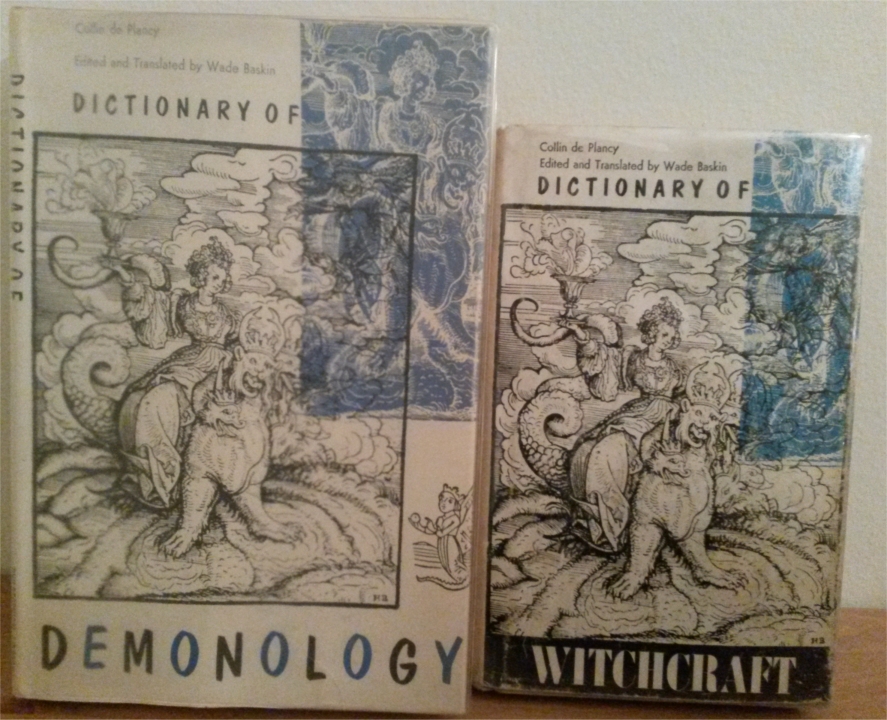
It’s a slightly larger version of the other book. I don’t mean larger as in expanded; I mean the pages are a little bit bigger. Apart from the title, the Dictionary of Demonology is word-for-word the same book as the Dictionary of Witchcraft. It’s just an earlier edition.

Oh, I am fortune’s fool! I am a stupid dunce. I wear a nappy and pick my bum.

wtfOne of the very few differences between the books, this mysterious, apple-holding princess appears only on the cover of DoD.

Looking back, it seems pretty obvious that this would have been the case. There is a note in the Dictionary of Witchcraft that reads,’Originally published under the title Dictionary of Demonology’. I’m not sure how I overlooked this, although it might have something to do with the fact that this claim is erroneous. This book was actually ‘originally published’ under the title Dictionnaire Infernal!

Both books claim to have been published in 1965. Maybe the Dictionary of Demonology saw a limited run and turned out more popular than expected. Then the publishers could have decided to put out a second edition (using smaller paper to save on printing costs). This would account for the fact that Dictionary of Demonology is much harder to find than Dictionary of Witchcraft. (Also, the listed price on the book cover is $10 for DoD, but only 6 for DoW.)

suckyfontThe comic-sans title really screws with the tone of my bookshelf.

I know this post doesn’t really say anything about the content of either book (the earlier post speaks on that a little), but it has been immensely gratifying to write. I have wasted far more time and money on these books than is reasonable, but at least now I have answers. Maybe someday a person who is wondering about the difference between these two books will end up on this page, and my folly will be their deliverance. I can rest easy tonight, knowing that I might so aid the community.
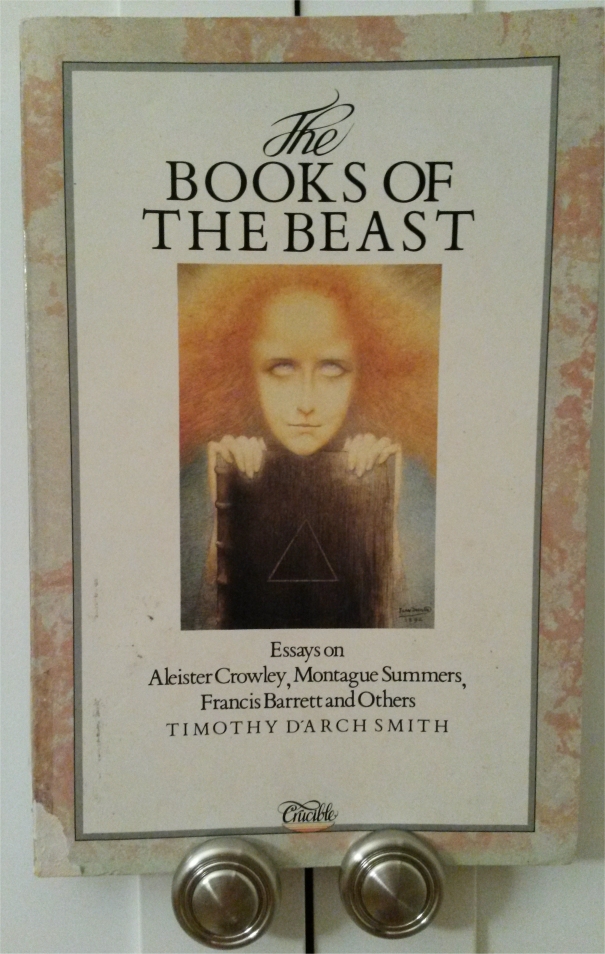
The Books of the Beast – Timothy D’Arch Smith

beastCrucible – 1987
This book popped up in my suggestions from Goodreads a few years ago, but it wasn’t until I came across a quote from it that claimed that Montague Summers had attended Black Masses that I decided to buy it.

It’s a rather interesting collection of essays about different books, their authors and their publishers. The first and longest essay is about Aleister Crowley and his predilections for certain colour combinations and kinds of paper. That might sound a little boring, but I assure you it’s a very entertaining read. Not only is it quite funny at times, it is also astoundingly well researched and documented.

Timothy D’Arch Smith didn’t know Aleister Crowley or Montague Summers personally, but he did know people that knew them. He was also a dealer of rare books for a very long time, and it is rather apparent that he’s an expert in the field. (He’s still alive; I don’t know if he’s still working.) The level of detail in here is genuinely exciting, not only because the subject matter is interesting but also because the author has apparently been able to devote his life to tracking down and examining and reading rare books about magic and sex. DEADLY.

Yes, that’s right; not all of the essays in here are about magic. One is about the collection of dirty books in the British Library and another is about Ralph Chubb, a gay paedophile. It turns out that T.D.S. is also an expert on the Uranian (bent ref) poets. Apparently there was a bunch of poets in the early 1900s who had had enough of keeping their desire to bum youngfellas to themselves. Ralph Chubb was really into it. Smith’s essay is very interesting, and I wanted to read some of Chubb’s poems to see what he was talking about, but I felt a bit wary looking them up on Google.

It is suggested herein (and elsewhere) that Montague Summers, a name my readers should be familiar with at this stage, might well have indulged in a few Uranian fantasies himself. This book also suggests that he attended Black Masses. Monty you scoundrel! In his own books, Summers violently condemns such activities, but it is here suggested that he was a practicing occultist in his youth. Smith believes that Summers was sincere in his admonitions against the Black Arts, but I’m halfway through Vampires and Vampirism at the moment, and I’m really finding it tough to believe that Summers was as credulous as he makes himself out to be. Then again, maybe he witnessed something genuinely diabolical at a Black Mass and set out to warn the world of the dangers of the powers of Hell. (Smith also wrote an entire book on Summers that I hope some day to obtain.)

There’s some other bits and pieces in here too. There’s an essay on Florence Farr (a member of the Golden Dawn who shagged both Yeats and Shaw) and an autobiographical piece. Both are interesting and worth the read. There is also a short essay on Francis Barrett, author of The Magus, an influential book of magic; however, from what I have seen online, modern editions of Smith’s book have replaced this essay with another chapter on Crowley. This seems a pity as I really enjoyed the piece on Barrett. (If anyone reading this review has a copy of the newer edition, I would be happy to scan the section on Barrett in return for a scan on the newer part on Crowley. Leave a comment or email me.)

The cover of my edition is super lame, and the page numbers on the contents page are wrong (I don’t know if it’s a numerological joke or a mistake), but all in all, this book was great; it’s short, funny and insightful. I read it in a day, but I feel that I’ll probably consult it again. Timothy D’Arch Smith seems like a real cool guy.

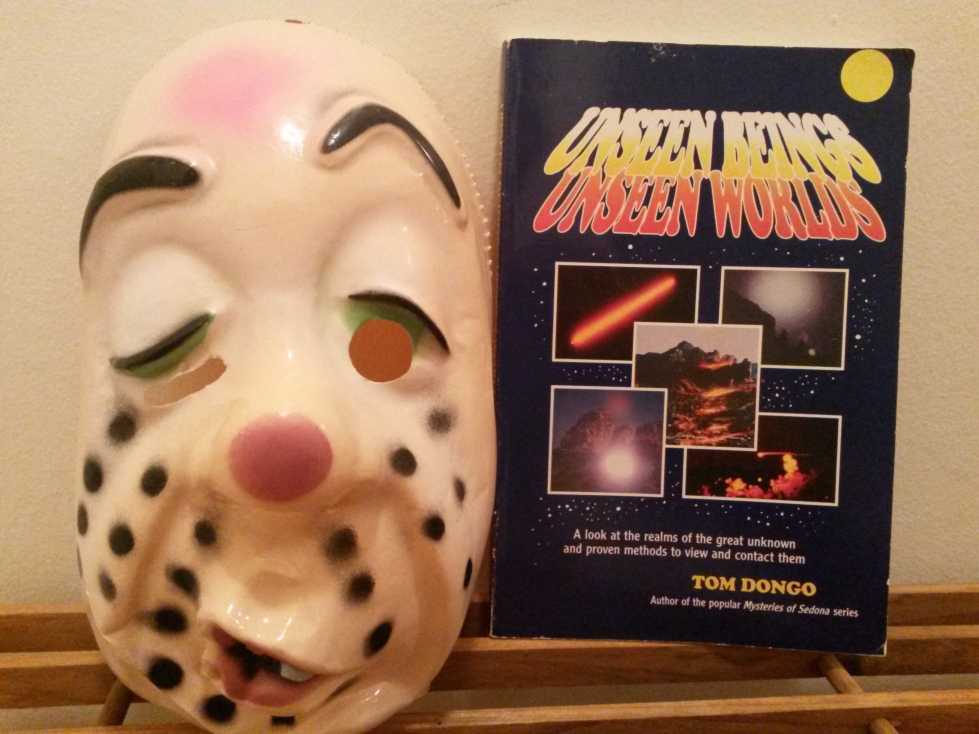
Unseen Beings, Unseen Worlds – Tom Dongo

1Hummingbird Publishing – 1994

This is a real piece of work. Somewhere in the introduction or the first chapter, Tom Dongo claims to be an extremely skeptical individual who is unwilling to accept anything that he hasn’t been able to prove to himself. He then goes on to write a book about his personal experiences with remote-viewing, aliens, the astral plane, demons, telepathy, reptilians, ghosts, channeling, and banshees. One has to wonder what counts as proof in his mind.

I’ve read lots of books about stupid topics that were written by what seemed to be relatively intelligent authors. (I would have imagined that the sillier the topic, the smarter the author would have to be to convince a publisher to put out their work.) Take Preparing for Contact as an example. It is utterly stupid, but the author managed to sculpt all of that stupid into an impressively cohesive whole. Psychic Discoveries Behind the Iron Curtain is a truly moronic nightmare, but the authors had clearly done a huge amount of scholarly research. Unseen Beings, Unseen Worlds lacks any traces of cohesion or intelligence. The author is an ignorant, arrogant fool of a man who has absolutely no ability to make sense. This is proof that anyone can write a book; it’s just a bunch of ridiculous ideas that popped into the head of a stupid weirdo.

2Ned Flanders… Wait, sorry, I mean Tom Dongo

Mr. Diddleyongo is of the opinion that many cases of mental illness are actually just cases of possession. He believes wholeheartedly in leprechauns. He claims that he can leave his body and travel around the universe. He often talks to spirits from different planets and dimensions. The man is a fucking imbecile.

Imbecile he may be, but stupidity isn’t a crime; the really irritating thing about Tom is the way that he talks about himself. He’s a know-it-all plonker. But, this isn’t really a book about the paranormal; it’s a book about Tom Dongo’s imagination. The ironic, and perhaps most infuriating, thing about this piece of rubbish is that the second chapter begins with the sentence; “I think I have read or am aware of just about every paranormal, esoteric, spiritual, and metaphysical book in print and many that are out of print.” The arrogance of that statement really put me in a foul mood when I read it. I would imagine that Tom’s reading was probably limited to whatever books were on the paranormal shelf in his local library.

I was going to go on and talk more trash about Tom Dongo, but after some consideration, I have concluded that he probably has some kind of mental impairment, and so it’s not really fair to make fun of him. I don’t think that a healthy, normal person would be willing to publish anything this cringe-worthy and idiotic.

3My copy is signed by the author too! Aren’t you jealous?
 

Foucault’s Pendulum – Umberto Eco

fp
Ballantine – 1990 (Originally published in Italian in 1988)

Most of the books that I review here are either too shit or too enjoyable to be clever. This one however, while it is rather enjoyable, is a rather astute piece of writing.

The plot is surprisingly simple. I’ll outline it in a way that won’t ruin the story for you: 3 book nerds, for a laugh, decide to patch together a ridiculous conspiracy theory. After a short while, they, and others, start to take their conspiracy too seriously and things get fairly messed up. That’s it. But if that’s the whole story, why is the book 500+ pages long? Well, Eco goes into detail, a LOT of detail, on the conspiracy that his characters are creating.

While the book is filled with interesting facts from what must have been an absolutely enormous amount of research, it’s not so much the conspiracies that are of interest as it is the psychology and biology of conspiracies and arcane ‘knowledge’. To put it another way, this is not a book about conspiracy theories in the same way that the Da Vinci Code is; this is a book about how conspiracy theories work. (Eco, when asked if he had read the Da Vinci Code, claimed that Dan Brown was one of the characters in this book.) While this book will satisfy readers of conspiracy fiction by mixing and matching their favourite secret societies and magicians, it will also force that reader to contemplate how silly most conspiracies really are. The way Eco engages with conspiracies only to end up making fun of them is really tactful. He never denies that they’re fun and interesting, indeed he would have had to have been a severe masochist to have thought that and written this book, but ultimately, he gives very little credence to any of them. Ah Umberto, a man after my own heart!

I really enjoyed this book. The subject matter is precisely the kind of crap that I like reading about, and the characters were great too. It does get a little heavy on the details at times, and I’d recommend having a decent understanding of who the Rosicrucians, Gnostics, and Templars were before you start. If you do decide to read it and feel like you’re getting bogged down in the details of the eclipse that occurred during the 14th birthday party of the blind translator of a coded manuscript detailing the fate of an obscure heretical sect from Southern France, you can probably just skim through those paragraphs without missing out on crucial plot details.

The book opens with the narrator snooping around the National Conservatory of Arts and Crafts in Paris. He has an appointment at midnight under the Foucault Pendulum housed therein, and he is trying to find a place to hide where he will not be noticed by the security guards as they are closing up. When I discovered that my University also houses a Foucault Pendulum, I determined to recreate that scene to the best of my ability.

I waited until the 23rd of June, the same day that the book’s narrator goes to see the pendulum in the Conservatoire. Unfortunately, I found it very difficult to sneak effectively, as there were very few people around to be suspicious of me. Regardless of this, I surreptitiously tip-toed into the building, constantly casting glances behind me in the hopes that I was being trailed. When I got to the pendulum, Disaster! Somebody else was standing there looking at it. I contemplated asking if he was there for the same reason as myself, but in the interests of my own personal safety (and dignity), I decided against doing so. I pretended that I wasn’t interested in the pendulum; I walked straight by it, exited the building, and bought a cup of coffee in a nearby cafe. I waited maybe 10 minutes and returned. The coast was clear, so I took the following video and ran for it.

I fear they may have seen me leave the campus. I am in hiding now, but I know that they will find me eventually. All I can do is wait. I might as well sit here and look out the window at the willow tree in the garden outside.

It’s so beautiful.


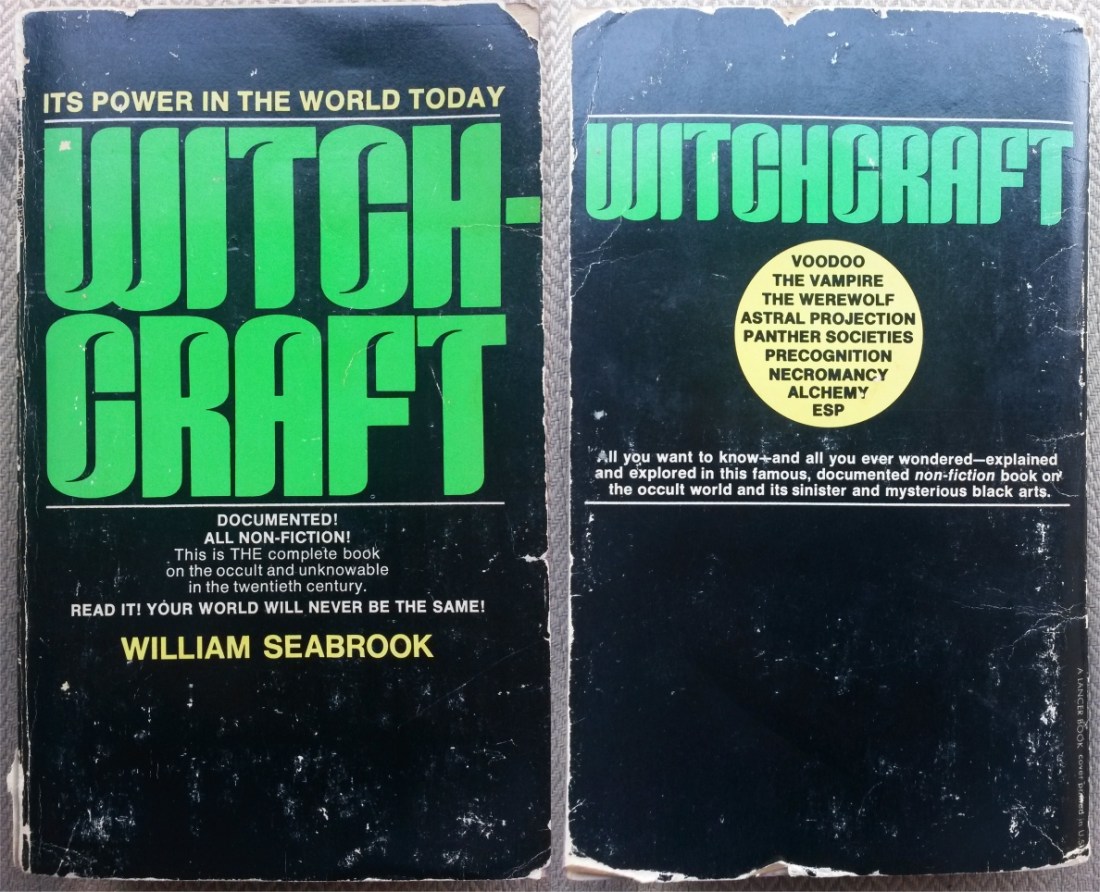
Witchcraft (Its Power in the World Today) – William Seabrook

witchcraft

Willie Seabrook was an explorer, cannibal, black magician, bondage freak and journalist. This is his book on Witchcraft, and it’s fucking wonderful. The book deals with Seabrook’s personal experiences with witchcraft, and while a lot of it is fairly unbelievable, it is deadly craic. It’s a bit like reading a Dennis Wheatley novel told in the first person. I put this on my to-buy list after reading about it in Cavendish’s Black Arts, but after seeing it referred to in my favourite section of the Illuminatus! trilogy, I knew I had to get my hands on it. The  Illuminatus authors have Seabrook playing a part in a conspiracy involving Ambrose Bierce, Arthur Machen, Aleister Crowley, Robert W. Chambers, J.K. Huysmans, and H.P. Lovecraft. (Expect a post on Bierce soon; I reckon I’ll get around to Chambers before Christmas.) It is implied that the Illuminati murdered Seabrook over what he published in this book and made his death look like a suicide.
20160625_221219
(p. 296, Illuminatus! Trilogy)
After reading this, I had to own a copy of Seabrook’s book. It’s not super rare, but it took me a while to track down a copy for what I considered a reasonable price. My edition has a fairly boring cover, but the edges are coloured an interesting purple.
purpleaki
Beyond the Mauve Zone?

So there’s three parts to the book. Each part is comprised of short accounts of different things that Seabrook witnessed. The first part is on Doll magic, and it’s probably my favourite. There’s one particular story about a deceitful white explorer in Africa that I absolutely loved. A lad cheats a tribe out of money and soon thereafter goes missing. Seabrook was mates with the lads in the tribe, and one day, one of the boys asks if he wants to see something interesting. Guessing that it has something to do with the disappearance, Willie warns him that if its the missing white man, he’ll be obliged to tell the police. The native laughs this off and brings Seabrook into the jungle and shows him something good. It’s the rotting corpse of another native, strung up to a tree. The ropes binding it to the branches are digging into the flesh of the corpse’s bloating neck, and things are starting to ooze. The corpse is wearing the clothes of the missing explorer, and if Seabrook was to have gotten up close, he would have seen clippings of the missing explorer’s hair stuck onto the head of the corpse.

The missing explorer was found dead a few days later after having died of a constricted windpipe. Black magic had caused what had happened to the corpse to also happen to the victim.
Fuck yes. That is the good stuff.

The second part of the book is on Werewolves and Vampires, and the third is on general occulty stuff. It tells of Seabrook’s friendship with Aleister Crowley.  This book is the origin of that famous story of Crowley walking behind a man, mimicking his gait, and consequently being able to make him collapse without touching or speaking to him. There’s also a part in here about Seabrook’s relationship with Upton Sinclair, author of Oil!, the most boring book I have ever read.

The book ends with a few chapters about kinky psychic-bondage experiments that Seabrook performed with his lover. He had a special gimp mask made for his partners that was basically designed to maximise sensory deprivation. He’d make his girlfriend Justine wear this mask, then tie her up by the wrists until she started hallucinating. They hoped these hallucinations would tell the future. The following images are not from the book, but they are extremely relevant. (They’re from an article about Seabrook from a 1942 edition of Click Magazine.)
seabrook's babe
One of Willie’s babes. Looks like he knew how to pick them.

seabrook mask
He was a man that knew what he liked, God bless him.

Overall, this book is delicious. The stories might seem unbelievable, but that hardly matters. They’re entertaining. Plus, the author maintains that he doesn’t believe in magic the whole way through the book, and his incredulity is charming. Seabrook comes across as  a remarkably interesting, and I am definitely going to keep my eye out for his other books. There were a few times in this one when he would write something quite rude, and it would take me a while to figure out if he was being bold or not. At one stage, I believe he refers to a woman’s vagina as a pickle-jar, but maybe he meant something completely different.  Like other similar books, this contains references to other texts that I am going to have to try to get my hands on. Unfortunately, some of the books mentioned herein are fairly rare, and any copies I can find are extremely expensive. Oh well, I guess I’ll have to wait till I’m rich. Until then, I’ll leave you with some awesome pictures that I found after hunting down a reference from this book. On page 20, Seabrook mentions an article from a 1939 edition of Life magazine about Ozark superstitions. Finding the full thing online really made me happy that we live in the internet era. (Full article here)
witch
This is why I do this blog. DEADLY!

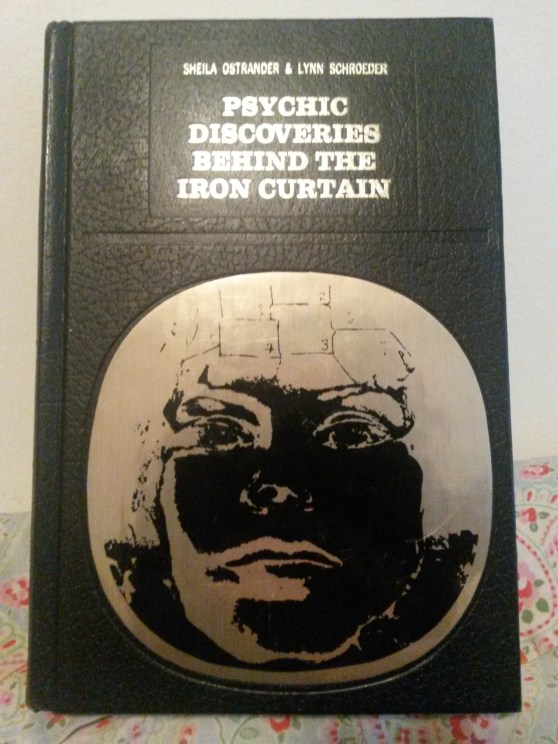
Psychic Discoveries Behind the Iron Curtain – Sheila Ostrander & Lynn Schroeder

20160617_180123
Laffont – 1970
I’m not going to read any more shit books for a long time. This horrendous pile of nonsense has ruined my month. ‘Look at the title though!’, I hear you say, “What did you expect, you fool?” Well, I knew it was going to be awful; I just underestimated how unbearable the nonsense would be.

This book was written in 1969/1970, and its major claim is the Russians are on the verge of several major breakthroughs in the field of parapsychology. The writing isn’t too bad; the book was clearly well researched, and there are lots of examples given, each described in detail. The main problem with reading this book is that it’s almost 50 years old, and, as far as I can tell, nothing much has come of any of its discoveries or predictions. Some old Russian lad guessed a bunch of cards; pffffft, who cares?  While not quite as nutty as Morning of the Magicians, this has a similar vibe to it, and it actually makes reference to Pauwel and Bergier’s work. While reading this one, I found myself constantly wondering if people 50 years ago were more gullible, but then I found this video (of two absolute legends), and I realized that people today are no better.

There is another book from the same authors simply titled Psychic Discoveries. I would have thought that that was just a different title for this book, but I read something online that suggests that it’s actually an earlier version. I’m not sure. They also wrote a book called Psychic Discoveries: The Iron Curtain Lifted in 1997, but hopefully I’ll never find a copy of that one.

Here’s a video of the actual authors being interviewed. The host is a dork, but the ladies seem genuine.
side
Sheila Ostrander’s hairstyle is the only paranormal element of the video that remains unexplained.

I could discuss specific cases from the book, but why bother? It’s all a load of shite. The only specific thing that was interesting enough to remember was the laboratory experiment that was set up to see if a clairvoyant could prevent the events they had foreseen from happening. Let me clarify how that experiment was structured:

  • The psychic would sit down and try to read the future.
  • Once they had predicted what was going to happen, they would have to think about how they could stop that event from happening.
  • The next step would be to actually stop the foreseen event from happening.
  • If the psychic managed to prevent the foreseen event, the experiment would be deemed a success.
  • That’s right; the experiment would be deemed successful if the foreseen events did not actually end up happening.
  • The only way for the experiment to fail would be for the psychic to actually be psychic.

What the fuck were you thinking, you stupid Communist bastards!

I bought this as part of a set at a library book sale a few years ago. The other books in the collection are about aliens and psychics and the like.
20160617_192800
The physical books are really nice, and I’d love to see a complete list of all the titles published in this series. They were published by Laffont. (So far, I have only reviewed Chariots of the Gods?.)

The other big problem with Psychic Discoveries behind the Iron Curtain is that it’s 400 pages long. It was too boring to read much of in one sitting, and so I spaced it out over my bus rides to school and back. It took me about a month, but I couldn’t bare for this to eat into any of my leisure reading time. I read it because it had a gnarly title, but it wasn’t worth it. Don’t waste your time.

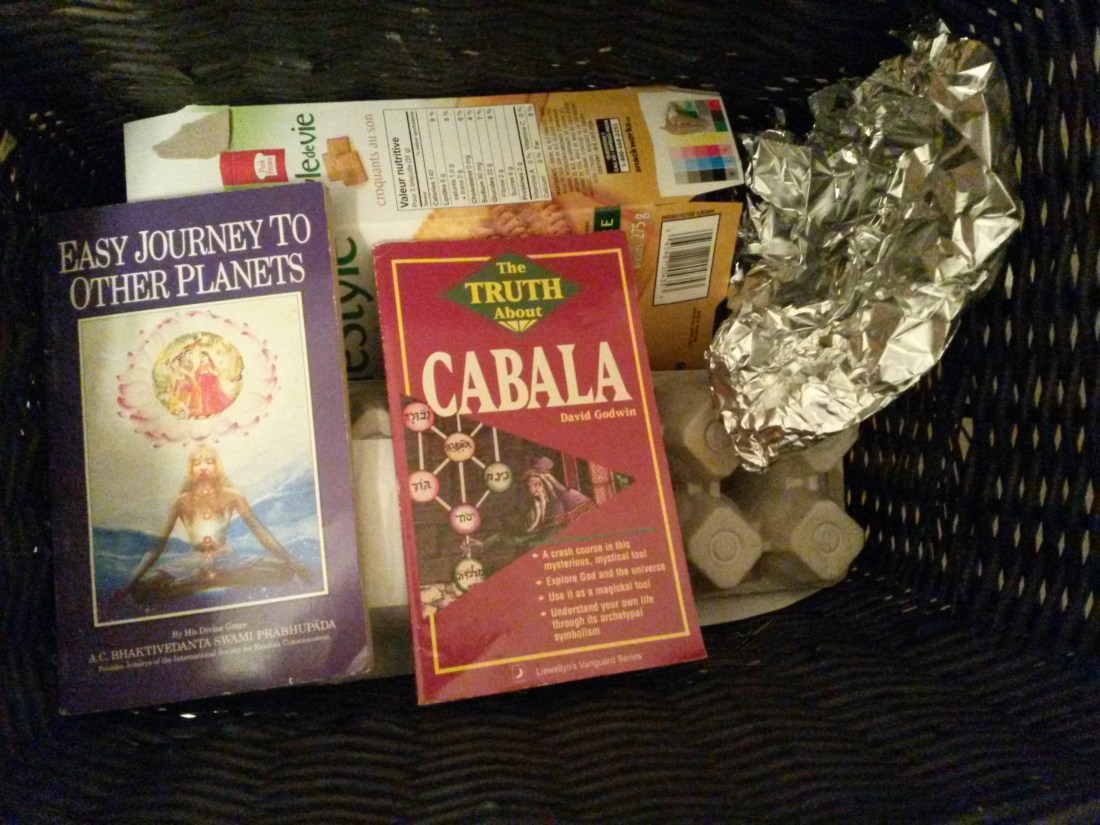
Easy Journey to Other Planets and The Truth About Cabala – Two pieces of trash

20160612_224655I thought these books were going to be pieces of shit when I bought them. I was right.

The Truth About Cabala – David Godwin
1994 – Llewellyn Publications
The one on Cabala isn’t too bad. I mean, if you wanted a little book to introduce you to the topic, this would do the trick. I’ve read a few books that required some understanding of Cabala (the Illuminatus! Trilogy, Transcendental Magic, Alan Moore’s Promethea series…), but I think the whole thing is a load of shit. Whatever though, this is only 50 pages long. I got through it in one sitting.


Easy Journey to Other Planets – A. C. Bhaktivedanta Swami Prabhupada
Bhaktivedanta Book Trust – 1997 (Originally published 1970)
Easy Journey to Other Planets is a really awful book. It starts off with the author claiming that the Bhagavad Gita pre-empted science in its discovery of antimatter. He then proceeds to reveal his complete misunderstanding of particle physics. The rest of the book is about how reincarnation is real. Overall, this is a crumby read, and although it’s quite short, it took me longer than expected to get through. Each day, I read a few pages as I shat in the toilet, but I couldn’t allow this nonsense to interfere with any other part of my life. Just thinking about this book brings a waft of shit to my nostrils.

20160612_224734
The face of a con-man.

I was hoping for some tips on making easy journeys to other planets, but all I got was some cretinous garbage about yoga. The author seems to believe that actually going to another planet would be a total waste of time. He says that the only way it would benefit us to visit a different planet would be for only our spirit to go. Fuck that. And the plonker doesn’t even give instructions on how to spirit-visit the planets; he gives tips on the things that you should do if you want to try to spirit-visit. Basically, this is instructions on how to get instructions. Truly, a piece of dirt. Fuck this shitty, scatty, awful, idiotic book.

20160612_224827
What would you want to do if you met God?
Ehhh, I’d like to muck about with him and some cows, please.


Two awful books that aren’t worth reading. I paid a grand total of 50 cents for the pair of them, and to tell the truth, I regret it.

Who is the Duke De Richleau? The Devil Rides Out, Strange Conflict and Gateway to Hell

It may come as surprise to some of you, but I am neither French nor a Duke. Le Duc De Richleau is the hero in a collection of 11 novels by Dennis Wheatley. For all of the philistines reading my blog, Wheatley was a prolific author of trashy adventure novels. Most of his books were spy novels, but he was also a self proclaimed expert on the occult, and some of his books, 2 of which I have already reviewed, deal with black magic. The Duke De Richleau series contains 3 Black Magic novels, including The Devil Rides Out, perhaps Wheatley’s most famous book.


20160605_232803
The Devil Rides Out
Hutchinson and Co – 1972 (Originally published 1934)
It’s been a long time since I read this one, but I remember it well enough to know that you don’t need an in-depth review to decide whether or not you should read it. This book is about Satanists, pentagrams, rituals, goats, spells, and demons. If you know that much and don’t want to read this, you’re a piece of shit. This is definitely one of the best places to start if you haven’t read any Wheatley before. The movie is deadly too, but for the love of Satan, read the book first.
2016-06-05 23.32.5920160605_232906
My copy of Devil Rides Out is a fancy hardback reissue. Some of these have illustrations.


20160605_232704
Strange Conflict
Arrow – 1981 (Originally published 1941)
Unlike the other two books in this post, I read this one last week, so it’s still fairly fresh in my memory. This was an enjoyable entry to the series, but it’s a pretty bad book. It sees the Duke and his mates being hired to discover how Nazi U-Boats have been successfully figuring out the trade routes of English ships. Using astral-projection, the Duke figures out that the Nazis are getting their info from an evil Voodoo priest in Haiti. Ok; Voodoo Nazis, sounds great right? Well yeah, that is super cool, but let’s just think about the idea of using astral projection as a means of espionage for a moment. Astral projection gives the Duke the ability to leave his body and go anywhere in the world. The book starts off with him sitting in his apartment in London as the city is being bombed to shit. WHY THE FUCK DID HE WAIT 2 YEARS TO START SPIRIT-SPYING? Why did he not volunteer to start sleep-creeping the Nazis as soon as they entered Poland? Also, out of the Duke’s team of friends, 3 out of the 5 are able to astrally project themselves. If 60% of people can do so, why the fuck were the British government so fucking slow to organize a full-on Astral attack on Germany? It doesn’t make any sense.

Anyways, as soon as they figure out that the bad guy is in Haiti, they decide to head over to kill him in his sleep. I have mentioned elsewhere that Wheatley was not one to be concerned with cultural or political sensitivity, and a trip to Haiti provides several lolworthy examples. This was written in 1941, so the author’s use of the term Jap is excusable, but referring to the “Jap” character as a “dirty little yellow rat” might be a bit much for the modern reader. Failing that, the description of the Haitian natives is sure to offend:
“Those coloured bums have just no powers of organisation at all and it’s like one big tropical slum. If it weren’t for the climate and the masses of fruit that can be had just for the plucking the whole darned lot of them would have starved to death long ago… The niggers live in little more than tents made from tying a few banana palms together.”  There’s another thoroughly unpleasant passage describing the parents of a missing teenager whose corpse has just been found in the hospital; “The man and woman were Mulattoes… The woman was a characterless bag of fat which appeared to have been poured into the good-quality silk dress that restrained her ample figure”.
He also refers to one of the black characters as a “wooglie”, although I’m not entirely sure whether or not that’s a racial slur. (My guess is that it probably is.) To top it all off, the book ends in an amazing proclamation on the superiority of the Anglo-Saxon race.

2016-06-05 23.31.59
Mr Wheatley, you charmer!

I’ve mentioned elsewhere that I don’t mind reading racist books as long as I’m not giving money to the author. In this case, the author is long dead, and I buy these books second hand. However, the most recent editions of Wheatley’s novels have been abridged, and the horrible racism and misogyny have been removed. This is utterly infuriating. It’s not that the publishers want to prevent the spread of racist ideas; it’s that they want to make Wheatley more palatable to the tumblr generation. Fuck that; if you buy a book about Nazi devil-worshippers but get offended by fictional characters’ racism, you need to kill yourself immediately. Yes, Wheatley was a shit, but if you can’t read a book by a person that you might not like in real life, you’re a stupid fucking loser. If you come across something in a book that makes you uncomfortable, think critically and learn from the experience. Censorship of literature is immoral, and anyone who begs to differ can go and help themselves to a hearty swig of bleach.

The rest of this book is standard Wheatley fare; chases, rituals, beautiful but enchanted young women, demons, the works… The ending involves a bit of the old deus ex machina, and I got the feeling that ol’ Dennis might have been making it up as he went along. I wouldn’t recommend this one as a starting point for his work, but it’s worth a read if you like this kind of garbage.

20160605_232625
Gateway to Hell
Arrow – 1974 (Originally published 1970)

I don’t remember much about this one to be honest. It definitely wasn’t as good as Devil Rides Out, but I gave it 5/5 stars on goodreads, so it was obviously thoroughly enjoyable. More diddies on the cover too; can’t go wrong like.

Overall, Wheatley’s writing is bad (He admitted so himself), his plots are silly, and a lot of his ideas are liable to trigger you into oblivion, but I really love his books. There’s something comic-booky about them, and I like to treat myself to one in between heavier stuff. These are just the Black Magic novels from the Duke De Richleau series, and I’ll probably review the others at some stage too.

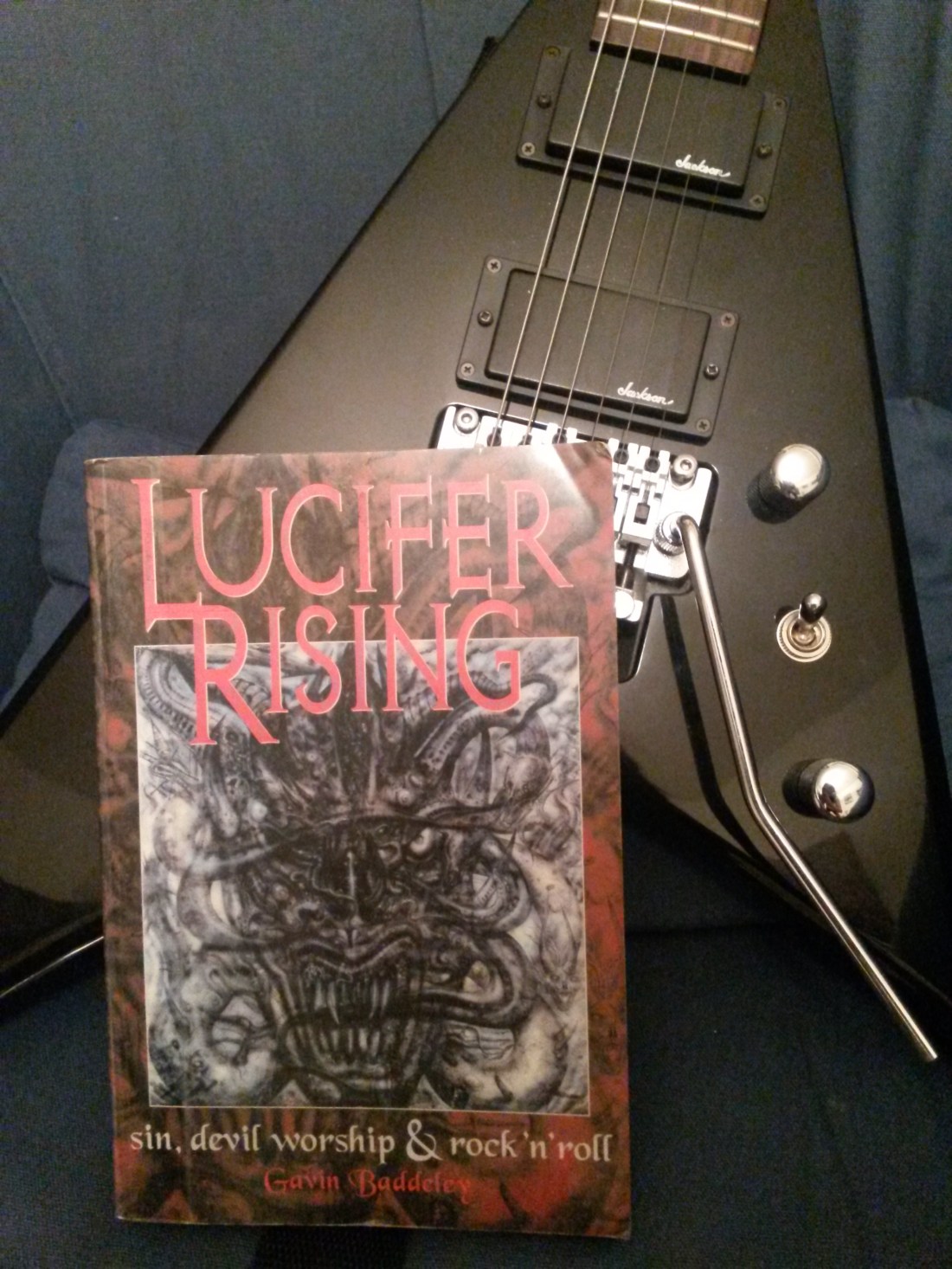
Lucifer Rising – Gavin Baddeley

20160512_224450
Plexus – 2006

This book deals with the different manifestations of Satanism within modern culture. It focuses on rock music and heavy metal, but it also discusses serial killers and horror movies. Sounds pretty great, right? A recommendation for this book showed up on my goodreads account, and my copy was ordered within moments of reading its description. I’m pleased to say that it didn’t disapoint. The author is a priest in the Church of Satan, and the history and outlook of LaVeyan Satanism is central to this book. I like LaVey, so I was entertained, but the author’s tone might be grating on some readers, particularly if they were Christian.

The first few chapters give a short yet surprisingly comprehensive history of Satanism, but the latter half of the book is mostly taken up with interviews. Some of these are excruciatingly embarrassing (Glen Benton is an idiot), and some are genuinely hilarious (Euronymous is precious). Varg Vikernes from Burzum has claimed that the interview with him is entirely fake. (He also claims that this is the worst book that he has ever seen.) I know lots of Burzum fans who claim to dislike Varg. Well, I always thought Burzum’s music was crap,  but I think he’s a pretty funny guy. (Don’t get me wrong; I know he’s a right-wing scumbag, racist, murderer and all-round crazy person, and I certainly wouldn’t say that I ‘like’ him, but let’s be honest; he regularly brings the lols.) There were a few interviews in here that weren’t hugely insightful, and it seemed that some of the interviewees may have been chosen based on their availability rather than their unique insight or authority on the topic, but this doesn’t take away from the cooler parts of the book. It might also be worth noting that I’m a fan of quite a few of the musicians interviewed herein, so I was probably more entertained than most people would be. If you don’t like rock music, this book might be a bit boring.

Baddeley suggests that there are as many different forms of Satanism as there are forms of christianity. (He also shows how hazy the lines between some forms of christianity and Satanism can be.) This book acknowledges the fact that Satanism is a very loosely defined set of beliefs and behaviors, and the author provides a thorough and entertaining account of the movement’s more interesting facets. (I picked up some cool recommendations for bands, movies and books too.) Overall, I would recommend this as a good primer for anyone with an interest in the Devil’s place in Rock’n’Roll.

I started writing a paragraph about my own take on Satanism, but it turned very lengthy very quickly, so I think I shall save it for a later date. Until then, Hail Satan!
(Update: This is what that paragraph eventually turned into.)


Edgar Cayce on Atlantis – Edgar Evans Cayce

20160509_204712Warner Books – 1968

This is one of the stupidest, shittest books that I have ever read. I started reading it in February, but school got busy and I gave up on it. Things have eased up a bit recently, and I saw this piece of garbage lying on my shelf, mocking me and boasting to my other books that it been victorious in clogging my bullshit filter. “No!”, I said, “I shall not be defeated!” I picked up the book with renewed vigor, and forced myself to wade through 170 pages of handicap.

Edgar Cayce was a lad from America who claimed he was a psychic. I watched a shite documentary on him once, and I wasn’t very impressed. He would pretend to be asleep and then diagnose people’s diseases. He also gave people information about their past lives and that kind of crap. Somehow, I have amassed a small collection of books about him, but after reading this one, I imagine it will be quite a while until I read any more of them.

20160509_204445.jpgMy Cayce Collection

God, even thinking about explaining what this book is about is making me feel embarrassed. Reflecting on the fact that I knowingly spent several hours of my life reading a book by an idiot about an idiot for a bunch of idiots is making me think that I ought to find a new hobby.

So the idea here is that 12,000+ years ago, Atlantis was an island inhabited by spirits. The spirits wanted to interact with the physical stuff on the island, so they entered into living bodies. Or maybe they created the bodies; I can’t quite remember. Either way, these living bodies were not quite human; some had animal parts. Then, after a bit, some of the weird creatures turned greedy and a split occurred. Half of them remained sound, but half of them turned bad. The bad ones were called the ‘Sons of Belial’, and the good ones were called …something else; I’ll be fucked if I’m reopening the book to find out. So the two factions went at each other, and Atlantis was destroyed. The lads took off, probably in their nuclear powered flying machines, and a bunch of them ended up in Egypt.

When they got to Egypt, there were so many Atlanteans that the Egyptians didn’t know what to do. Somebody came up with the idea of bringing back RaTa. Now, RaTa, for those of you who weren’t aware, was a high priest who had been banished from Egypt. Anyways, RaTa was a bit of a genius too, and he managed to help the Atlanteans assimilate into Egyptian culture. This is how probably how the Egyptians learned about pyramid power and all of that shit. Oh yeah, I forgot to mention; RaTa, the diplomat, outcast, high-priest and all round hero of the story, was actually a previous incarnation of Edgar Cayce himself.  I can’t remember if the book ever mentions why he had been banished from Egypt. I personally suspect that it was for molesting young boys.

This book is a piece of dirt, fouling up my bookshelf. I started off reading it on the toilet, but I found that it gave me constipation. I’ll never read it again. Edgar Cayce was a stupid bastard.