Sinister Forces: A Grimoire of American Political Witchcraft (Part 1: The Nine) – Peter Levenda

sinister forces the nine levendaSinister Forces: A Grimoire of American Political Witchcraft (Part 1: The Nine)
Peter Levenda

I used to think that I was more interested in conspiracy theories than I really am. Investigating these theories becomes far less alluring after you’ve done it a little bit.

There’s a few reasons why I think researching conspiracy theories is a waste of time:

  1. The internet has to be your main source of information – these theories evolve too quickly for books to be worthwhile anymore. But anyone can post information on the internet. There is such an abundance of crap online that you’ll rarely get to the bottom of anything.
  2. At this point in global history, the current state of politics is actually as twisted, shady and worrying as any conspiracy you can imagine.
  3. In the era of QAnon and fake news, belief in conspiracies has become too mainstream to be cool. I want to be in the same party as Frohike, Langly and Byers, not Margery from Nebraska.

Peter Levenda’s Sinister Forces series is about American conspiracy theories. It covers everything you’d expect; MK Ultra, the Manson family, the UFO phenomenon and everything in between. Unfortunately, Levenda doesn’t just describe these theories; he tries to link them all together. Can you remember Umberto Eco’s book, Foucault’s Pendulum? Levenda is like a comic-book version of the characters in that novel.

This was a very boring read. Every now and then an interesting bit would pop up, but I didn’t come across a huge amount of interesting information that I wasn’t already aware of.

I found the stuff on the mind control of Candy Jones interesting, but this was largely because of the similarity of her name to the name of one of the characters in Russ Martin’s Satanic mind-control series.

candy jones candy sterlingTwo books about mind-controlled beauties. Is there a link?

The only part of the book that actually convinced me of anything was the discussion of government agencies’ use of disinformation. That the American government has fed its citizens deliberately obfuscating untruths is undoubtedly true. The extent and nature of these untruths is a remarkably interesting topic, but it’s also one that very few, if any,  people can discuss with certainty. There’s always another layer of deception that could be peeled away.

A lot of the stuff in this book is pretty X-Files-y, and Levenda actually references the work of Mulder and Scully a few times throughout. I love the X-Files, but that series presents itself as fiction. Levenda’s talking about real life, and his ideas are far too convoluted to be remotely convincing.

I was planning on finishing the series, but I couldn’t get more than a few pages into the second book. I’ve had a copy of Levenda’s Unholy Alliance on my shelf for a couple of years now, and I reckon it’ll be another few before I get the courage to pick it up. Levenda recently co-authored a book about aliens with the singer from Blink-182. Yuck.

Gilles De Rais, the Perverted Son

trial of gilles de rais george batailleThe Trial of Gilles De Rais – George Bataille
Amok Books – 1991 (Originally published 1965)

Gilles de Rais is the kind of person that makes the belief in Heaven and Hell extremely appealing. There is no satisfaction to be derived from the fact that he was executed for his crimes. Those crimes were so hideous that their perpetrator deserves an eternity of agonizing torment – a quick execution is no payback for the brutal torture, rape and murder of countless children.

Gilles was an extremely powerful and ludicrously wealthy nobleman in 15th century France. For roughly 10 years, the Baron De Rais had his servants abduct poor children to satiate his hideous desires. He would slowly torture and murder them, usually stabbing them in the neck, sometimes severing their heads completely. As they perished, he would sit on their stomachs, peer into their dying faces and laugh. These victims would be raped at various stages during this process. After decapitating them, the Baron would kiss the children’s severed heads.

Oh, and while these horrendous acts were doubtlessly the result of de Rais’ depraved sexual impulses, he performed them in the name of the Devil. He employed several black magicians to help him communicate with demons. These sorcerers took De Rais for a fool. They would attempt to raise demons in front of him and after a while of nothing happening, they’d send him out of the room and lock the door. Then they’d start screaming in terror, and when Gilles would come back they’d tell him that the Devil told them to ask for some more money. Gilles would grant this request immediately. At other times, they would ask the Baron to provide them with the limbs and organs of dead children. These same sickos would also be present when Gilles was torturing kids. It seems that they were part of an abhorrently disgusting necro-paedophile ring. These scum were worst of the worst.

Gilles De Rais was eventually brought to trial for kidnapping a priest, and when the authorities started investigating the Baron, they heard the terrible rumours that had spread about him.

During a relatively painless trial (no torture on record), Gilles de Rais confessed his guilt and repented. He was excommunicated, but he was soon thereafter re-communicated by the Catholic Church because he had willingly confessed. The Church took the allegations of kidnapping a priest and being an alchemist more seriously than the rape and murder of countless children. Gilles was executed quickly, and the locals in his area were given a 3 day holiday to grieve for their master.

I don’t know guys. This is remarkably unsatisfying. I wanted to read about this lad dying slowly in unspeakable agony. His crimes are so gruesome that my initial response (and the response of many others) was to assume that the charges against him were false – they’re just a bit too extreme to imagine them really happening. That being said, the best evidence that is available to us, the court documents of his trial, provide a very cohesive and damning account.

It is these documents that make up most of the text of George Bataille’s The Trial of Gilles De Rais.

This is a very repetitive book. The first section is comprised of Bataille’s philosophical ramblings on the case. The second part is a very, very detailed timeline of Gilles De Rais’ life, much of which was already covered in the previous section. The last section is made up of the court documents of the trial. There is very little information in these documents that has not been discussed previously in the book. Also, court documents are fairly repetitive by their nature, so this book ends up delivering the same story about 5 times. I do appreciate the comprehensive nature of this book, but I think it would have been more effective to put the timeline first and Bataille’s thoughts after it.

The content of this book makes its repetitive nature remarkably depressing. You get to read about poor parents searching for their murdered children over and over again. This is fucking harrowing stuff. Bataille was a bit of a weirdo though, and I guess this was intentional. I read his Story of the Eye years ago, but I remember very little of it.

I’ve already mentioned that some people think that Gilles De Rais was the innocent victim of a conspiracy. He was a wealthy politician with plenty of enemies, and it is likely that many other people would profit from his downfall. My old friend Aleister Crowley was one of the individuals to proclaim the innocence of the Baron de Rais.

In an infamous lecture that was never delivered, Crowley argues that it was very likely that De Rais was framed. He argues that the claims against de Rais are too ridiculous to be taken seriously – they sound too similar to rumours spread to villainise the Jews throughout history. Crowley seems to have read a very different account of the trial of De Rais to the one presented in Bataille’s book though. Aleister claims that De Rais only confessed to his crimes when tortured, but the court documents presented by Bataille show that De Rais actually managed to avoid being tortured by confessing. Also, while the number of victims in Bataille’s text ranged from 35-140, Crowley gives the number of victims as 800 on the authority of Montague Summers. Summers, as we all know, was either very gullible individual or just prone to sensational exaggerations, and Crowley, an acquaintance of Summers, had to have known this. The swarmy, sarcastic and provocative tone that Crowley uses throughout the lecture make it seem all the less convincing.

I’ve encoutered De Rais a couple of times in fiction. The protagonist in Huysman’s Là-bas spends his time researching the evil Baron, and Gilles himself comes back from the dead to appear in Philip José Farmer’s Image of the Beast. And Ough! – he’s obviously a heavy metal hero too. I have a tshirt with a picture of him on it. I don’t wear it to work.

gilles de rais macabre shirt.jpgIt’s for this rather silly but historically detailed song.

I’d like to believe that De Rais was innocent, but the testimonies collected in Bataille’s book are very cohesive. It would be far more comfortable to believe that Gilles De Rais died an innocent man than to accept the horrendous deaths his victims suffered at his hands. This guy seems to have been a real piece of shit.


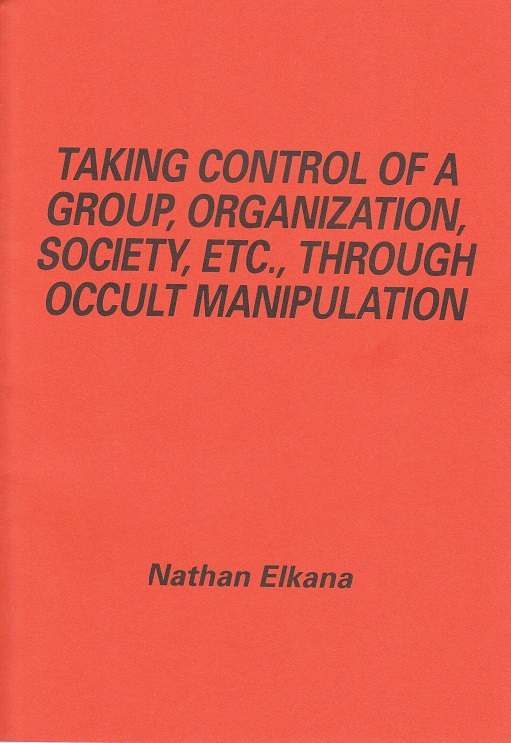
Taking Control of a Group, Organization, Society, etc., through Occult Manipulation – Nathan Elkana

Taking Control of a Group, Organization, Society through Occult Manipulation - Nathan ElkanaTaking Control of a Group, Organization, Society, etc., through Occult Manipulation
Nathan Elkana
Finbarr International – 2008

Jesus Christ, the world is home to some seriously pathetic human beings. I read this piece of garbage on the bus today. It’s awful shit, but it’s only 9 pages long. Here’s what the cretinous author has to say for himself:

There must be an unseeable world because existence is dualistic – there is no black without white, so if there is something that physically exists, it follows that there must also be something that does not physically exist. The author doesn’t mean that there are things that don’t exist though; he means that there are things that don’t exist physically. That which spiritually exists is obviously this. (Whoever believes this is a Grade-A moron. It doesn’t make any sense, but the rest of the book is based on this idea, so let’s just get on with it.)

Every place, company and type of worker is influenced by its sign and planet. This idiotic statement is followed by long lists of professions and places that are influenced by the different signs of the zodiac. These lists take up about one third of the entire text, but they’re followed by the claim that the influence of the stars doesn’t really matter all that much.

Ok, now to the most important part of the book. This is how to influence a group of people that you’re not part of. Imagine the group you want to influence as an individual human being on the astral plane. Picture a person who looks like what this group stands for. Imagine bossing this person around and telling them what you want to do. This figure will soon appear to the group’s members in their dreams and convince them to do what you want.

If the astral being resists, threaten to chain them up. If they continue, imagine them in chains. They’ll soon learn their lesson.

This method will work to influence any group, but it’s a bad idea to do it to a coven because they’ll figure out whats going on and send the entity back to attack you.

That’s it.

So, if you want to become a millionaire, all you have to do is imagine a lad named Sam with a computer for a head. Tell him to convince the executives at Microsoft to give you a percentage of their profits. If your new imaginary friend refuses, imagine him tied up. Then, a little later, imagine untying him and then wait for him to go and work his magic. Pretty soon you’ll be rich.

Some people probably paid to read this book…

There’s very little information online about the author of this text. He also published a book called The Master Grimoire of Magickal Rites & Ceremonies in which it is mentioned that he has published under many other names. Some people believe that Nathan Elkana is actually a pseudonym for Basil Crouch. It could be – both Elkana and Crouch are stupid cunts.

The Legend of the Mass of Saint Sécaire

mass of saint secaire
This is an original translation of Jean-François Bladé’s description of the diabolical Mass of Saint Sécaire:

Of course, some magicians have a more dangerous trick up their sleeves, one of these being the Mass of Saint Sécaire. It withers a man’s body, little by little, and doctors won’t be able to diagnose what’s happening to him.

Very few priests know the Mass of St. Sécaire; and three quarters of those who know it will never perform it, neither for gold nor for money. Only evil priests, damned without hope of redemption, are willing to do it. These are the type of miscreants who never stay two consecutive days in the same place. They travel by night, constantly on the run, today on the mountain, tomorrow in Bordeaux or Bayonne.

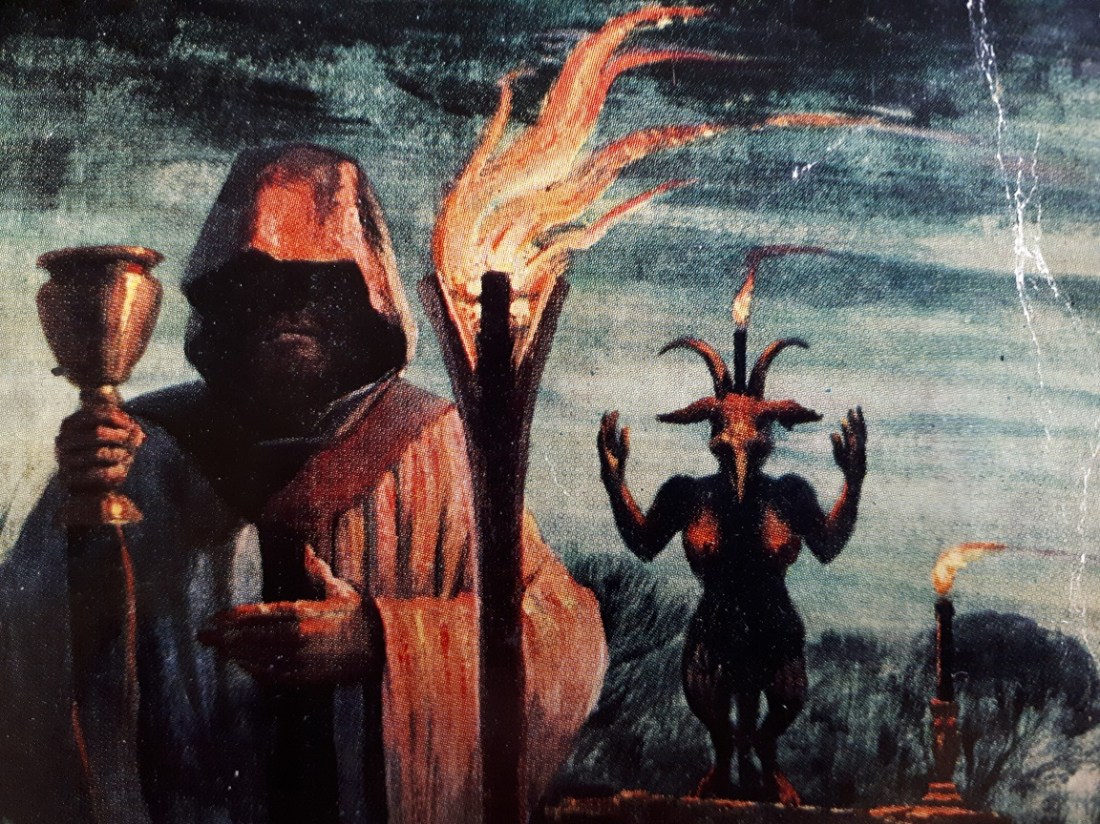
The Mass of St. Sécaire can only be said in an abandoned church that has been partly demolished or tainted by some terrible occurrence. These churches should house owls, bats, and occasionally gypsies. Under the altar, there should be plenty of croaking toads.

For the mass, the evil priest brings his mistress with him to serve him as clerk. He must be alone in the church with this slut, and they must share a fine supper. At the stroke of eleven o’clock, the mass begins and continues until midnight. The communion wafer is black, and three-pointed. The evil priest does not consecrate wine: he drinks water from a well in which an unbaptised child has been drowned. The sign of the cross is made on the ground with the priest’s left foot.

There are other terrible things that happen at the Mass of St. Sécaire, but to see them happening would blind a good Christian for the rest of their lives.

This is how some terrible people wreak vengeance on their foes.

The evil priests and their customers will find themselves in a nasty situation on judgement day. Only the Pope of Rome can grant forgiveness for this most terrible of sins, and the penance that must be paid is truly Hellish and must last until the death of the sinner. Very few of these wretches submit to their penance, and most die damned to eternal suffering in Hell.

There is a way to guard against the Mass of St. Sécaire; but I do not know the counter-mass that must be said. Please believe that if I had been taught it, I would pass it on to you…(there’s a couple of lines here that I’m omitting because they have nothing to do with the mass.) Unfortunately, the counter-mass only has the power to gradually kill the bad priest and the people who paid him. Both will die as their victim did, without knowing the cause of their own death.

I first heard of the abominable mass of Saint Sécaire in Montague Summers’ The History of Witchcraft, and I recall it popping up again when I was reading H.T.F. Rhodes’ The Satanic Mass. The description was intriguing. Summers notes that he read about this horrible rite in  Jean-François Bladé’s 1883 book, Quatorze Superstitions Populaires de la Gascogne. An almost identical description appeared 7 years later in James Frazer’s Golden Bough, and this doubtlessly brought the Mass to the attention of a larger audience. You can find Frazer’s account online, but I always want to read the original of everything and I wasn’t able to find a direct English translation of Bladé’s text online, so I made one myself. My French isn’t great, but after comparing my translation with Frazer, I’m confident that the above gets the message across.

Frazer omits the few lines about the counter-mass at the end of Bladé’s description of the Mass of Saint Sécaire, but otherwise his account is almost identical. The descriptions of the mass in the aforementioned books by Summers and Rhodes follow directly in this line of succession. (Summers provides another extremely similar account in his later book, A Popular History of Witchcraft.)

When I briefly mentioned this blasphemous ritual in a post 4 years ago, I knew that I’d have to return to it at some stage. A couple of weeks ago I picked up a novel that had been lying on my shelf for years. It turns out that the Mass of Saint Sécaire is a major part of the story.
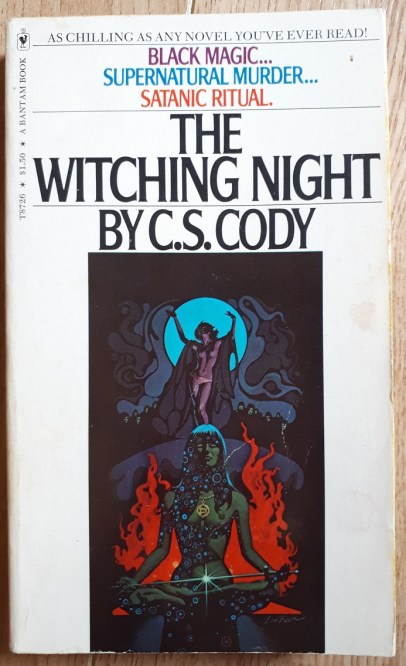
the witching night c.s. codyThe Witching Night – C.S. Cody (Leslie Waller)
Bantam 1974 (First published 1952)

I’m ripping through my paperback collection at the moment, and I’m trying to get some of the boring ones out of the way with. When I was starting The Witching Night, I assumed that it would be fairly dull. It turns out that it’s actually a Satanic love story filled with mystery and suspense. This book is absolutely deadly.

A doctor encounters an old friend who is dying. The doctor realises that something very peculiar is going on, but his friend won’t speak explicitly about it. The only clue he gives before dying is the name of a girl. When the doctor tracks her down, he finds her irresistible. The only problem is that she is the Satanic witch who performed the Mass of Saint Sécaire that killed his friend! The doctor soon suspects that he too has been cursed, but he can’t bring himself to sever his relationship with the woman who he knows is responsible.
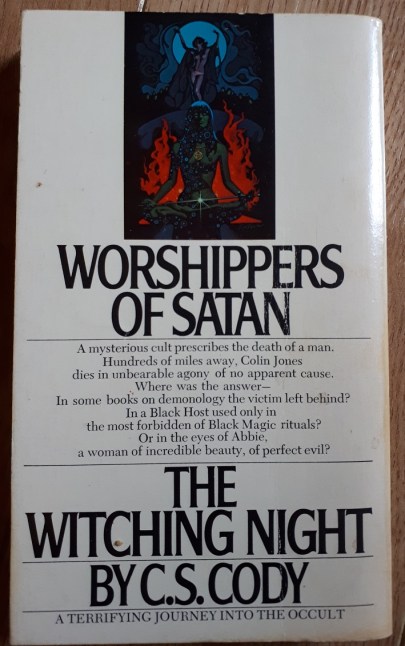
the witching night c.s. cody back coverFuck yes.

Some grisly Satanic rituals are described, but the really entertaining part of the book is how the author gets into the psychology of what’d be like to fall for a very sexy, yet very evil, witch. Imagine being in love with a person who was slowly killing you. There are also some really interesting dream sequences and supporting characters in here, and I was kept guessing what would happen until the last few pages. This is a surprisingly well written book. (So well written in fact, that I discovered some pathetic loser who copied the text, changed the names of the characters and tried to pass it off as her own work. Join me in complaining to her publisher.)

The author of The Witching Night, Leslie Waller, used ‘C.S. Cody’ as a pseudonym for this work, and as far as I can tell didn’t write any more occult themed fiction. This is unfortunate, as he did so in a tasteful way. The occultism in here is serious and effective. This isn’t a Scooby-Doo episode where the devil is unmasked and demystified at the end. The power of Satan is real! And while it’s an infamous black magic ritual that moves the plot of this book along, the author doesn’t rely on occult references to make his book entertaining.

Frazer’s account of the Mass is quoted in this novel, but later in the book the female character admits to having said the mass herself. This doesn’t really make sense, as she’s obviously not a Catholic priest, but I’ll let it slide because it adds to the story. Also, Waller describes a hitherto unmentioned way to cancel the effects of the Mass, but you’ll want to read the book to find out what that is.


After reading The Witching Night and realising that I’d have to do discuss the Mass of Saint Sécaire in my review of this book, I decided to check out the Aleister Crowley story about the Mass too. It was written in 1918 and published as part of Golden Twigs, a book of 8 short stories that were influenced by Frazer’s Golden Bough.

aleister crowley simon iff and other worksAll 8 of the Golden Twigs tales are featured in this collection.

If you’ve read the above description of the mass, this story is pretty straightforward. Two men love one woman. She loves one back. The other lad gets jealous and gets a dodgy priest to say the Mass… No surprises. I think I liked Crowley’s description of the Mass best. I mean, it gives the exact same details as Bladé‘s, Frazer’s, Summers’, Rhodes’, Waller’s and mine, but I felt that Crowley made it sound nice and creepy. I haven’t read any of Crowley’s other short fiction, but I have a couple of books of his short stories that’ll get reviewed on here someday.


While researching the Mass of Saint Sécaire, I saw that there was a radio play recorded in 1974 that was based around this terrible ritual. It was part of CBS’s Mystery Theater series, and it was called The Secret Doctrine. Thankfully, somebody has posted every episode of this series online (complete with advertisements from the early 70s). I was so happy to be able to listen to this. Again, if you know about the Mass, this story is very straightforward. Unrequited love, frustration, blasphemous ritual, death… This story is perhaps the most complete fictional account of the mass – it includes the sinner’s repentance and penance. There was a brief mention of Eliphas Levi, and the play seems to take its name from Helena Blavatsky’s 1888 theosophical opus. The writer here seems to have had a genuine interest in the occult. I was also intrigued to see William Johnstone on the cast list for this show. (He plays Father Giles.) A decade after this radio drama was recorded, Johnstone would go on to write a bunch of insane horror novels about Satanists – I just finished his The Nursery a couple of days ago. I can honestly say that it was one of the most mental books I’ve ever read.
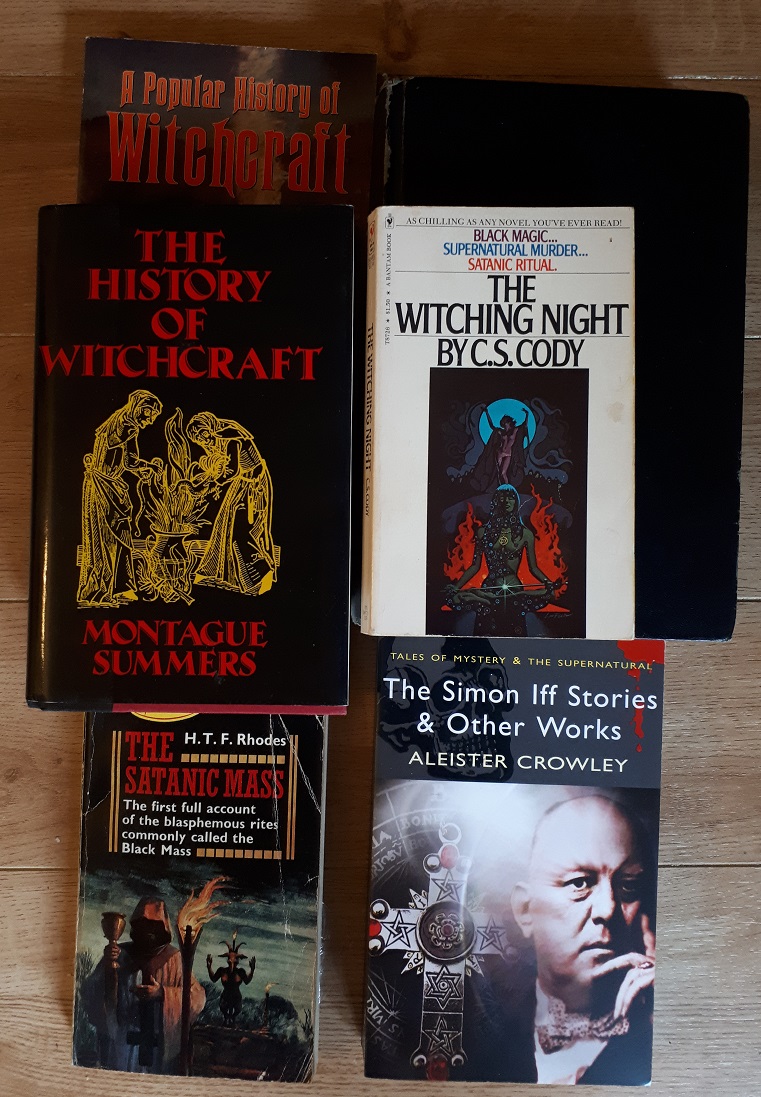
mass of saint secaire books
Just some of the works I had to reference for this post.

Of course, there is no Saint Sécaire. There are 3 Saint Sacerdos, 2 Saint Securus, a Saint Sacer, a Saint Sektar and a Saint Sagar. A few of these boys were French too, so the name Saint Sécaire probably sounded legitimate to the Gascony peasants from whom Bladé heard the legend. Also, I have read several places online that Sécaire probably comes from the French word ‘sécher’ which means to dry. If you wanted to imagine a corresponding creepy name for a Saint in English, you could go with Saint Withers. I think that works pretty well. I wouldn’t want one of my enemies saying the Mass of Saint Withers against me.

Back in November 2001, in an article in Fortean Times titled Satan in Suburbia, Gareth J. Medway suggested that the Mass of Saint Sécaire was fictional. (Meday also claimed that the original source for the story of the Mass was Bladé’s Contes Populaires de La Gascogne, but this is not quite true. Contes Populaires was published in 1895; Quatorze Superstitions had been published in 1883. The passages in these books about the Mass are identical though, so the point that Medway was making in his article still rings true.) Bladé was a collector of folklore and fairy tales, and he never presented his account of the Mass of Saint Sécaire as history. Russell Hope Robbin’s Encyclopedia of Witchcraft and Demonology states that “The so-called mortuary mass of St. Sécaire in Basque-speaking territories and the mass of the Holy Ghost in Normandy belong to folklore or anthropology, but not to witchcraft.” Was the Mass of Saint Sécaire ever a real thing? I really doubt it, but let’s be honest, it makes for a damn cool story. In the aforementioned article by Medway, he points out that later occult authors went on to use parts of the description of this terrible ritual in their descriptions of more general Black Masses, and from what I have read, it has since become a basis for modern black magic ceremonies. I’ve presented three pieces of fiction based on this blasphemous rite, and I’d love to know if there’s any more out there.

If you’re interested in other folk tales that came to be accepted as elements of occult history, I recommend that you check back soon. I’ve got a post on Gilles De Rais lined up for next week.

 

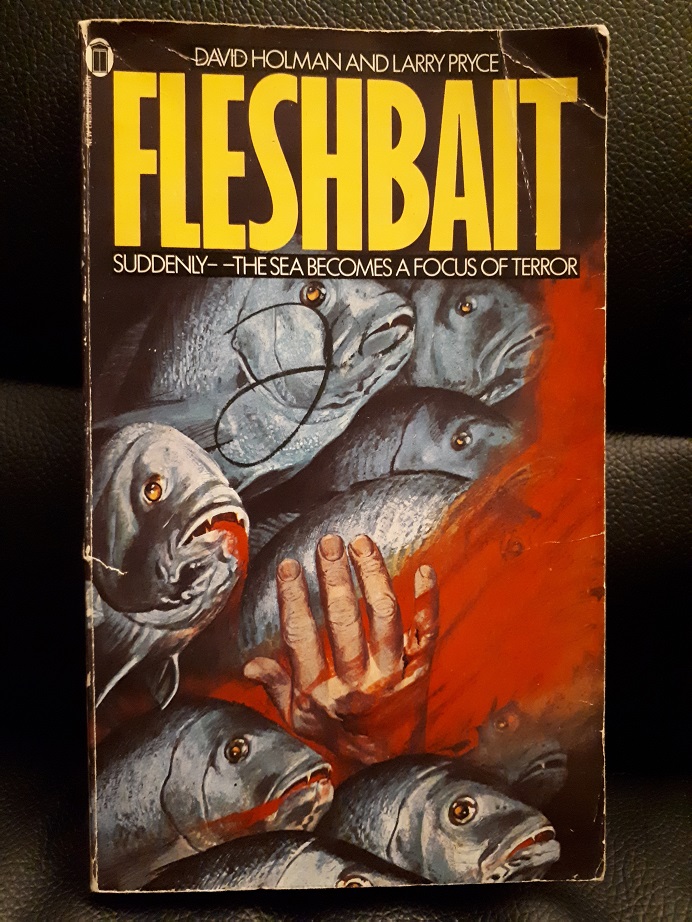
Fleshbait – David Holman and Larry Pryce

fleshbait holman pryce.jpg
Fleshbait – David Holman and Larry Pryce
New English Library – 1979

There was a period a few decades ago when animal horror was the big thing. Authors would pick any living creature, imagine them having murderous tendencies and a book would soon emerge. Harmless creatures such as dogs, cats, rats, slugs and crabs all had their turns at turning nasty. This type of horror isn’t hugely appealing to me, but I was in a bookstore the other day and found a short book about what looked like killer fish for 2 dollars. I thought I might as well give it a go.

One of the many problems with this truly awful book is that the first identifiable group of killers is a swarm of trout.

There are two reasons why I find trout amusing. Can you remember when you and your friends were teenagers and you would collectively fixate on a word or phrase? In my school this happened several times. The boys in my 4th year classroom decided as a whole that the word “girth” was hilarious. We’d mutter it under our breaths when the business studies teacher turned his back, or we’d write “Adam has a girthy one”on the inside of Adam’s copy book. Another time, somebody realised that a boy in the year below us had bulbous eyes and a fishy looking mouth. When he dyed his hair different colours, he sealed his own coffin. From that moment on, he became known as ‘Rainbow Trout’. For the interests of mischief, we dropped the Rainbow part of the phrase when in class, but the phrases ‘trout’ and sometimes even ‘brown trout’ were forevermore heard echoing through the classrooms and corridors of my alma mater.

The second reason that the word trout brings me mirth is a text message my sister sent me a few years ago. She was on holiday with a less than responsible friend, and on one occasion, my sister returned to their hotel room only to discover this friend engaged in an act of passion on the veranda. I believe the exact phrasing of her later report to me was, “I walked in and there was a lad on the floor licking her trout.” To this day the memory of that text never fails to bring me a chuckle.

Keeping these points in mind, the reader will understand how I found it difficult to take seriously the horror of a swarm of malevolent trout.

There’s more than trout to this book though. After a bunch of nuclear waste leaks into the sea, any fish that encounter it begin to mutate. They quickly evolve larger brains, vocal apparatus, telepathic abilities and a thirst for revenge against the humans that have hunted them for thousands of years.

A scientist, still reeling (haha) over the suspicious death of his best friend, finds himself in charge of the campaign against the killer fish.

After a particularly nasty fish attack, he calls a press conference, but the only person to speak at this conference is an insane woman.

When the scientist discovers that his friend actually committed suicide because he was gay for him, he recklessly dives into the most contaminated part of the sea and discovers a slab of rock that’s covered with mutilated human bodies that the fish have put on display in much the same way that fishermen display pictures of their catches on the walls of their offices.

This grisly grotto turns out to be a radioactive hub that is charging the local sea life with mutating radiation. After it is blown up, everybody assumes that the problem is solved.

This illusion is shattered when a big gang of fish assemble near a railway that passes by the ocean front. When a train containing the scientist and his team passes by this little stretch, these fish point their arses inland and flip their flippers. This causes a tsunami that knocks the train off the tracks.

Haha, this book was such a piece of crap. I just looked back through the animal horror section in Paperbacks from Hell and saw that it does get a brief mention there. Of all the books I’ve read that were featured in there, this is definitely the worst. The authors try to fit too many ideas into a very short text, and the antagonists aren’t scary at all. This book is shite.

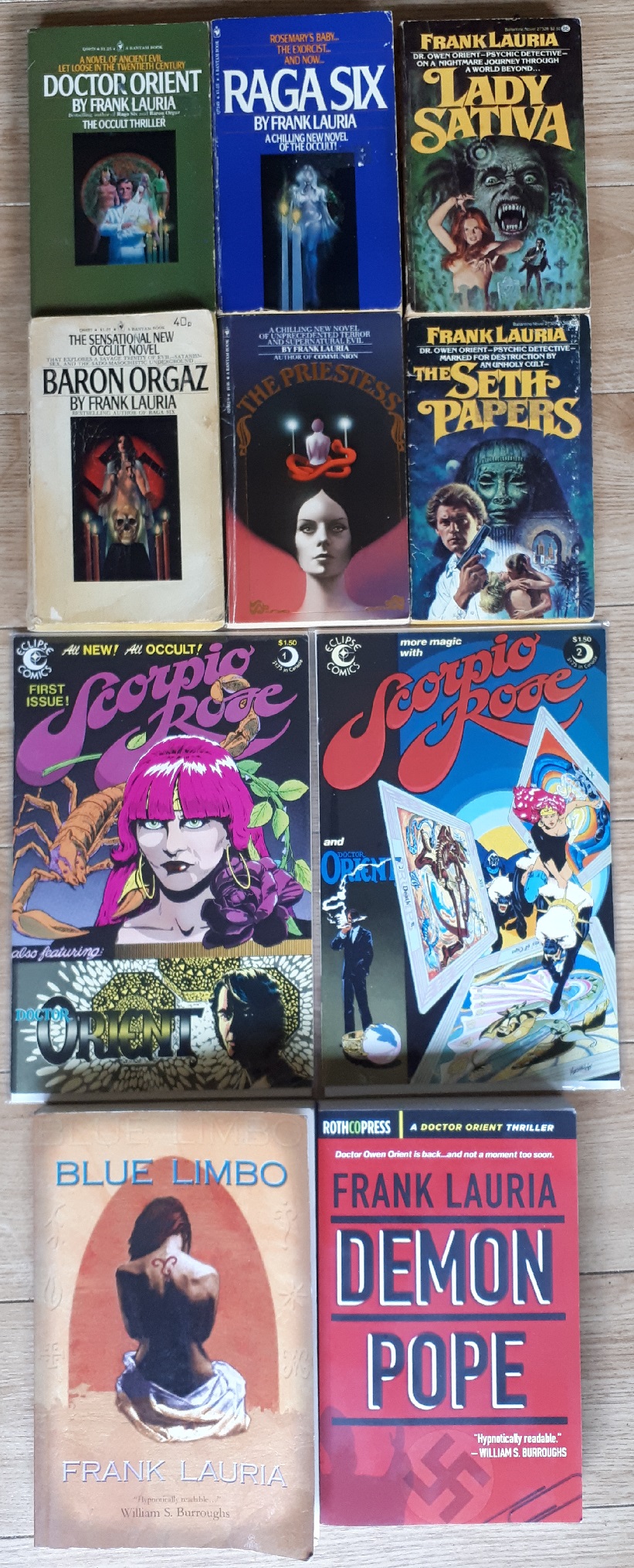
The Doctor Orient Series, Books 5-8

doctor orient
I published a post on the first 4 Doctor Orient novels at the beginning of last year. If you’re not familiar with this series, you might want to read that post before reading this one.

the priestess frank lauriaThe Priestess – Frank Lauria
Bantam Books – 1978

This one sees the Doctor getting involved in a voodoo cult in Florida while he’s on the run from a government agency. Owen Orient is alone in this book; his friends from the previous novels are entirely absent here. This is pretty much what you’d expect, lots of sexy ladies, cocaine and snakes. Pretty good. The previous owner of my copy seems to have been very knowledgeable on the subject of Cuban witchcraft; my book is filled with notes on Lecumi.

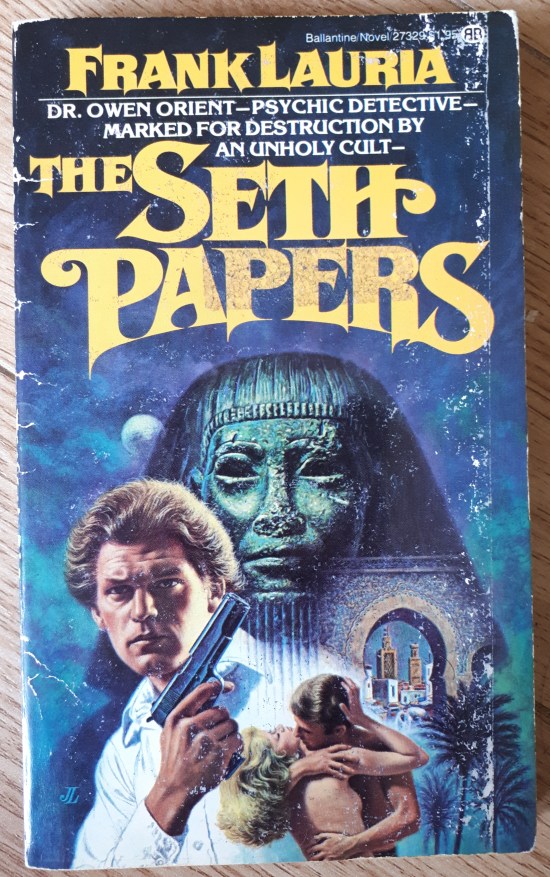
seth papers frank lauriaThe Seth Papers – Frank Lauria
Ballantine Books – 1979

The Seth Papers is both the shortest Doctor Orient novel and the only epistolary novel in the series. I quite enjoyed the book, but it’s based around a rather strange idea. It’s about an Italian neofascist secret society that is attempting to retrieve the mythological Hand of Seth to take control of the Vatican. It was published in 1979, a good 2 years before the general public was made aware of P2, the Italian neofascist secret society that close ties with the Vatican and the Mafia. Did Frank Lauria come up with a plot that resembled reality by coincidence? If not, how did he know about this strange secret society? How did he publish a book about it and live? Those P2 lads hung a lad from a bridge for less!

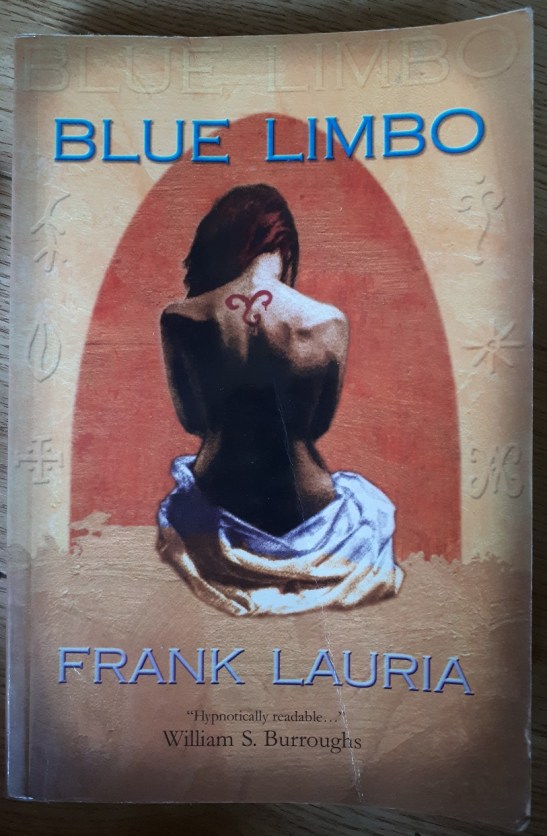
blue limbo frank lauriaBlue Limbo – Frank Lauria
Frog, Ltd. – 2001 (Originally published 1991)

Doctor Orient’s 1991 return sees him in Jamaica battling another High Priest of Voodoo. As usual, the plot involves the main character falling for an evil woman and getting himself into serious trouble. There’s a nuclear submarine, some zombies, a psychic albino and some Cuban agents thrown into the mix too. The plot of this one was overly complicated. There was also a character who only spoke in rhymes. That really pissed me off. It didn’t make him sound mystical or profound; it made him sound like an annoying little cunt. This was my least favourite entry in the series.

frank lauria demon pope
Demon Pope – Frank Lauria
Rothco Press – 2014

More than 2 decades after his last outing, the doctor returns to New York. Unfortunately for him, he gets involved with a group of Satanic immortal Nazi clones who are have stolen the Spear of Destiny and are planning to use it to take control of the Vatican.

Unlike other occult detectives, Doctor Orient is a powerful psychic, and at times throughout the series, this gives him opportunities to solve impossible problems. He’ll topple over a candlestick into a curtain, causing a distraction that allows him escape from a guarded room. He can also talk to people on the astral plane, and this allows him to track his friends and enemies down without GPS. The first Orient novel was published in 1970, and he uses these powers throughout all of his adventures. In Demon Pope, a novel published 44 years into Owen Orient’s career as a hero, he acquires a new skill. Now he is able to transform into a panther. Honestly, this was a bit hard to swallow.

Demon Pope is a bit of a mess to be honest. It’s very unclear as to why the stuff that is happening is happening. There’s a part at the beginning where a teenage girl is sacrificed that is never explained. Also, the text is full of typos. You’d have thought that somebody at Rothco Press would have read over Frank’s manuscript before printing it. That being said, this was still a fairly enjoyable read.

doctor orient complete The Complete Collection

The first 6 Doctor Orient novels were published in the 70s. After The Seth Papers, Doctor Orient kept his head down for over a decade. After returning in 1991’s Blue Limbo, he would take another two decades off before coming back for Demon Pope. Why such long waits? I’ve actually discovered the answer to this seldom asked question. In 1982, Doctor Orient made a brief appearance in comic book form. He was given several pages in both editions of Steve Englehart’s 1983 Scorpio Rose comics. This was supposed to have at least one more part, but the series was cancelled because it wasn’t very popular. The 3rd edition of Scorpio Rose was eventually published in a collection of Englehart’s work, but this did not contain a 3rd installment of Doctor Orient’s adventures.

scorpio rose doctor orient

So what happens in the Doctor Orient comics? Not as much as I’d have liked – they’re really short. The Doctor exorcises a young girl and ends up going back in time to fight with a Nazi called Von Speer. Sound familiar? It will to anyone who has read Demon Pope. It seems as though Demon Pope is the novelisation of the story Frank Lauria wrote or at least started writing in the early 80s for the Orient comics. While Demon Pope wasn’t published until 2014, Lauria had actually come up with the plot for it only a few years after finishing The Seth Papers.


Well, that’s that. It took me more than 3 years to collect and read the entire Doctor Orient series, but now it’s done. It’s a bit of  push to classify these as horror novels; they’d be more accurately described as adventure books about occult phenomena. While Doctor Orient probably isn’t the greatest Occult Detective out there, these novels were very entertaining, and if there’s ever another published, you know I’ll be reading it. As of now, Raga Six (#2) was my favourite. I’ve also reviewed Frank Lauria’s The Foundling if you’re interested.

The Devil’s Grimoire – Moribus Mortlock

the devil's grimoire - moribus mortlock.jpgThe Devil’s Grimoire: A System of Psychic Attack – Moribus Mortlock

Winter Tempest Books – 2013

Has somebody done something to annoy you recently? Want to retaliate but you’re too much of a pussy to take action? Have you suffered a severe brain injury that has rendered you a clinical moron? If your answer to all 3 of these questions is ‘yes’ then I have the book for you!

Moribus Matlock’s The Devil’s Grimoire is a simple guide to solving your petty grievances through the art of demonaltry. This short book lists off the names of 36 demons, the incantations for summoning them and some situations that might warrant doing so. It’s pretty basic stuff, not much to really discuss.

There was one demon, a certain Malvader, whose description gave me pause for thought, “An obsessive rape demon with a curved appendage nearly as large as his torso who viciously and without cessation attacks your enemy in every orifice.” The indefinite article ‘an’ suggests that there is in fact more than one obsessive rape demon. Yikes!

I will give ol’ Mortibus some credit for having noisy neighbours 1st on his list of potential victims. There are few things in the world that irritate me as much (and as frequently) as rude people assuming that nobody minds having to listen to their shit music. Noisy neighbours are heinously annoying, but what about those inconsiderate cunts who play loud music on the bus or train? That my friends is the very height of rudeness. Those individuals deserve a visit from our old pal, Malvader.

Nazi Poltergeists – Michael Falconer Anderson’s The Unholy

the unholy - michael falconer anderson.jpg


Roughly a year ago, I read and reviewed Michael falconer Anderson’s Blood Rite. It was an exceptionally dry, unimaginative, style-less piece of trash. If you had asked me then about the likelihood of me reading another book by the same author, I would have said it was extremely slim. But this was only because I didn’t realise that Michael Falconer Anderson had also written a horror novel whose cover featured a skull with swastikas for eyeballs.

A train crashes on its way into a small English town because its driver suddenly becomes convinced that he’s actually driving a train full of unfortunates to a concentration camp. A mysterious box belonging to the train’s most suspicious passenger is lost in the crash, and soon thereafter a troop of supernatural Nazis (they’re half ghost and half zombie) start killing, raping and possessing the locals. A newspaper editor and his psychic friend deduce that these horrible occurrences are due to the presence of some terrible talisman of power.

The major selling point of The Unholy is obviously its cover, but one glance at such will spoil the central mystery of the book for the astute reader. Once the protagonists realise who and what they’re dealing with, they have no choice but to find and destroy the most sacred relic of the Reich.

Preventing them from doing so is the mysterious occultist David Preese, a character clearly based on Aleister Crowley.  Another character describes him thus, “You may remember about five years ago the newspapers were calling him “The Beast”. He’s involved in all kinds of things. He’s even started his own religion – the Priests of the Aryan Dawn. It’s some kind of mixture of old Indian religions and Teutonic myths…” Preese is soon thereafter depicted performing a sex magic ritual with two teenagers. He later turns out to have been the mysterious individual who lost the box during the train crash.

This book is quite bad – much like Blood Rite, the actual writing is like eating a sandwich with no filling. The plot of The Unholy however, is far, far more interesting. It’s like a mixture of Emmerdale, Evil Dead and Downfall. It only took a few days to read, and I actually quite enjoyed it. Shall I seek out and read Michael Falconer Anderson’s other horror novels? I might.

One interesting feature of this book is how it deals with the Holocaust. I doubt very much that this would find a major publisher today. Nazis are clearly presented in an evil light, but the victims of the Holocaust are also made part of the horror. At one point the protagonist watches as the Nazis gun down a herd of people into a pit. That stuff actually happened, and it’s scarier than any ghost stories. It feels a bit cheap for an author of horror fiction to exploit it.

The crazy thing about this novel is that I discovered it existed after buying it. I was glancing through my search history on abebooks when I saw a book that I didn’t recognise. I had ordered it a year previously, but it never arrived, and I had totally forgotten ever buying it. This has never happened before. I found a pdf copy online though, so at least I didn’t have to buy it again.

Wiccan Sex-Magic – Inga Steddinger

wiccan sex-magic inga steddinger.jpgWiccan Sex-Magic – Inga Steddinger
Runa Raven – 1999

The image that pops in my head when I hear the word Wicca is of a middle-aged white woman with a nose ring and a well stocked spice-rack. It’s that flowery witch bullshit for Rennaisance fair geeks, right? Well, apparently there’s more too it.

In an introduction by Stephen E Flowers, it is made clear that the word Wiccan in the title of this book means “that of the sorcerer”, so the title really means “Sex Magic of the Sorcerer”. I assume this is pointed out early on so that people know that this work isn’t tying itself to the Mommy-with-a-moon-tattoo sect of witches that we all think of when we hear the word Wiccan.

Gerald Gardner, the father of Wicca, was friends with Aleister Crowley, and while Gardner’s Wiccan tradition did involve the use of sex in its practice, it seems that many Wiccans today shy away from the kinky stuff, at least publically. This book goes the other way and embraces it.

The main idea here is that sex magic is effective because when performed correctly it corresponds with the actions of the Gods of Norse Mythology as told in the Eddas. It’s all about power. There’s always a submissive and dominant, and this power imbalance and the flow of power it entails ensure that the rituals are highly charged. When the magician gives his girlfriend a passionate rimjob, he is worshipping her as the fearless Warrior Gröd worshipped the Goddess Holfurnbjorn. By becoming an avatar of the hero in this manner, he activates that hero’s powers. I’m being a bit silly here, but I’m confident that I’ve made the idea clear.

It wasn’t just the intro to this book that reminded me of Stephen E. Flowers; it’s also full of talk about bondage and birching. When I reviewed Carnal Alchemy, the book on Sado-Magical techniques that Flowers wrote with his wife, I noted that it had a  self-aggrandizing “We do S&M. We’re magicians. We’re so cool” vibe to it. Wiccan Sex Magic is similar. Then again, I suppose that most magicians are bound to bring their other interests into their practice, and if Inga Steddinger wants to incorporate her love of going to orgies and having her bum slapped into her magical practice, good for her.

This is a short review, but Steddinger’s book is only about 40 pages long. I have some cool stuff lined up for the next few weeks, so check in again soon.


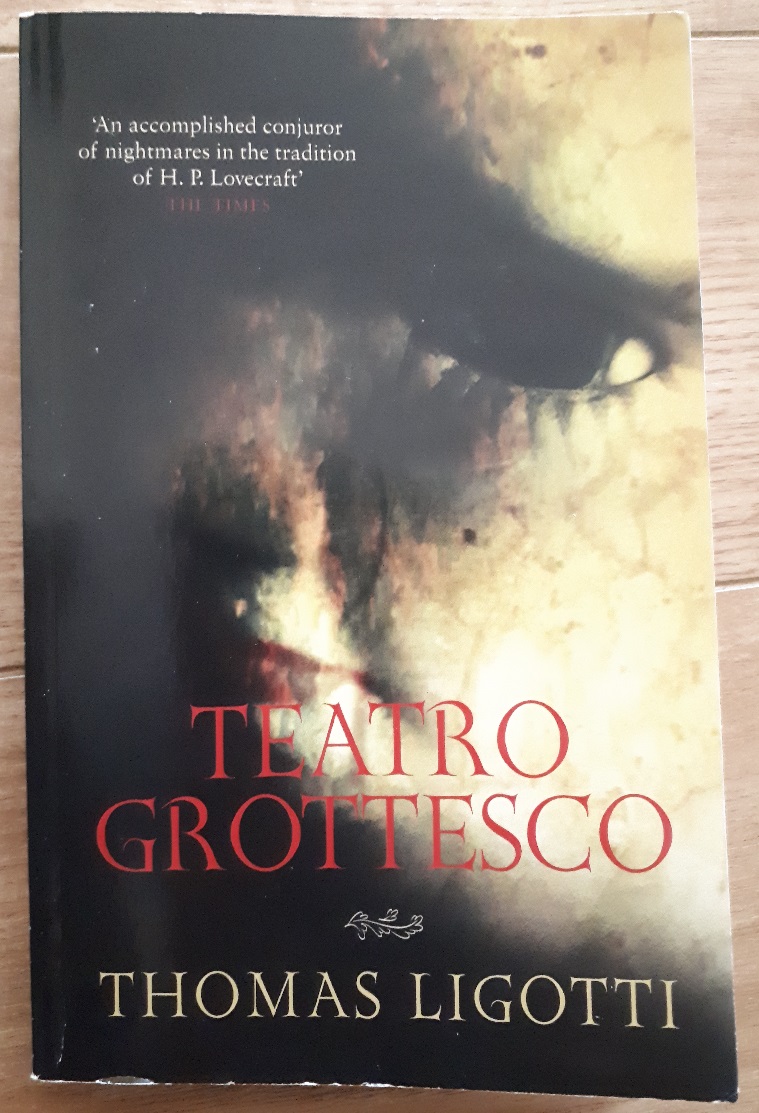
Teatro Grottesco – Thomas Ligotti

teatro grotessco thomas ligotti.jpgTeatro Grottesco – Thomas Ligotti
Virgin Books – 2008 (First published 2006)

This collection of short stories makes most of the horror fiction I’ve read seem like a children’s cartoon. This isn’t bump in the night stuff; it’s black, oily, suffocating horror. It is the second book that I have ever read that actually gave me nightmares.

Nightmares are interesting things. While they always contain some kind of unpleasant element, they also have to be similar enough to our day to day lives to actually disturb us, and it’s this fact that gives this Teatro Grottesco a truly nightmarish quality.

This collection is truly weird weird-fiction, but while the scenarios it describes all contain an element of the fantastic, their reality is never far enough from our own to void the message they deliver. And there is a message in these tales. Ligotti is a philosopher as well as a fiction writer, and it is his takes on reality that make these stories truly horrifying. This will come as no surprise to anyone who has read his The Conspiracy against the Human Raceone of the most pessimistic books in existence. I read and enjoyed that one a few years ago, but my one complaint was that although the arguments therein are convincing, they didn’t hugely influence the way I was feeling when I read them. I was able to brush them off as somebody else’s bad attitude. For me, it was far more effective coming across these ideas in fictional narratives than in a treatise of philosophy. The final tale in this collection, The Shadow, The Darkness, is one of the most profoundly articulate discussions of the futility of human existence that I have encountered. It made me feel quite bad when reading it. Indeed, the horror of Ligotti’s prose is more directed at its reader than at its characters.

The characters in these tales are very strange. They appear more as shadows than as distinguishable individuals. They’re all artists or managers of boarding houses. The narrator of any one tale in this collection could be the narrator of any of the others. This might seem like a criticism to somebody who hasn’t read the book, but I strongly suspect that it was intentional. One of the key ideas throughout this collection is that the self is an illusion. Human minds and souls aren’t real; they are a symptom of the sickness of reality, and the attempt to distinguish between one person and another is a pathetic exercise in futility. In one of the tales, a character describes himself thus:

“My body – a tumor that was once delivered from the body of another tumor, a lump of disease that is always boiling with its own disease. And my mind – another disease, the disease of a disease. Everywhere my mind sees the disease of other minds and other bodies, these other organisms that are only other diseases, an absolute nightmare of the organism.”

Get the idea? What difference does it make who is narrating the story if every living thing is just a drastically diseased and deluded tumor? This book is horrible – horrible but also absolutely deadly.

Shout out to my mother in law for buying me this for Christmas. It’s probably my favourite book that I’ve read this year – I really, really liked this one. It’s also the third of Ligotti’s books that I’ve read, and from what I can see online, most of his books are fairly difficult to come by. This is unfortunate because he’s a brilliant writer. I’ve seen a bunch of stuff that talks about how Ligotti is like a modern Lovecraft, but I find his writing more similar to that of Samuel Beckett than to any horror writer I’ve read. (I think the similarity lies in how both writers present human relationships – maybe I’ll write an essay about this some day.) Anyways, I am going to try to find a copy of the Penguin edition of Ligotti’s first two books and review it in the very near future. This is the kind of horror I want to read.