Le Ménage à Trois (A Threesome of French Filth): Story of the Eye, Irene’s Cunt and The She Devils

How do you know when a Frenchman’s been in your back yard?
Well, your garbage cans are empty and your dog is pregnant.
– from The Body (1982) by Stephen King

There’s no aliens or demons this week, just 3 books by some dirty Frenchmen. These texts may be a little different to the stuff I usually review, but Bataille’s book’s weirdness and elements of body horror are enough to warrant its inclusion here. That book goes hand in hand with the book by Aragon, and the title of Louÿs’ book makes it at least sound like my usual fare. There’s countless other dirty French books that I could have chosen for this post, but these 3 were published within a couple of years of each other, and all three are critically acclaimed. I also read all of them recently, so it works out.
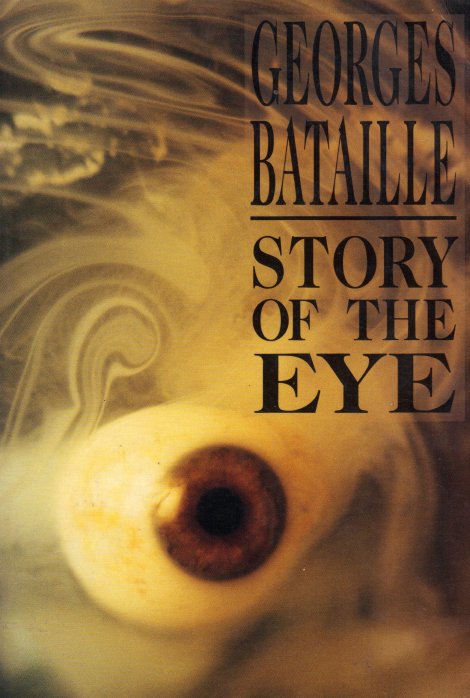
StoryOTheEye - batailleStory of the Eye – George Bataille
City Lights Publishers – 2001 (First published 1928)

Story of the Eye is about a teenage couple doing some very disgusting things. It’s certainly a dirty book, but I don’t really see it as erotica or porn. I’m not really sure what the difference between erotica and porn is, but this book is not sexy by any stretch. Maybe piss fetishists might get a bit aroused by the parts where the characters piss on eachother, but their excitement will probably dissipate when these same characters start shoving eggs up their bums or raping a priest.

The story here is fairly easy to follow, but the events described are so strange that it’s hard to imagine them taking place outside of a dream. I’ve seen this book described as horror before, and I think that’s a fair assessment. It’s like reading a repulsive sexual nightmare. I first read Story of the Eye years ago, but I reread it recently after reading George Bataille’s book on Gilles de Rais. I’m considering reading more of his stuff, but I’m afraid that some of it will be too philosophical for me.

irene's cunt louis aragonIrene’s Cunt – Louis Aragon
Creation Books – 1996 (First published 1928)

This book had been on my to-read list for several years, but when I actually read it, Irene’s Cunt was a little too deep for me. It’s quite an arty book, and either there’s not much of a story or the story is horribly obfuscated by changing narrative perspective. When these narrative shifts occurred, I wasn’t sure if I was dealing with a new narrator or an older version of the previous narrator.

At one point in the text, the narrator rails against bourgeois fascination with plot, and one would be hard pushed to give a concise plot summary of this peculiar work. Both George Bataille and Albert Camus sang its praises, but most of it went over my head.

There’s some fairly graphic depictions of sex, but again, this book isn’t very sexy. You’d have a hard time wanking over it anyways. It was published in the same year as Story of the Eye, and both books originally contained illustrations from the same artist, André Masson, so if you read one, you should probably check out the other. Stylistically, Irene’s Cunt is more obtuse than Story of the Eye, and I found it far less interesting. Truth be told, it’s not even that cunty.

 

the she devils pierre louysThe She Devils – Pierre Louÿs
Creation Books – 1995 (First published 1926)

I bought this book because of its title. I knew it was going to be dirty, but I was hoping that the plot would be somehow related to the Devil. It’s not. This is just a book of filthy pornography.

The She Devils was published 2 years before the other books in this post, and its author had died a year prior, so it might have been written quite a bit earlier. While Bataille and Aragon were linked with the surrealist movement, Pierre Louÿs was more of a symbolist. Honestly, even after reading the wikipedia entry, I’m not really sure what symbolism is, but judging by this text, it’s a little bit less absurd than absurdism.

The She Devils has a very simple plot. At all moments during the narrative, it’s pretty clear what’s going on. A woman and her three daughters move into the apartment beside a young man, and this cheeky chappy sodomises his new neighbours whenever they come to visit him. That’s pretty much it. Seriously, this book contains a lot of bumming.

Maybe the sheer unbelievability of the plot gives it a dream-like quality that might be engaging to some, but I didn’t find much of interest in here. Things get dirtier and dirtier as the story plods on – it turns out that one of the daughters was conceived when her elder sister shat cum into her mom’s vagina. I read this a few months ago, so I can’t be sure, but I also recall a bit of poo-eating. Yuck. This book is repetitive, boring and distasteful.

I’m not trying to appear pious or anything – I’ve reviewed porn here before and I’ll do it again – but this book was actually pretty horrible to read. It wasn’t interesting or thought provoking. It was just some dirty French bastard’s wank fantasies. Honestly, I regret reading this.

french flag

Why are these Frenchmen’s sexual fantasies so weird? Was it something in the water? Je ne sais pas! Don’t get me wrong; I know there’s perves everywhere, but these books aren’t supposed to be just porn. I think they’re supposed to make grand statements about the nature of sex and sexual relations. Personally, I wasn’t able to make out what these grand statements were. All of that stuff went over my head because I was too busy laughing at the parts about pooing and willies.

Vive la France!

The Old Ones were, the Old Ones are, and the Old Ones shall be – Lovecraft’s Legacy, Part 4

the book of old ones - scorpio.jpgThe Book of Old Ones – Scorpio
Finbarr – 2002

Truly, there are terrible primal arcana of earth which had better be left unknown and unevoked; dread secrets which have nothing to do with man, and which man may learn only in exchange for peace and sanity; cryptic truths which make the knower evermore an alien among his kind, and cause him to walk alone on earth. Likewise are there dread survivals of things older and more potent than man; things that have blasphemously straggled down through the aeons to ages never meant for them; monstrous entities that have lain sleeping endlessly in incredible crypts and remote caverns, outside the laws of reason and causation, and ready to be waked by such blasphemers as shall know their dark forbidden signs and furtive passwords. – from The Diary of Alonzo Typer

When I read a book on Lovecraftian magic, I want to learn about the aforementioned dark forbidden signs and furtive passwords. Unfortunately, this is never what these books contain. The one I’m reviewing today, Scorpio’s The Book of Old Ones, might well be the silliest of all the Lovecraftian grimoires I’ve read.

Imagine what a grimoire would read like if its author had absolutely zero understanding of magic. It’d probably contain powerful spells that are quick and easy to perform and unfailingly effective regardless of whether the person performing them believes in them or not – ‘say this magic word under your breath, and the girl beside you on the train will become your sex slave’ kinda crap. Take 20 pages of that garbage, add a few Lovecraft references and some stories about pathetic losers trying these rituals and then becoming rich, sexy and succesful, and you’ve got Scorpio’s Book of Old Ones.

Much like The Necronomian Workbook, this book shows little understanding of the total apathy of Lovecraftian entities towards human beings. The Old Ones are bigger and older than us. Their children made us for the sake of their amusement. Cthulhu is not concerned with the affairs of mere mortals. He’s plotting revenge on the elder things that imprisoned him. I doubt he’s interested in watching over you as you go on sea voyage, and I really struggle to imagine him helping you find a girlfriend.

cthulhu love spell.jpg
Seriously?

This book is stupid. The author understands neither magic nor Lovecraft’s mythos, but he has written a book combining them. This Scorpio guy seems like a real moron. Then again, this was published by Finbarr, so I’m not quite surprised.

I have made fun of the authors published by Finbarr Publications quite a few times at this stage, and I had initially planned this week’s post on two grimoires written by another of their authors. After doing a little bit of research though, I discovered that this guy actually has a learning disability and has suffered tremendously with his mental health. I’m not being facetious. I decided against reviewing his books, as he uses his real name, and I don’t want to cause any suffering for a person with serious mental problems. I mention it here only to highlight the remarkably low standard of stuff that this publisher puts out. I didn’t find out much about this Scorpio guy, but he’s clearly an imbecile too.


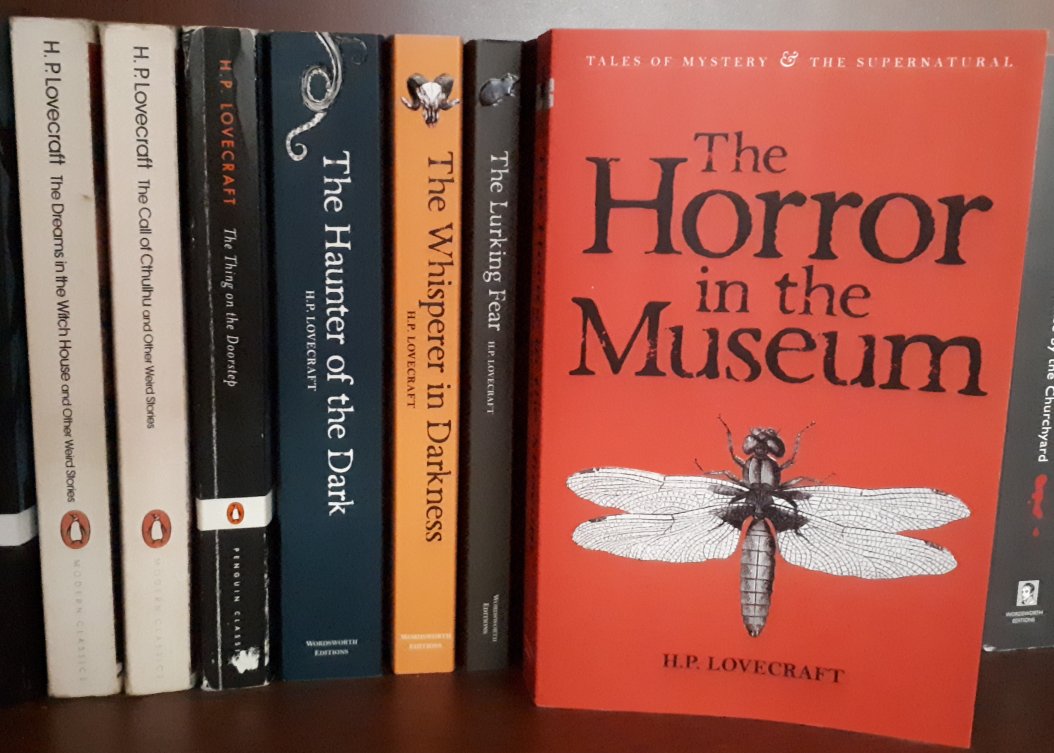
lovecraft horror in the museum.jpgH.P. Lovecraft – The Horror in the Museum
Wordsworth
This is the second entry in Wordsworth’s Lovecraft series, and it is comprised of works that Lovecraft worked on with other authors, only one of which I had read before. Most of the stories in the other 3 Wordsworth entries are included in the Penguin editions which I read and reviewed years ago, and after a year of rereading tales I had previously encountered, it was really cool to dive into a fresh batch of unread terror. The quality here is pretty high, and I enjoyed most of the stories in here more the fantasy stuff in Volume 3 and the odds and ends in Volume 4. Picking favourite stories from this collection is quite difficult. The tales in here are really good, and many of them flesh out the Cthulhu mythos – there’s references to Yog-Sothoth and Cthulhu every few pages.

This volume contains the following stories:
The Green Meadow, Poetry and the Gods, The Crawling Chaos, The Horror at Martin’s Beach, Imprisoned with the Pharaohs, Two Black Bottles, The Thing in the Moonlight, The Last Test, The Curse of Yig, The Elecrtic Executioner, The Mound, Medusa’s Coil, The Trap, The Man of Stone, The Horror in the Museum, Winged Death, Out of the Aeons, The Horror in the Burying Ground, Till A’ the Seas, The Disinternment, The Diary of Alonzo Typer, Within the Walls of Eryx and The Night Ocean
(Imprisoned with the Pharaohs appears in the Penguin collections as Under the Pyramids.)

Some of these tales are fairly racist. The word ‘nigger’ is thrown around quite a bit. One of the stories, Medusa’s Coil, is particularly nasty. It’s about a very evil woman. I was quite confused when I finished reading it. In this edition, the last line reads; “It would be too hideous if they knew that the one-time heiress of Riverside… was faintly, subtly, yet to the eyes of genius unmistakenly the scion of Zimbabwe’s most primal grovellers.” I wasn’t entirely sure what to make of this, so I looked up a summary, and it seems as though the editor at Wordsworth actually cut the final line of the story. The original text ends: “No wonder she owned a link with that old witch-woman—for, though in deceitfully slight proportion, Marceline was a negress.” The final revelation of tale is that the anatagonist is a bit black. This is not made very clear in the Wordsworth edition. In 1944, August Derleth anthologised this story and altered the final line to say “though in deceitfully slight proportion, Marceline was a loathsome, bestial thing, and her forebears had come from Africa.” At least Derleth’s version kept the meaning. The redacted Wordsworth edition makes the ending confusing rather than ugly. This is obviously a horribly racist ending to a horribly racist tale, but I’m pretty disgusted that Wordsworth thought it acceptable to censor it. I absolutely hate when publishers do that. If you choose to publish a dead racist’s work, don’t pretend he wasn’t a racist.

So why do I devote so much of my time to reading and reviewing books by and about this horribly bigoted individual? Well, it has a lot do with passages of writing like this:

These scribbled words can never tell of the hideous loneliness (something I did not even wish assuaged, so deeply was it embedded in my heart) which had insinuated itself within me, mumbling of terrible and unknown things stealthily circling nearer. It was not a madness: rather it was a too clear and naked perception of the darkness beyond this frail existence, lit by a momentary sun no more secure than ourselves: a realization of futility that few can experience and ever again touch the life about them: a knowledge that turn as I might, battle as I might with all the remaining power of my spirit, I could neither win an inch of ground from the inimical universe, nor hold for even a moment the life entrusted to me. Fearing death as I did life, burdened with a nameless dread yet unwilling to leave the scenes evoking it, I awaited whatever consummating horror was shifting itself in the immense region beyond the walls of consciousness.

Come on. That is brilliant. This is from The Night Ocean, the last story in the collection. Of all the stories in here, this one is the least explicit in its horrors, but the sense of gloom and despair that pervades the narrative is perfectly effective. Lovecraft may have been a horrible racist, but damn, his work does a damn fine job of expressing the futility of life. Interestingly enough, the author of The Night Ocean (Lovecraft was mainly an editor for this one) was gay. He was also an anthropologist, and was actually one of William Burroughs’ professors at Mexico City University.

There’s another curious little tale in here called Till A’ the Seas that I really liked. It’s about the last human on an Earth that has overheated. It’s set in the distant future, but by now it could believably be set 60-70 years from today. You should definitely read the full story (link above), but if you’re too lazy, just read this:

And now at last the Earth was dead. The final, pitiful survivor had perished. All the teeming billions; the slow aeons; the empires and civilizations of mankind were summed up in this poor twisted form—and how titanically meaningless it all had been! Now indeed had come an end and climax to all the efforts of humanity—how monstrous and incredible a climax in the eyes of those poor complacent fools of the prosperous days! Not ever again would the planet know the thunderous tramping of human millions—or even the crawling of lizards and the buzz of insects, for they, too, had gone. Now was come the reign of sapless branches and endless fields of tough grasses. Earth, like its cold, imperturbable moon, was given over to silence and blackness forever.

God damn, that’s beautiful.

Originally, the second collection of Lovecraft’s work put out by Wordsworth was titled The Loved Dead, but this story was removed from this collection after the people at Wordsworth decided that Lovecraft’s influence on that tale was only minor. Also, Through the Gates of the Silver Key is curiously absent from this collection despite being a collaboration between Lovecraft and E. Hoffmann Price. Through the Gates… is the only story to appear in the Penguin editions of Lovecraft’s work that is missing from the Wordsworth collections. I’m planning a fifth and final post in this series on the few tales by Lovecraft that are missing from this series, so keep an eye out for that in the near future.

Edit: For convenience sake, I’m including the links to all of the posts in this series for anyone who’s interested. (Part 1, Part 2, Part 3, Part 4, Part 5)

J.N. Williamson’s Martin Ruben Series: The Ritual, Premonition and Brotherkind

martin ruben seriesHere’s three books by prolific horror author, J.N. Williamson. I had never read any of his books before reading these, and it is highly unlikely that I will ever read anything else by him again. The description of Brotherkind in Paperbacks from Hell ensured that I was going to track it down and review it here, but after buying it, I discovered that it was part of a series of 3 books: The Ritual, Premonition and Brotherkind. Naturally, I had to read all of them.

the ritual j. n. williamson
The Ritual – J.N. Williamson
BMI – 1987 (First published 1979)
A young boy turns out to be the Antichrist. His body becomes possessed by the spirits of Napoleon, Hitler Aleister Crowley and Genghis Khan, and he goes on a spree of rape and murder. Other people in his town also go a bit mad and start misbehaving. A local university professor and expert on the occult, Martin Ruben, is called in to deal with this issue. With the help of a priest, a police officer and one of his students, Ruben tries stop the Antichrist. This is just a shit version of The Omen.

If you don’t want spoilers, skip the next paragraph.

This book is really surprisingly shit. Most of the text is taken up with Ruben’s squad attempting to exorcise the kid through hypnosis, but in the end they just kill him. What a damn waste of time!

There’s no suspense, no mystery and no likable characters. This book also contains what might just be the worst line I’ve ever seen in a horror novel: “what Greg was doing had nothing to do with love or marriage and a great deal to do with rape.” Yuck. There are a couple of needlessly brutal rape scenes in here. I guess that’s what you have to resort to when you have no interesting ideas on how to scare people. I was looking forward to finishing this junk after only a few pages.


brotherkind j. n. williamsonBrotherkind – J.N. Williamson
Leisure Books – 1982

In J.N. Williamson’s brief profile at the back of Paperbacks from Hell, both Brotherkind and the Premonition are said to acheive an accident “lunatic grandiosity”, so I was hoping they’d be more fun than The Ritual. They are a little better, but they’re not good books.

The description of Brotherkind in Paperbacks from Hell makes it sound awesome. Bigfoot and a gang of aliens gang rape a woman in the first step of a plot to subjugate mankind, but their plans are eventually foiled by the rock’n’roll music of KISS. I mean, maybe that sounds unsavory to some, but probe my ass, it sounds amazing to me. Read that description again though. It took me a single sentence to give you all of the cool parts of this 283 page novel. Unfortunately, there’s nothing else in here of any worth. This is long, overwritten and surprisingly boring.

The book, while fiction, actually serves to expound Williamson’s sincere theories about the UFO phenomenon. He thinks that UFOs and their pilots are beings made of anti-matter that are actually from Earth. He thinks that they are contacting us to try to help up develop the side of our brains that we don’t use as much. I picked up Brotherkind right after finishing The Dark Gods by Anthony Roberts and Geoff Gilbertson, so my patience for bullshit theories about aliens was already wearing thin. Williamson lays out his ridiculously stupid ideas in great detail. This slows everything down and makes for a tedious reading experience. Between chapters, he includes lists of quotations from crackpots and alien researchers, including himself, and he actually ends the book with a page of quotations from The Eternal Man, one of the sequels to Pauwels and Bergier’s Morning of the Magicians. I’ve had that book on my shelf for many years, but I’ve avoided picking it up because I know how incredibly shit and dumb it will be.

The plot of Brotherkind is ridiculously  trashy, but it could have been awesome if Williamson had acknowledged this and gone with it. Instead, he absolutely ruins the book by trying to make it thought provoking and clever. What a waste.


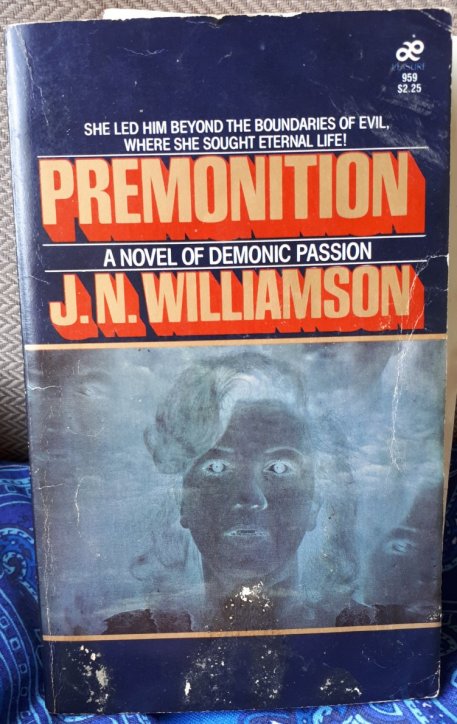
premonition j. n. williamson

Premonition – J.N. Williamson
Leisure Books – 1981

By the time I got around to reading Premonition, I was well and truly sick of this series. I didn’t want to read this at all, and I ended up mostly skimming through large sections of the book. This method actually enhanced my enjoyment of the story greatly, and I reckon that this book and Brotherkind would have greatly benefited if 100 pages had been cut from each. The stories in these two are mental enough to be entertaining, but they get bogged down in boring details. I know publishers used to charge more money for longer books, so maybe these were originally good stories that Williamson ruined for some extra cash.

Brotherkind had a mental storyline, but I reckon Premonition is probably the wackiest of this series.

Ruben goes to work for Solomon Studies in an abandoned amusement park on an isolated island. It turns out that his boss is the reincarnation of King Solomon, and her company is secretly trying to develop a way to prolong life indefinitely. Unfortunately, the island where they have their headquarters is also home to a sex demon that is made of cancer. Also, one of the doctors working there, a former Nazi, has cloned a pterodactyl. Eventually this pterodactyl teams up with a magical hermaphrodite midget to put a stop to the cancer demon. I’m not joking.

Like I said, I flicked through this one pretty rapidly, mainly just skimming for the important points of the plot. There was one passage that jumped out to me though. It’s a scene in which a hospital worker is verbally abusing an elderly patient to prove to Ruben that the old man is in a catatonic state. He shouts, “you’re a useless piece of excrement on life’s shoals, a chunk of fleshy shit caught on the rocks”. I laughed heartily at that, both when I read it and again when I was typing it out. Think about what that would look like. For a shit to be described as ‘fleshy’, it would have to have some girth to it. You wouldn’t use the word fleshy to describe a stringy little turd. It’s the next deductive step that provides the big laughs though: for a shit to be girthy, the person who did it must have had a stretched anus. The hospital worker is telling the man in a vegetative state that he is a big poo from a big bumhole. This made the book worth reading.

premonition williamsonThis is the image from the cover, un-negatived. I wonder who she is.
These books share a central character, but they’re not much of a series. The timeline is all messed up. Aside from Martin Ruben, there is one other character who appears in all three books, but he actually dies in the first one. In terms of publishing, The Ritual came first, then Premonition and then Brotherkind, but the timeline of the actual stories is quite different. Premonition comes first, and then The Ritual and Brotherkind take place at the same time. There’s a single mention in Brotherkind of the stuff that’s happening in The Ritual, but Williamson didn’t have the foresight to include events from the unwritten Brotherkind in The Ritual. The characters must be incredibly talented at compartmentalizing their lives. They simultaneously save the world from the Antichrist while also preventing an invasion of alien rapists, and they do so without letting one event even remotely interfere with the other.

All in all, this series was terrible. There’s some silly ideas in here that could have been entertaining, but these books are boring and unpleasant to read.

Snowdrops from a Curate’s Garden – Aleister Crowley

snowdrops curate's garden crowley
Snowdrops from a Curate’s Garden – Aleister Crowley

Birchgrove Press – 2011 (First published 1904)

Aleister Crowley was a mystic, a poet, an Irish Republican, a mountaineer, a propagandist, a dead-beat dad, a spy, a pilgrim, a preacher and a problem when he was stoned. He was also a bit of a pervert.

This is a collection of his dirtier writings. I wouldn’t really consider it pornography or erotica – it’s really just filth. I don’t mean that in a derogatory way either. This is literally page after page of gross-out material.

The bulk of the text is made up of The Nameless Novel. Crowley wrote this while his wife, Rose Kelly, was recovering from the birth of their daughter Lilith. Every day he’d write a new chapter and give it to her that evening to make her laugh. The story is about the life of an Archbishop, and each chapter aims to be more repulsive than the last. This is a challenge when the opening chapter starts off with the following passage:

“Good, by Jesus!” cried the Countess, as, with her fat arse poised warily over the ascetic face of the Archbishop, she lolloped a great gob of greasy spend from the throat of her bulging cunt into the gaping mouth of the half-choked ecclesiastic.”

After this, the Archbishop takes a massive shit in the Countess’s mouth and then stabs her in the guts and sticks his cock in the wound…

It gets worse when the pig arrives:

“From his dripping schnickel frothed a hot stiff stream of greenish piss at an incalculable pace, while from his pink arse dripped the faeculent and pultaceous turdlings which we associate with a diet of wash.

The stench was intolerable. Minute by minute passed by, and still the unsurpassed bladder of the unclean animal of the Semite and the Mussulman shot out its hissing torrents. Her greedy mouth frothed and seethed with the o’erflowing billows; for the poor lass’s throat, do what she might—and she had done her best to swallow many a slimestick, thereby noticeably enlarging the passage—was still too small to dispose of the formidable current of urine with which her too complaisant lover now furnished her. Her merkin too dripped over the odd ends of the champion stool. “The gospel hall is full” whispered the Archbishop. “They will have to hold an overflow meeting in the arsehole.”

Sure enough, the delicate-minded girl now turned her attention to the part in question. By her incomparable gift of suction, which years of practice and not a little natural aptitude had bestowed upon her rectum, she absorbed the bulk of the faeces; while any unconsidered trifles stuck in her abundant and curly pubic hair.”

Yep. You’ve just read about a pig filling both ends of a woman’s body with shit. And guess what folks – it gets worse again! When the Archbishop’s gay lover dies, things get quite nasty indeed:

“I flung myself upon the dear corpse; I buggered him night and day, entirely surpassing—for I was now come to my strength—the childish efforts upon the queenly butter-boat of E…..d’s debauched ruler. As the work of putrefaction proceeded—and the stench was awful, for S…y’s little leaven had pervaded his whole lump—I rammed my arse-wedge frantically into his holes as they formed, as if in the insane hope of damming the damage of damned death’s fell flood. Indeed for a week or so I did more than this. The patient actually gained weight. But time tells on the strongest. In the second week I kept barely level: in the third he steadily lost ground: in the fourth he fell to pieces under me: in the fifth I sedulously and conscientiously buggered the pieces one by one: but it was no good. Steven Jimson was (in the immortal word of Poe) a nearly liquid mass of loathsome, of detestable putrescence. Do not think for a moment that my affection was shaken by so slight a circumstance! But I assure you—nay! I swear it to you upon this holy Relic! (he produced a piece of the True Touch-her-home, with the Magdalen’s clap-juice sticking to it still, and reverently kissed it)—that there was not one ounce of that body of love that could reasonably be firky-toodled any more. As long as anything that could be called Viscosity was inherent in the mass, I jounced it like a man. But this soon ceased: I reluctantly withdrew. Yet such was my love for my darling that I buggered a hole clean through his tombstone, and for six months I never left the hallowed spot.”

There’s other parts about fucking the Queen and a woman with an extendable, elastic clitoris. Things get worse and worse until the Archbishop describes the sadistic blood orgy at his father’s secret island full of negro slaves in the West Indies. I’m not going to quote that section here. I am quite sure that the whole point of this book is to be gross and offensive, but this particular section will probably be a little bit too much for most modern readers, even as a deliberately offensive joke.

After The Nameless Novel, there’s a few short stories and a bunch of dirty poems that were added on to provide enough material for a book. These are largely about eating poo and buggery. Some of them are quite funny. Here’s a nameless song:

Bugger me gently. Bertie! My arse is rather sore:
Tinkety – tunkety – tinkety – funk! I haven’t been long a whore.
Mash the shit into gravy! Make me slimy and slick!
Tinkety – tunkety – tinkety – tunkety! That’s what does the trick!

Bugger me gently. Bertie! My arse is rather tight.
Tinkers – tunkety – tinkety – tunk! We’ll ram each other all night!
Bugger me gently, Bertie or I’ll blow off your balls with a fart!
Tinkety – tunkety – tinkety – tunkety! Softly now, dear heart!

Oh Bertie, I’m in heaven! I see the golden walls!
Tinkety – tunkety – tinkety – tunkety! Shove it up to the balls!
Jesus is waiting for me with the Holy Ghost up his bum:
Tinkety – tunkety – tinkety – tunk! You bloody sod, you’ve come!

Honestly, of all the stuff I’ve read by Crowley, I found this the most enjoyable. I’ll take childish toilet humour over cabalistic mysticism every time.

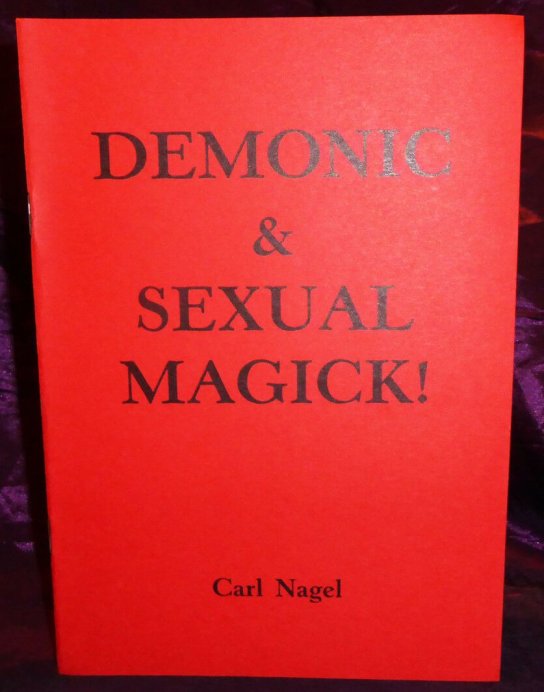
Demonic and Sexual Magick! – Carl Nagel
demonic and sexual magick carl nagelDemonic and Sexual Magick! – Carl Nagel
Finbarr Publications  – 1996

I make the effort to read and review at least one book per week, and I try to say something interesting about each book I’m reviewing regardless of how crap it is. I’m at a serious loss for words with this one though. It’s a boring, stupid, disorganized mess. It reads like the work of an 11 year old who is stupid enough to believe that Harry Potter is real. All of the texts I’ve read that were put out by Finbarr Publications have been of remarkably low quality, but this one is the most inane. There’s nothing here that sets it apart from the utter shit they published.

There’s no order to anything in here. Half of the text is taken up with silly sex magic rituals taken from other sources. These rituals are of the ‘wank off in front of a red candle and stick a black feather up your ass when you’re cumming – visualise the face of your love when doing so, and she’ll be in your bed by the end of the week’ variety. The other half of the book is accounts of people who tried and benefited from these rituals. None of these accounts are remotely believable. There’s also a few unrelated paragraphs on different Occult topics such as Aleister Crowley and Voodoo thrown in too, just to take up space.

Finbarr Publications are the bottom of the bucket when it comes to Occult books, and this is the most boring text that I’ve read from them. (Here’s some more examples if you’re interested: Basil Crouch’s The Hallowed Genie and Secrets of the Black Temple by the Red Spider, Marcus T. Bottomley’s Dark Rites & Encounters With the Devil, and Nathan Elkana’s Taking Control of a Group, Organization, Society, etc., through Occult Manipulation. All of these books are beyond shit.)  Demonic and Sexual Magick! is a particularly rotten bucket of crap. One wonders about the kind of individual that reads this shit in earnest. The world is filled with idiots.

What else can I say? This was truly terrible rubbish. The paper it’s printed on would be better used as toilet paper. Seriously, if you ever come across a copy of this book, use its pages to wipe away excrement from your rancid anal cavity.

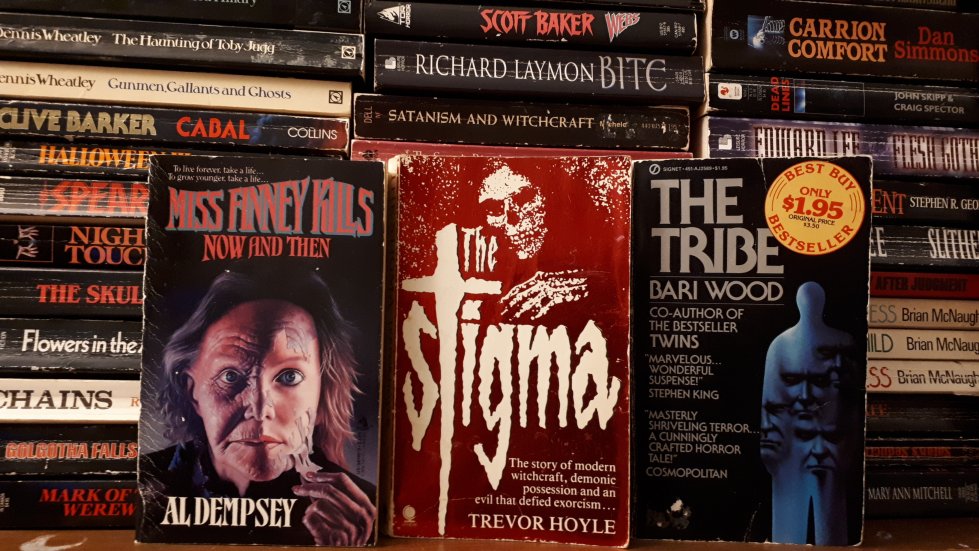
Summertime Reading: A few more Paperbacks from Hell – Miss Finney Kills Now and Then, The Stigma and The Tribe

paperbacks from hell summerI’ve read quite a few paperback horror novels over the summer. Most of them are throwaway reads that don’t justify a post of their own, so I’ve been grouping them by series, authors and publishers. (Expect posts on William Johnstone’s horror novels, J.N. Williams’s Martin Ruben series, Richard Jaccoma’s Werewolf series, and random Zebra and Tor books showing up here in the next few months.) The books in this post have nothing to do with each other aside from the fact that they were all featured in Grady Hendrix’s and Will Errickson’s Paperbacks From Hell and also reviewed by those guys online. I don’t feel a need to go into much detail with these books as Grady and Will have done so already.
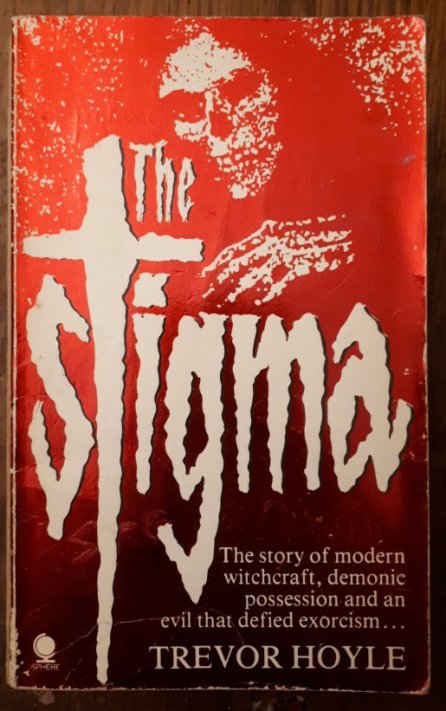
 

the stigma trevor hoyleThe Stigma – Trevor Hoyle
Sphere Books- 1980
This book starts off very serious, and there’s a bunch of references to real witch trials and the Brontë family that got me excited. I’ve never reviewed Jane Eyre or Wuthering Heights on this blog, but they’re two of my favourite books, and the Brontë references left me moist. There were also some fairly scary moments, and by the halfway mark I was wondering if it was really fair for a book like this to have been listed alongside the work of J.N. Williamson in the pages of Paperbacks From Hell. Then I got to the bit where a naughty dog tries to rape someone and had to reevaluate my stance. Things get grosser and sillier as the book comes to a close, and the ending alone warrants its inclusion in PFH. This is ultimately quite a silly book, but I enjoyed it.

I decided to buy The Stigma after reading about it in PFH, but like so many of the texts featured therein, cheap copies of The Stigma became scarce for a while. I paid more than I should have a year and a half ago, but it seems that there’s loads of affordable copies online again now. Grady Hendrix also wrote a more elaborate review of this book for Tor.com


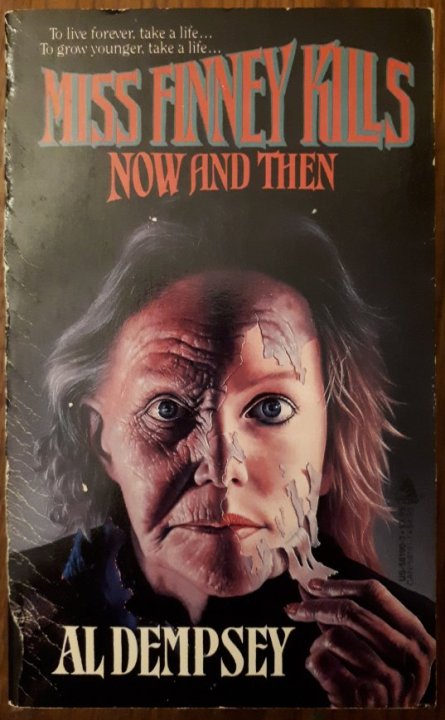
miss finney kills al dempseyMiss Finney Kills Now and Then – Al Dempsey
Tor 1989 (First published 1982)
This is the story of an old woman who can grow younger by murdering people. I found it very enjoyable. The characters are more interesting than I expected, and the plot, while obviously ludicrous, is pretty entertaining. When I was buying this at a thriftstore, there were two copies. One had a slightly classier looking cover featuring a bloody dagger, but I obviously went for the hideous hag one. I discovered Grady Hendrix’s review of this book right after finishing it and then realised that it’s actually featured on the front cover of Paperbacks from Hell. Will Errickson also reviewed Miss Finney. He hated it.


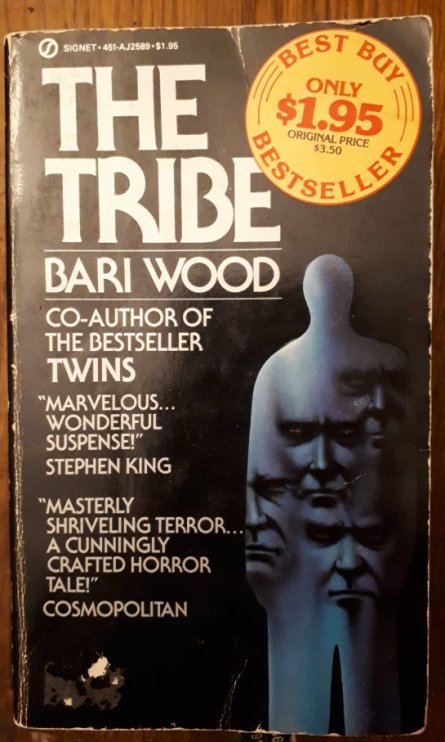
the tribe bari woodThe Tribe – Bari Wood
Signet – 1981
I saw a copy of this at a used bookstore a few weeks back and picked it up. I couldn’t remember reading about it, but I knew it was recently republished under Valancourt’s Paperback from Hell reissue series, so I assumed it would be pretty good.

This is definitely a cut above the other two books in this post. It’s actually a well written novel with an exciting plot and complex characters. It deals with complicated issues in a way that doesn’t get pedantic or preachy. The Tribe tells a story that makes you think. Will Errickson and Grady Hendrix both commented on the effectiveness of the prologue, and I can confirm that it’s pretty great. I can’t imagine anyone reading the first 20 pages of this book without wanting to read the rest.

Oh yeah, it’s about a murderous Golem in New York, but don’t let that put you off. It’s actually fucking great.

After having read The Tribe and enjoying it so much, I definitely aim to read the other Paperbacks From Hell that Valancourt are reissuing.


Well, there you go. These books were amoung the better horror novels I read over the summer. Thanks to Grady and Will for the recommendations.

Secret Cipher of the UFOnauts and Secret Rituals of the Men in Black by Allen H. Greenfield

secret cipher of the ufonauts secret rituals of the men in black greenfieldSecret Cipher of the UFOnauts 
Secret Rituals of the Men in Black
Allen H. Greenfield

Here are two books by the same author that make up one whole. Let me attempt to briefly summarise their contents:

Humanity has been in contact with ultraterrestrial forces for millennia. A kind of merman from Sirius came down to Earth a long time ago and taught us how to organise civilisation.

The secret wisdom of the fish god has been passed down through the coded messages of myths and the ciphered language of the rituals of secret societies. Very few humans still understand the true messages behind these stories and rites. Magic is ultraterrestrial technology, and most, if not all, aspects of the Occult relate to this technology.

summoning alien.jpg
In 1904, Aleister Crowley received messages from Aiwass, a discarnate entity. Within these messages was a key to the ciphered messages of the UFOnauts (ultraterrestrials), but despite his efforts, Crowley wasn’t able to find the key within the message that he himself had channeled. Some of Crowley’s followers discovered the key to the cipher in the 70s.

Allen Greenfield, the author of these books, claims that this key unlocks the meanings of the nonsensical names of aliens and planets given by UFO contactees. It also decodes elements of the secret rituals of certain masonic fraternities.

The deciphered meaning of these terms and rituals gives credence to the claim that ultraterrestrials have long been meddling in human affairs. Some aliens seem to be good, but others are pretty bad.

These books are not easy reading, but that’s their basic message as far as I can tell. The evidence given for these claims is fairly cabbalistic, and I don’t have the background or the patience to assess it properly. I read every word in the book, but entire paragraphs went entirely over my head. There’s a lot of references to different contactee cases that I am only mildly familiar with and a good deal of discussion on different aspects of freemasonry that I didn’t get at all.

I feel that things might have made more sense to me if I had already read Robert Temple’s The Sirius Mystery. It’s mentioned quite a few times in here. I’ve had a copy of this book on my shelf for years, bit I’ve found it tough to work up enough courage to actually read it. I suppose I should really look through it before delving any deeper into UFO lore.

Philip K. Dick’s VALIS was also mentioned in here quite a few times. VALIS was one of the first of Dick’s novels I read, and I remember finding it quite confusing at the time. I wonder if it’d make more sense to me now. I thought it was pretty cool to see Dick’s work being discussed alongside Crowley’s.

The main texts of both Secret Cipher and Secret Rituals are followed by interviews with an individual who calls himself Terry R. Wriste, and these interviews contain the most entertaining, most straightforward and most unbelievable parts of the books. In one of them, this Wriste guy describes being part of an underground shootout between a group of Vietnam veterans and a bunch of aliens. Wriste was one of the only survivors. In the other interview, he claims that UFOs can be shot down with sex energy. So remember, if you’re ever about to be abducted by an alien, just whip out your dick or pussy and rub it in their direction. They’ll disappear.

Robert Anton Wilson described Secret Cipher as “A very strange book, even for the field of UFOlogy”, and I have to agree with him. This stuff is mental. It was nice reading it so soon after Dark Gods by Roberts and Gilbertson as that book discusses a lot of the same cases. I cut down on the alien books after reviewing a bunch of new-age channeling nonsense a few years ago, but the books I’ve been reading recently have got me interested again. I’ve been enjoying the way they bring other aspects of the Occult to their discussions.

I’ve found it a bit tricky to figure out accurate publishing information for Greenfield’s books. The first one, Secret Cipher, was originally published in 1994.  I’m not sure when the second one, Secret Rituals, was published, but I know it wasn’t after 1995. I read the 2005 digital editions of both texts. (Secret Cipher of the UFOnauts, Secret Rituals of the Men in Black) The texts are about the same thing, and I’m certain they’re meant to be read together. A few years ago, the author put out another book, The Complete Secret Cipher of the UFOnauts. I haven’t been able to verify this, but it seems probable to me that that text is just the other two books stuck together.

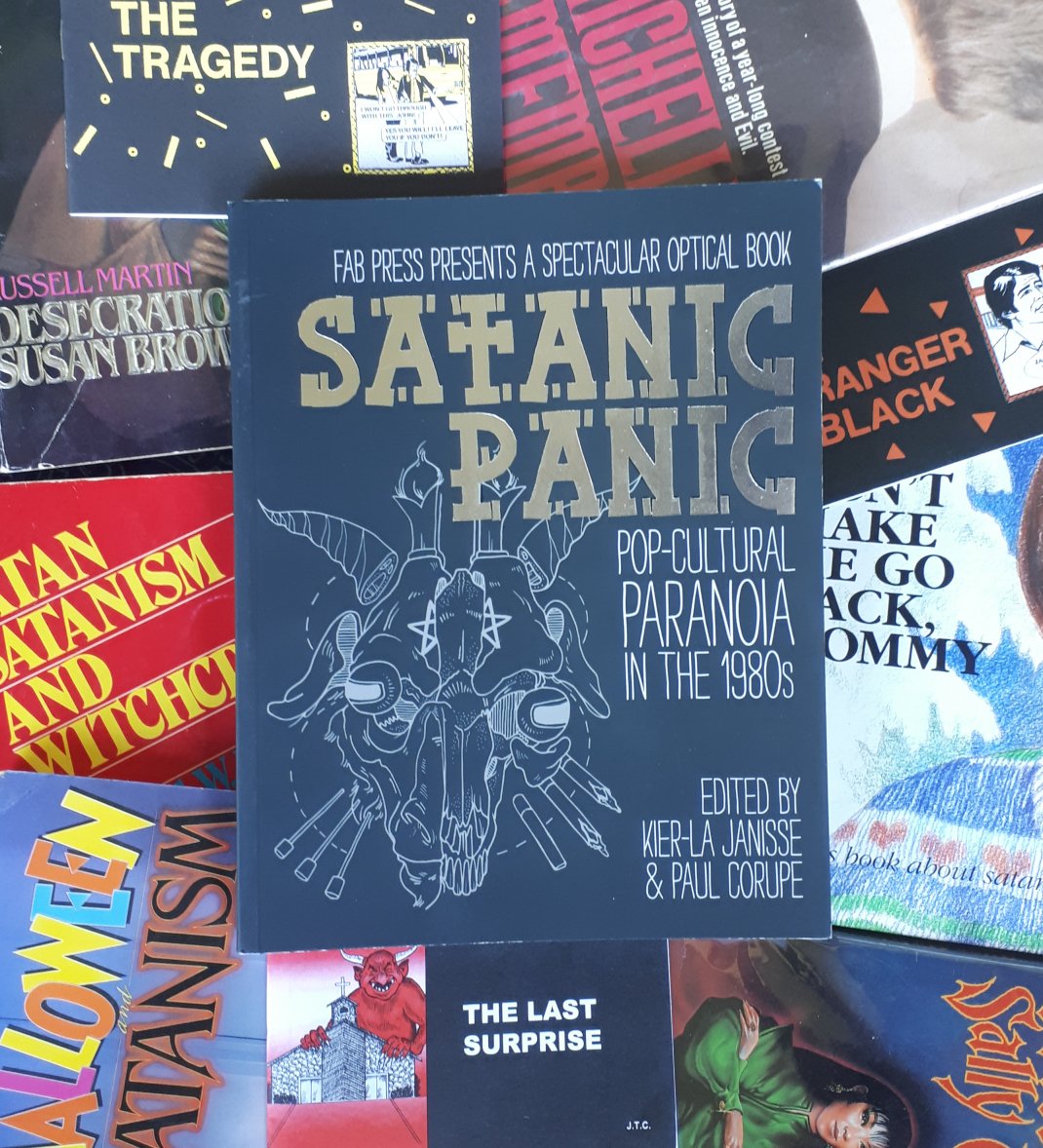
Satanic Panic: Pop Cultural Paranoia in the 1980s – Edited by Kier-La Janisse & Paul Corupe
satanic panic pop-cultural paranoiain the 1980s.jpgSatanic Panic: Pop Cultural Paranoia in the 1980s 
Edited by Kier-La Janisse & Paul Corupe
FAB Press – 2018 (Originally published 2015)

This is a collection of essays about different elements of the Satanic Panic of the 1980s. I remember seeing something about this book when it came out and thinking that it looked cool, and when I recently saw that it contained an essay on Russ Martin’s sexy Satanic mind-control novels, I knew I’d have to read it. I got a couple of gift vouchers from work over the past year, and I was delighted to find a way to use those vouchers to pursue my interest in Satanism.

The essays in here are of varying quality, but most are pretty good. I guess it’s inevitable that each reader will like some better than others. Together they present a pretty comprehensive look at the Satanic Panic of the 1980s.

Reading the book over the course of a few days was a bit odd as the introductory background information in some of the essays is pretty similar. Geraldo’s infamous Exposing Satan’s Underground special gets quite a few mentions. I guess this two hour TV special is probably the defining peak of the panic. Despite multiple attempts, I’ve never managed to watch the whole thing through. After a few moments of it, I feel a maddening urge to listen to Slayer and throw stones through church windows.

I’ve encountered a lot of the material in this book before, and covered some of it on this blog. There’s essays on Michelle Remembers, Bob Larson, books by Phil Phillips, and one on the McMartin preschool trial. The McMartin essay was one of the more interesting in the book. It argues that the claims of Satanist involvement in that case actually prevented prosecutors from busting a real paedophile ring. There are also interesting essays on Chick Tracts, Dungeons and Dragons, and heavy metal in here.

I felt that a few of the writers went a bit overboard trying to make their essays feel academic. One of them even references Foucault. Ugh. We get it guys, you went to college…

(Haha, after writing that last bit, I looked up the guy who made the reference to Foucault, and he actually teaches a course on college writing in a college. Classic! Referencing ol’ Michel might be a surefire way to dazzle your liberal arts prof, but it don’t impress me much.)

This is a far fancier book than the ones I usually read. It looks and feels really nice. There’s so many cool pictures, and it felt like a lot of work was put into the layout. Just to flick through it is a cool experience. In sincerity, if you know any goths who have a birthday coming up, this would be perfect for their coffee table.

I don’t have much more to say about this one. Overall, it’s a very cool book. I’m quite sure I’ll reread some of these essays as research for future posts.

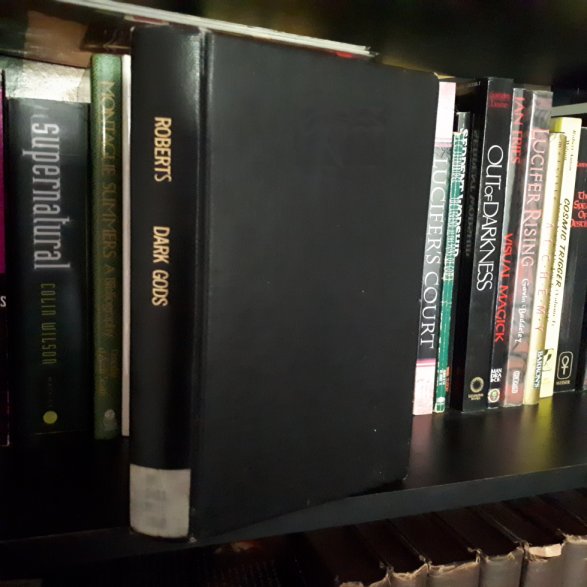
Dark Gods – Anthony Roberts and Geoff Gilbertson
dark gods - anthony roberts and Geoff Gilbertson.jpgDark Gods – Anthony Roberts and Geoff Gilbertson
Rider/Hutchinson – 1980

Malevolent forces from another dimension have long been plotting against humanity. Throughout history these forces have manifested as demons, angels, spirits, fairies, vampires, dragons, aliens and Men in Black. They have convinced some humans to create secret societies that unwittingly aim to bring about the downfall of humanity. Lovecraft’s tales are not mere fiction. Nyarlathotep and Cthulhu are very real, and they’re patiently waiting for misguided humans to call them forth so that they can lead us into an era of blasphemous anarchy and interdimensional terror.

I mean… if you don’t want to read this book after that description, you’re on the wrong blog.

There’s so much to unpack here. This utterly insane book takes the work of H.P. Lovecraft, Bulwer Lytton, Erich Von DänikenFrancis King, Pauwels and Bergier, Eliphas Levi, Aleister Crowley, Trevor Ravenscroft, and John Keel and mixes it with Biblical Lore, black magic, cryptozoology, secret society conspiracy theories and UFO abduction stories. This is essential reading.

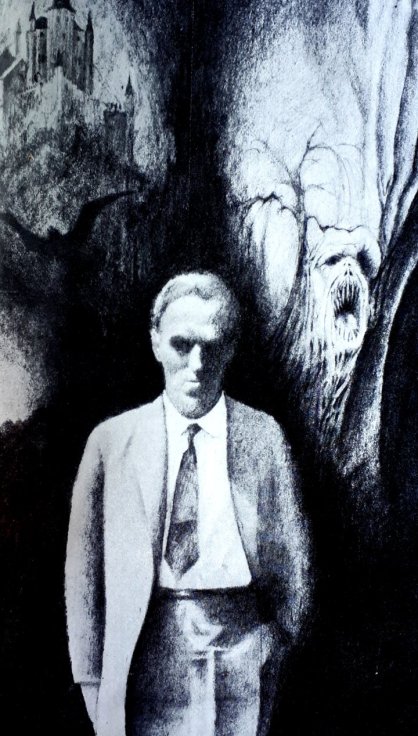
h.p.lovecraft - tom evesonjpg.jpgI’ve seen this image of Lovecraft before. It’s by Tom Eveson.

When I read Colin Wilson’s The Occult, I complained about the author’s unquestioning acceptance of ridiculous ideas. This approach made a little more sense to me after I read Morning of the Magicians by Pauwels and Bergier and understood their concept of fantastic realism, but I still thought of Wilson as a fairly credulous yet knowledgeable individual. Wilson actually wrote the foreword for this book, and it’s rather telling that he seems uncomfortable accepting this book’s findings. While he praises the authors of Dark Gods’ inquisitive vigor, he can not endorse their blind acceptance of their own conjecture. What is too much for Wilson will be far too much for almost everybody else.

Truly, this is a ridiculous book. There is no consideration given to the reliability of any of the authors’ sources; they even accept testimony from individuals they acknowledge as being liars.  They make no distinction between myths, fiction and eye-witness witness reports. Lovecraft’s short stories, extracts from The History of the Damnable Life and Deserved Death of Doctor John Faustus and Bulwer Lyton’s novel The Coming Race are presented alongside historical documents as proof of the conspiracy.

I don’t mind authors being ridiculous if the material they’re presenting is entertaining, but unfortunately, not all of the stuff in here is hugely interesting. Much of the second half of the book is taken up with descriptions of different secret societies such as the Golden Dawn, the Illuminati and even the Bilderburg Group. I recently wrote about my current disdain for conspiracy theories, and I found this section of the book to be grueling. The general message of the last 100 pages or so can be summed up by saying that any secret society that claims to offer illumination is actually run by Satanic forces that aim to enslave the society’s members and ultimately destroy humanity. I will give the authors some credit for briefly suggesting Reptilian government leaders 10 years before David Icke went mad, but this part of the book was painfully dull.

dark gods crowley blavatksy weishauptMadame Blavatsky, Rudolf Steiner, Adam Weishaupt, Aleister Crowley, Houston Stewart Chamberlain and Dietrich Eckart – Satanic Illuminatists (Picture by Tom Eveson)
Overall, the writing is quite bad. The authors seem to dance around the points they’re trying to make rather than just stating them clearly. This is particularly unfortunate as the points they are making are hardly common-sense ideas.

Perhaps the most confusing, convoluted part of this book is the bit explaining the motives of the entities who seem to abduct people in UFOs. ‘The phrase ‘seem to’ is very deliberate in that sentence. The authors of Dark Gods don’t believe that aliens are coming to Earth and abducting humans; they believe that interdimensional beings are coming to Earth and pretending to be aliens that are coming to Earth and abducting humans. We’re talking about malevolent ultra-terrestrials, not inquisitive extra terrestrials. (The idea of ultra-terrestrials rather than extra-terrestrials can be found in Whitley Strieber‘s abduction books too, but ol’ Whitley never imagines his visitors to be so deceptive.) Why are these weird entities playing such an elaborate hoax on humanity? According to Gilbertson and Roberts, it’s basically just to confuse us.

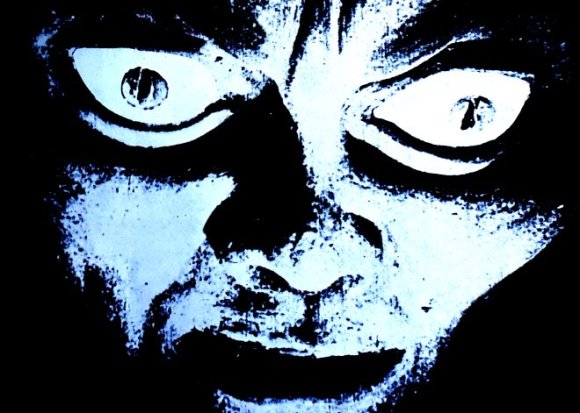
golem dark godsThis image of a Golem later appeared on the cover of a book by David Schow.
Think about that for a second. Inter-dimensional creatures are crossing over into our dimension and then pretending to be aliens because they think that will make us feel afraid and uncertain. The pretending to be aliens part just seems a little bit redundant to me. They’re inter-dimensional creatures – that’s plenty frightening and confusing. What kind of deranged people came up with this nonsense?

There’s sparse information on the authors available online, and I had to dig around quite a bit for it to paint a cohesive picture. What I could find was fairly depressing. Both men are now dead.

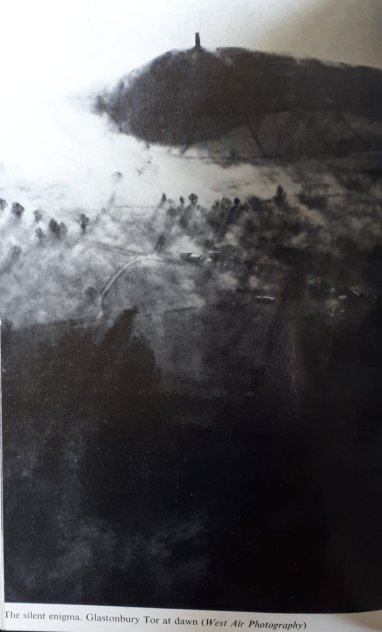
Anthony Roberts had previously published some other books on Atlantis and mythology. Paul Weston, an expert on Glastonbury’s mythology, claims that the mood of Roberts’ earlier books were “considerably different” to Dark Gods. Roberts ran a publication company called Zodiac House with his wife. He died in 1990 while climbing up Glastonbury Tor to see a lunar eclipse. He died of a heart attack, but some have suggested that he was actually killed by fairies for planning to summon the ghost of Robert Kirk, a folklorist who was supposedly abducted by the fairies in 1692. Most accounts of Anthony Roberts that I have found have presented him as a rather temperamental individual. (Sources: an essay on meeting Roberts, Paul Weston’s notes, and Roberts’ obituary on page 12 of The Ley Hunter Winter 1989/1990)

glastonbury tor - dark gods.jpgThis creepy image from the book shows the spot where Anthony Roberts would later die.

Geoff Gilbertson died more recently, in 2017. Despite living longer, he seems to have been the more tragic of the pair. He died alone of untreated cancer. I believe Dark Gods is his only book. After publishing it, he supposedly became convinced that the Dark Gods were after him for doing so. He apparently suffered several psychotic breakdowns and spent time living on the streets and in a mental institution. One of his friends believed that he was on the autism spectrum. This guy genuinely seems to have suffered horribly with his mental health. People that knew him seem to have thought him a very nice guy though, a fact which is not true for Anthony Roberts. Nearly all of the information I could find on Gilbertson came from this article.

I’ve read accounts describing both men as unstable. I don’t know how they met or what their relationship was like, but it seems that their interactions with each other created an echo-chamber of Fortean paranoia. Dark Gods doesn’t read like some transparent attempt to synthesize occult ideas in order to make a quick buck. No, this book is a genuine trek into Crazy Town.

I first saw Dark Gods being mentioned on twitter. Somebody was discussing how difficult it is to find these days. Underneath that comment, somebody else had posted a video review of the book by Occult Book Review, one of my favourite youtube accounts. (He’s another Irish dad with an interest in occult books, basically a nicer, smarter, more respectful version of me.) After the first few minutes of that video, I knew I’d have to track down and read this thing as soon as possible.

Doing so wasn’t easy. This book really is quite tricky to find. You’ll be very lucky to buy a copy for less than 200 dollars, and I wasn’t able to find a digital version. With a little bit of work, I managed to get my greedy little claws on a physical copy. It’s actually a very tedious read, but if you’re determined to read it and can’t afford to spend a bunch of money, ask me nicely and I might be able to help you out.

Conjuring Spirits – Michael Osiris Snuffin

conjuring spirits a manual of goetic and enochian sorcery michael osiris snuffin.jpgConjuring Spirits: A Manual of Goetic and Enochian Sorcery
Michael Osiris Snuffin
Concrescent Press – 2010

Here’s a book about communicating with demons.

There are two parts to this text. The first is a modern guide to Goetic evocation. It simplifies some of the steps that you’ll find listed in older manuals. This part was fine. I don’t practice Goetia, but I’ve read enough about it to have been able to follow along. Everything here seems to make sense in the context of modern ceremonial magic.

The second part of the book looks at the author’s system of Enochian magic. Enochian magic, for those of you who don’t know, originated in the scrying experiments of John Dee and Edward Kelley. I found it very difficult to bother with this section for a few reasons. First of all, Enochian magic is a system of communicating with angels. I’m more of a demon guy myself. Next up, Enochian magic is a load of bollocks – from what I’ve read, it seems that Edward Kelley was a just conman who strung John Dee along so that he could fuck his wife.

On top of this, the author has his facts mixed up about Dee and Kelley. He says in the opening paragraph of this section, “Between 1851 and 1859 , Elizabethan Magus Dr. John Dee and his seer Edward Kelly (sic) received one of the most powerful systems of magick in Western Occultism.” The problem here is that John Dee died in 1608, roughly 250 years prior to these dates. Queen Elizabeth reigned from 1558 until 1603.

Kelley’s relationship with Dee was actually confined to the 1580s, and I thought that the dates given by Snuffin might just have been a typo, getting the 1580s mixed up with the 1850s, but Snuffin later says that it has been more than 250 years since Dee and Kelley did their experiments. This is technically more accurate than his original dates, but Snuffins book was published in 2010, so this number places Dee and Kelley’s work together somewhere in the mid 1700s.

I know that historical accuracy isn’t entirely necessary for a functioning magical system, but I was quite surprised by this lack of attention to detail. I’ve read that Snuffin is going to release a second edition of this book, so hopefully these errors will be corrected there.