Holy Blood, Holy Grail

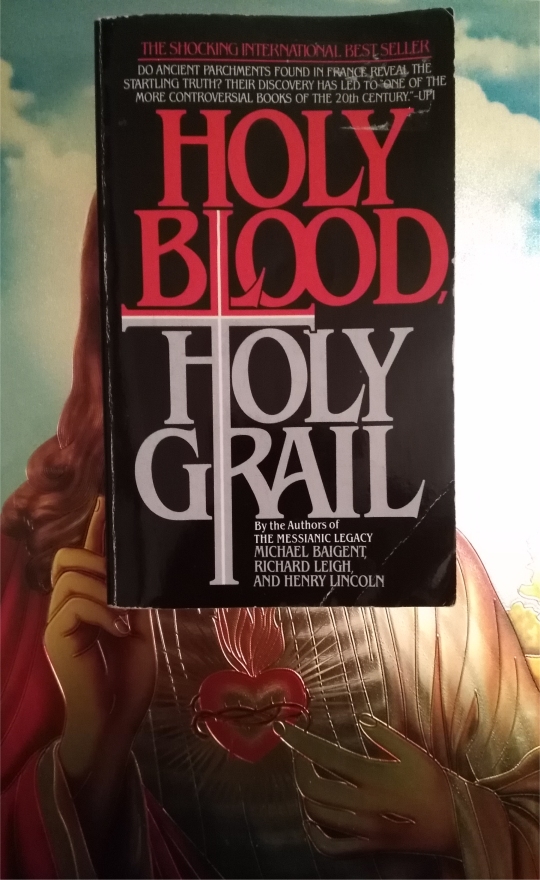
holy-blood-holy-grailHoly Blood, Holy Grail – Michael Baigent, Richard Leigh and Henry Lincoln
Dell – 1983 (First published 1982)

I finally bit the bullet and read Holy Blood, Holy Grail. This very stupid pile of shit is perhaps best known today as the blueprint for Dan Brown’s the Da Vinci Code, but it was a best-seller on its release and has had a huge effect on the formulation and popularization of conspiracy theories ever since. I never expected it to be any good, but I thought that I should read it to familiarize myself with modern grail lore before beginning some of the more dubious texts on that subject.

The main idea here, and we’ve all heard this one before, is that Jesus had a kid. The authors claim that Jesus was actually married to Mary Magdalen and that this pair had a child. Personally, I see absolutely no reason for the historical Jesus to have remained celibate. We don’t know where he was or what he was doing during his 20s. What do most people do in their 20s? They go out and ride whatever they can get their hands on. It would have been weird if Jesus was a virgin. I don’t need the evidence in this book to convince me that he might have had kids. I would be more interested in sensible reasons to believe that he didn’t. And less than 50 pages of this 450+ page book are actually spent discussing the evidence for a horny Jesus. The other 400 pages are taken up with the authors making complete idiots out of themselves.

So one of the authors, I can’t remember which one, read a book on his holidays one year in the early 70s. This book was about Berenger Sauniere, a priest in the south of France who had suddenly became rich in the late 1800s. There were all kinds of rumours about Berenger having found treasure of some kind, and the lad reading the book thought this was pretty interesting and decided to do some research on the mystery of the priest’s wealth. He went over to France and started looking for clues. While he was over there, somebody gave him an anonymous tip-off that there was a dossier of curious documents in a library in Paris that might contain information pertaining to this mystery. Sure enough, he goes to the library and there, in this dossier, are a bunch of cool documents that keep mentioning a weird sounding secret society. Convinced that he’s onto something big, the lad makes some photocopies, goes back to England and starts mashing his pieces of the puzzle together. A few weeks later he gets another call from his anonymous informant who tells him that a few more very interesting documents seem to have shown up in the secret dossier in the library. Our boy is on the next ferry over to France, and what do ye know, when he gets to the library, the dossier is looking thicker. This happens a few times over the next few years, and by the end, his friends and he have managed to piece together the peculiar history of the Priory of Sion, a mysterious secret society that has links to the Merovingian and Carolingian Dynasties of Medieval France, the Knights of the Round Table, the Cathars, the Knights Templar, the Rosicrucians and the Freemasons.

The authors use all the evidence from the secret dossier and a generous dollop of imagination to argue that the Priory of Sion is a secret society devoted to protecting the bloodline of Jesus Christ in the hopes that they will someday be able to reinstate his descendants as the rightful rulers of civilization.

The problem here is that the Priory of Sion is completely fake. It was made up by Pierre La Plantard, a dodgy Frenchman who believed that he was the descendant of some medieval French Kings. Him and his friends had been the ones putting the documents into the secret dossier all along. The whole thing was a load of absolute bollocks. Now, Pierre’s claim was that he was of Merovingian descent, but the authors of Holy Blood, Holy Grail were claiming that he was the direct descendant of Jesus Christ. He got a bit embarrassed about this and renounced the book. His mates that were involved the hoax came forth and acknowledged that they made up the whole thing. (As far as I can tell, the authors’ response to this was to maintain that their claims were true and to claim that La Plantard was lying about having lied.)

pierre-le-plantardPierre La Plantard (AKA Pierre Christ)

I knew that the Priory of Sion was made up before I read this book, and that made it a fairly excruciating experience. The ‘evidence’ presented in here is taken from novels, legends, the bible and hearsay, and the authors’ reasoning is absolutely infuriating. You’ll see their approach criticized in any review of this book; it really is terrible. It made me recall that of the protagonists in Eco’s Foucault’s Pendulum. (And I would find it very surprising if that novel, written in 1988, was not written partly in response to this book and how it had been received.) Leigh, Lincoln and Baigent accept any tangential idea that pops into their heads as long as it can not be immediately disproved. I have adopted a similar approach below to prove that Adolf Hitler was a descendant of Count Dracula:

Transylvania was under Austrian Hapsburg Rule between 1699 and 1867. This would have meant that things and people from Transylvania would sometimes have found their way back to Austria.

Count Dracula, Transylvania’s most infamous resident, although made famous in an 1897 novel, was actually based on a real person, Vlad the Impaler. Vampyrism is probably not a supernatural condition but some kind of hereditary disease, and so Vlad’s descendants would also have been vampires if he was one, which he probably was.

Did the bloodline of Dracula find its way into Braunau am Inn, the birthplace of Hitler?

Well that would explain a lot. We know that Hitler’s mother was born of peasant stock and had a thing for older men. (Hitlers dad was 23 years her senior.) Would she have been able to resist the charms of a tall, dark stranger with a mysterious foreign accent? I think not. If Vlad, or one of his descendants, had shown up on her doorstep, she would have let them drain her right then and there. Ok, I know at this point our argument might seem a bit tenuous, but if we continue with this line of reasoning, a lot of things begin to make a lot of sense.

Ok, so Hitler’s mother was definitely drained by a vampire, thus becoming a vampire herself. She got pregnant with a vampire baby. She tried to pass it off as her employer’s, but this baby had dark hair, like his real father.

Hitler was certainly responsible for a lot of bloodshed. Think about it dummy: Vampires love blood! Was his body ever found? No; he flew off into the night!

At this stage, anyone with an ounce of sense will agree that Hitler is a vampire and probably still alive. It would be utterly ridiculous to claim otherwise.

I did that in about 10 minutes, and I reckon it’s probably more entertaining  and no less sensible than the work of Leigh, Baigent and Lincoln.

Holy Blood, Holy Grail is a pile of shit, freshly emitted from a large hairy anus. At least the Da Vinci Code was superficially entertaining. This is just embarrassing. I wouldn’t recommend it.

This post marks two years of this blog. I’m going to become a dad at some stage in the next month, so things on here might be a bit slow for a while. Make sure you like the facebook page for future updates. Thanks for all the interest.

Wicca vs. Trump and Voodoo vs. Hitler

I don’t normally write about politics, but here we go. There has been a bunch of recent articles (BBC, FoxNews, DailyMail…) about groups of witches casting spells to get rid of Donald Trump. Personally, I think that Trump is a piece of shit and that his administration is a pack of horrible cunts, but I don’t have a very high opinion of  unkempt, dreadlocked wiccans either.  And imagine the chaos that would ensue if their spell actually worked. Congress would round up every goth with a triangle tattoo and burn them at the stake. I think that American witches would do well to draw as little attention to themselves as possible for the next four years.

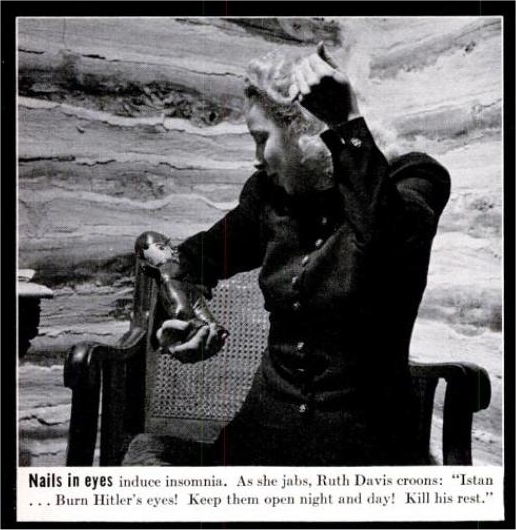
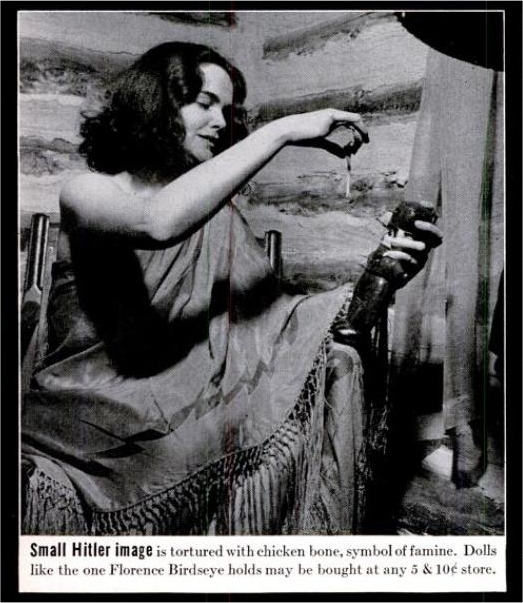
Anyways, putting hexes on fascist dictators is really nothing new. In 1941, Willie Seabrook and friends attempted to kill Adolf Hitler with voodoo. I found the full Life Magazine article about the ritual online, and I’ve uploaded it here for you.

hitler-voodoo-1

hitler-voodoo-2

hitler-voodoo-3

hitler-voodoo-4

hitler-voodoo-5

hitler-voodoo-6Pretty cool, huh?

The Maker of Moons – Robert W. Chambers

maker-of-moonsArchive.org and Librivox Editions (Both from original 1896 text)

This is the collection of short stories that Robert W. Chambers put out after The King in Yellow. There are a other collections of Chamber’s short stories that use the Maker of Moons title that contain a variety of tales, but this is a review of the original 1896 collection. I started it a few weeks ago because I was in need of an audiobook to listen to while doing housework. I didn’t have very high hopes, as it seems to be common knowledge that Chambers wrote far more bad than good, but anything beats making dinner in silence. I really liked most of the King In Yellow, even some of the more romantic tales, but this collection is of a generally lower quality. Including a few soppy stories in a collection otherwise brimming with ghouls and horror is acceptable, but forcing a few quirky tales into a collection of stories about loverboys going fishing makes for a fairly shit book in my opinion.

Here’s my rundown of the stories:

The Maker of Moons
The ‘weirdest’ and most entertaining tale in this collection, The Maker of Moons features weird creatures and strange dimensions. It’s the only story in here that comes remotely close to horror, but in comparison to Chamber’s earlier stories, this remains very much on the fantasy side of weird. I’d save this one for last if I were you.

The Silent Land
A lad with a pet bird goes fishing and falls in love with a strange woman. This is a bit like a really boring version of the title story of the collection.

The Black Water
A lad is in love with a girl. He has a sore eye. This story is shit.

In the Name of the Most High
Chambers was obviously a fan of Ambrose Bierce, and this story could have been taken right out of the Tales of Soldiers section from Bierce’s In the Midst of Life. Unfortunately, Tales of Soliders was my least favourite of all Bierce’s collections, and this reads as a shit version of a shit story. Awful.

The Boy’s Sister
A lad falls in love with a boy’s sister. Lame.

The Crime
A lad goes fishing and falls in love. The only crime here is the inclusion of this hogwash.

A Pleasant Evening
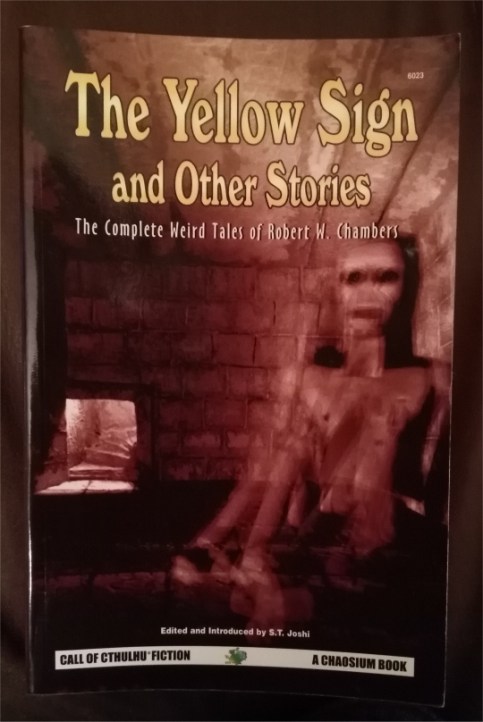
This is a ghost story about a guy closely resembling the author. It’s not the worst thing in the collection; it starts off promising, but it falls apart towards the end. This is the only other tale that Chaosium deemed worthy to include in their Complete Weird Tales of Robert W. Chambers collection

robertwProbably all you need when it comes to Chambers.

The Man at the Next Table
Weird, yes, but not very good. Although it doesn’t appear in Chaosium’s selections from this collection, it is incorporated into Chamber’s novel, In Search of the Unknown, as the Pythagoreans chapter. In Search of the Unknown is included, in full, in the Chaosium collection, but judging by the original version of the story, I don’t know if I’ll ever get around to it. This is a story about a lad who meets a pair of metaphysical losers, and a cat.

If you have the Chaosium collection, I would recommend sticking to the stories included in there. The other tales in the original collection aren’t horrendously painful to read/listen to, but they are all rather similar and forgettable. I’m not going to rule out reading more Chambers in the future, but I’ll probably wait for a recommendation on which of his texts are actually worth reading.

Satan’s Disciples – Robert Goldston

satans disciples goldston.jpg
Ballantine Books – 1962
I added this book to my to-buy list immediately after stumbling across a picture of the cover somewhere online. I was worried that the book itself might not live up to the cover image, but it delivered.

This is a trashy and rather sensational history of satanism and witchcraft. Robert Goldston skips the boring parts (numerology, kaballah, astrology, palmistry…) and goes straight for the sadistic orgies, blood sacrifices, and hag torture. Needless to say, I enjoyed every page.

The introductory chapter to this magnificent work claims that “It can be safely asserted that from the year 1200 until the middle of the seventeenth century, the overwhelming majority of the people in Europe worshipped Satan and regularly attended his festivals.” While I have come to expect this kind of exaggeration from Christian writers writing about Satanism, nearly all of Goldston’s condemnations are actually directed at the church. He doesn’t quite espouse Satanism, but the book, as a whole, almost seems like an attempt to justify it.

While claiming to be a “a full account of witchcraft for modern readers”, this is really more a mish-mash of descriptions of some of the grislier characters, legends and phenomena from the history of witchcraft, each description doing its utmost to err on the side of ridiculous. Included are tales of the ‘blood cows’ of Elizabeth Bathory, how Oliver Cromwell sold his soul to the devil (I believe it, the cunt!), a woman who gives birth to a pair of goblins and feeds them to her dog, and Doctor Fian, a Scottish wizard who specialized in pube magic. There’s a wonderful account of a priest who stupidly banished a demon to a toilet and thus ended up with a burnt, shit-besplattered arsehole, and there’s the heartwarming tale of the Chatelaine De Beauvoir, a lady that I can’t find mention of anywhere else who managed to convince a troop of young men to be her sex slaves. She divided these men into different groups of animals (some were dogs, some were birds) and had them do her perverted bidding. When a police officer inquired how she maintained control over these fine fellows, he was told that she did so by feeding them her shit. What a cool lady! There’s also plenty of other stories about rape, incest and cannibalism. This book definitely doesn’t shy away from the nasty stuff. There’s one particularly brutal account of a young nun who is accused of witchcraft and jailed. Confined to her cell, she is routinely raped by her three guards. At first this treatment leads her to attempt suicide, but she later grows to like it and eventually ends up spending the non-getting-raped parts of her days worshipping Satan.

Towards the end of the book, Goldston temporarily abandons his objective of chronicling the history of witchcraft and devotes a single chapter to the actual practice of Black Magic. Chapter 11, Spells, Curse and Demons, is basically a grimoire in and of itself. It includes useful spells to cure gout, guard against vicious animals, summon Satan, get rid of a headache and kill your enemy. Crucial stuff.

In ways, this book was quite similar to Peter Robson’s The Devil’s Own, but while equally as trashy, this one contains a bibliography and actually makes frequent reference to real historical texts. I wasn’t surprised to see William Seabrook’s book on witchcraft in its bibliography either. All three of these books have a delightful bullshit/reality ratio, and if you have enjoyed one of them, you will definitely like the others. I would really love to know if anyone has recommendations for similar books.


Disinformation’s Book of Lies

img_20170119_170708 Book of Lies – Richard Metzger (Editor)
Disinformation – 2003
I can’t quite remember what put this book on my radar, but it was on my goodreads to-read list for a few years before I picked up a copy. Unabashedly taking its name from one of Aleister Crowley‘s books, this is a collection essays on Magick and the Occult, all written by modern authors. (Actually, I recently found a copy of Crowley’s Book of Lies at a library booksale for a cool 75 cents, so you can expect a review of that at some stage in the future.) The format (and choice of contributors) of this book reminded me a bit of the super edgy Apocalypse Culture series (although, in fairness, this book contains less paedophilia). I’ve been making my way through it since December, and although I have not read every single essay herein, I doubt I will get much further.

The book is divided into 8 sections, each dealing with a different aspect of occultism:

Section 1 is about the actual practice of Magick. Even though I had heard it during his infamous speech at DisinfoCon, I enjoyed Grant Morrison’s explanation of sigil charging through masturbation, I struggled through Mark Pesce’s piece, and I gave up about two paragraphs into Genesis P Orridge’s pile of rubbishy nonsense. Joe Coleman, the artist who did the covers for the Apocalypse Culture books, wrote a fairly cringeworthy prose poem on the magickalness of his own art. I barely even looked at the other essays in this section. All together, this part really sucked. The kind of magick being discussed here isn’t completely loopy stuff; it’s really just other forms of self motivation. If this kind of thing works for you, and I totally understand that it could, that’s awesome, but it isn’t for me.

Section 2 is about “Chemognosis”. I’m not a drug user, and I have no interest in ‘getting high’, so I skipped this section completely.

Section 3 is about magickal icons. There are several essays on Austin Osman Spare, Brion Gysin and William S. Burroughs. I once heard a poem by Brion Gysin that was so irritating that I decided to skip the essays about him. I don’t really care for Spare either, but I may come back to the essays on him if he ever catches my interest. I read Burroughs’ first 3 novels in my early twenties, and I used to think he was really cool because he had collaborated with Kurt Cobain, U2 and Ministry. (Coincidentally, I only recently realized that Ministry’s Psalm 69 song and album were allusions to Aleister Crowley’s Book of Lies.) That being said, William Burroughs was definitely full of shit, and I don’t really care about his forays into magick. There was another essay in here on Lovecraft’s influence on occultism, but it didn’t tell me anything I didn’t know already. This section ends with excerpts from two books. I don’t like excerpts, so I skipped them.

Section 4 is mostly about Aleister Crowley. The essays focusing on him were extremely boring. Donald Tyson’s essay on John Dee and the Enochian apocalypse was entertaining enough, but I can’t really remember what it was about and I’m only after reading it last week. Richard Metzger’s essay on Jack Parsons wasn’t horrible, but Jack’s wikipedia page is currently more informative.

Section 5 is titled Scarlet Women. There are three essays here, one on Marjorie Cameron, one on Ida Craddock, and one on Rosaleen Norton. They were ok. In a book that is 350 pages long, only 22 pages are about women. Out of the 40 essays in this book, one was written by a woman and three were written by Genesis P Orridge. I have seen this book being criticized for its very white guy perspective on occultism and magick, and while I certainly don’t want to read about sacred femininity and that kind of nonsense, I’d have to say this is a fair criticism.

Section 6, the section on secret societies, was probably my favourite. Twyman’s article on Hitler and the occult put me on the trail of a few interesting books, and P.R. Koenig’s accusations that the Ordo Templis Orientalis are a gang on spermchuggers was rather amusing. It pains me to admit it, but Boyd Rice’s very silly essay connecting Enoch’s Watchers, the Holy Grail, Dagon, Jesus Christ and Ea, Lord of the Depths is probably the best part of the entire book. The last essay in this section is rather long and it explains why wicca might not be as legitimate as some people think. I have never taken wicca seriously, so I didn’t care to finish that one.

Section 7 is quite short and not particularly interesting. It includes an interview with an aged Anton LaVey and an introductory essay about rock music’s links to the occult.

The final section is awful. There’s a big, boring, section on Julius Evola, the esoteric fascist. There are also 3 essays by Peter Lamborn Wilson/Hakim Bey. Wilson/Bey, for those of you who don’t know, is a rotten paedophile. He freely admits to and writes about wanting to have sex with children. I didn’t read what he had to say, and I really wish that he hadn’t been included in here. I am very glad that I bought a second hand copy of this book and thus avoided giving the publishers any money. Fuck that. Put that paedo in the oven. This section ends with a super cringy essay on “The Secret of the Gothic God of Darkness“. We’re dealing with seriously edgy stuff here.

Overall, Book of Lies was a bit disappointing. Some of the essays are on very interesting ideas, but in most cases, they barely scratch the surface. Then again, I bought my copy cheap, and it gave me the names of a few books that I will be checking out in the future. If you see a copy for less than a tenner and you want a nice book to leave beside the toilet, you could do worse than this.

The Trials and Tribulations of (reading about) Paracelsus

paracelsusParacelsus Magic into Science – Henry M. Pachter
Collier Books – 1951

I was looking for a new book to start at the end of November when I picked up a most peculiar volume off my shelf. 100,000 Years of Man’s Unknown History had come as part of a set of cooky ancient-alien books that I bought years ago, and as I skimmed through it, I saw mention of the mysterious Count Von Küffstein and his homunculi. (If you’re not familiar with the Count Von K, you might want to check out my post about Aleister Crowley’s strange creations.) I was intrigued, but I was about to spend half the day on a bus and I wanted a smaller book that would fit in my pocket. I was buzzing off the idea of homunculis though, and so I picked up the biography of Paracelsus that I had found on a ‘free books’ table when I was in university.

Paracelsus was a travelling doctor/healer in the 16th century. He disdained the traditional academic approach to medicine and tried to figure out better ways to heal people. Most of his methods would sound very silly to us today, but his approach, which was based on reasoning and experiment, has contributed to the development of the modern scientific method. He was a pretty cool guy too. He traveled around Europe, healing people, writing books, getting drunk and starting arguments with local professors and doctors.

theophrastus
The man’s life was interesting, but in truth, this book is actually quite boring. However, when it comes to books on Paracelsus, I reckon the boring ones are probably the most trustworthy. Pachter’s focus is on how Paracelsus influenced science, and while he never denies Paracelsus’s fascination with the occult, he doesn’t give it as quite as much attention as I maybe would have liked. There’s only a few very brief mentions of Homunculi in here. (Paracelsus claimed it was possible to create miniature human life by placing glass bottles of sperm into steaming piles of horseshit.)

Pachter acknowledges that other writers have gone completely overboard with their interpretations of the more mystical aspects of Paracelsus’s writings, and even though I was fairly bored with Paracelsus when I finished this one, I went straight on to a silly book on Paracelsus that I had been meaning to read for the past year.

paracelsus-by-hartmannThe Life and Doctrines of Paracelsus – Franz Hartmann
1886?

The only attraction of this book is the fact that it seems to have been the text that brought the story of Count Von Küffstein to the attention of the occult community towards the end of the 19th century. In the 8th chapter there’s a chapter on Homunculi that contains an extremely lengthy footnote telling the story of Count Von K. As far as I can tell, this book was originally written in German and later translated into English. If it was originally published in German, we can presume that the footnote on the Count was a paraphrase of the account given in Die Sphinx. (Again, read my post on Crowley if you’re not following this.) This would mean that nobody has ever actually translated Die Sphinx directly. I have been toying with the idea of translating and publishing it myself, but I don’t want to waste my time if it was already been done. If anyone has any information on this, please let me know.

Aside from a single footnote, this book was un-fucking-bearable. The first chapter gives an account of Paracelsus’s life, and the rest explores his beliefs. This is basically the exact opposite of Pachter’s book. While Pachter gives perfunctory mention to the more nonsensical ideas of Paracelsus, Hartmann wallows in them. I read the first two chapters and then skimmed till I got to the homunculus bit. I simply wasn’t prepared to give these dated and stupid concepts the attention that would be required to make sense of them. This book was utter shit.

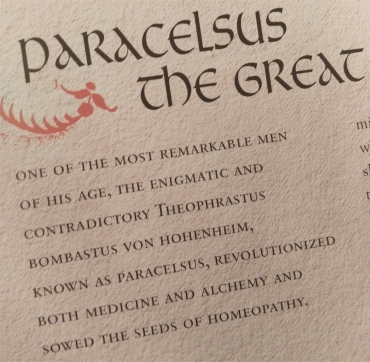
paracelsusthegreatFrom The Book of Alchemy

Paracelsus was actually cooler than I expected, but these books were a real chore to read. I’m reading two other dry ones at the moment, and I don’t think I’ll move straight on to 100,000 Years of Man’s Unknown History as I reckon I ought to treat myself to something a bit more enjoyable first. The story of Paracelsus played a part in shaping the Faustian Legend, and I am now considering a reread of Marlowe and Goethe’s versions of that tale for a future post on the same.

paracelsus-ulyssesParacelsus was Swiss born, but James Joyce thought so highly of him that he included him in a list of Irish heroes and heroines of antiquity in Ulysses.

Year in Review: 2016

2016 is very nearly over, and although it was a tremendously shit year in a lot of ways, it was a pretty good year for this blog. Not only did the site’s traffic increase to 4 times what it was in 2015, I also believe that my content has improved in quality. For much of the first year of the blog, I was reviewing books that I had read a long time ago. At this stage, I’m reviewing books right after reading them, and the more I read on these topics, the more links I have been able to draw. Not every post on here is groundbreaking, but there have been a few this year that I am quite proud of. Here’s my top-10 list for 2016:

bulwer-green-skull


10. The Haunters and the Haunted

A look at the different versions of Bulwer Lytton’s classic ghost story. This post features Colin Wilson getting pwned.

2016-05-19 22.01.48

9. The Books of Whitley Strieber
(Communion, Transformation)
I want to bully this guy so much.

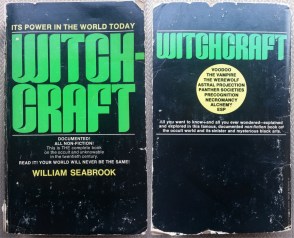
witchcraft


8. Seabrook’s Witchcraft

Willie Seabrook: explorer, sceptic, sorceror and sex-pervert. My hero.

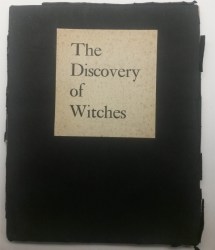
buk


7. Matthew Hopkins’ Discovery of Witches

The coolest physical book in my collection

dictionaries-of-witchcraft-and-demonology

6. Dictionary of Demonology/Dictionary of Witchcraft
The biggest disappointment of 2016

20160325_000821

5. The Fiery Angel
A curious, Russian occult novel that turned out to be based on a true story.

20160803_210212


4. Black Magic Grimoires
An in-depth look at some of the most infamous works of black magic.

demoniality-liseux-version

3. Ludovico Maria Sinistrari (Part 1, Part 2)
A weird Friar who believed in randy fairies and gander-neck appendages that grew from between the legs of horny women.

frontispiece

2. Varney the Vampire
You won’t find many reviews of this book that are as thorough as this one.

bookwith angel

and finally… 1. Michelle Remembers
My post of the year without doubt. An on-site investigation into the diabolic, incestuous rape fantasies of a masochistic idiot and sex fiend.

I want to stress that this is a list of the best posts from this blog in 2016. (It most certainly does not reflect the 10 best books that I read in 2016!) I hope that Nocturnal Revelries has been insightful and entertaining to the people who have found themselves reading through it over the last year. I have really enjoyed reading and writing for this blog, and I intend to keep the content coming during 2017. That being said, my wife and I are expecting our first baby in March, and I imagine that she’s going to leave me with significantly less time to spend reading.

Thanks for all of the support. Read books, drink tea, skip mass and have a good new year!

(Oh, and just in case you didn’t know, I have facebook, twitter and tumblr pages set up so that you can keep track of what’s happening on the blog even if you don’t have a wordpress account.)

Dracula vs. Hitler – Jon Ruddy’s The Bargain

thebargainfrontcoverThe Bargain – Jon Ruddy
Knightsbridge – 1990
Although it’s disguised as a novel, Jon Ruddy’s The Bargain is likely the most historically accurate account of the sinister proceedings that brought an end to the second world war that has ever been published. This is the true story of how Count Dracula used an army of vampire whores to bring and end to Third Reich.

It took me approximately one minute to order a copy of this book after seeing an image of its cover online. I don’t regret my purchase. The cover is phenomenal, and the book itself is actually fairly enjoyable. There’s lots of sex, swearing and gore, and it really wouldn’t be fair to expect anything more from a book with that cover. To use Ann Radcliffe‘s distinction, this book is very much a horror novel rather than a tale of terror, and sometimes some straight forward horror is just what I need.
thebargainbackcover
Dracula never died, but he got really annoyed when Hitler invaded Romania, so he  made a bunch of vampire prostitutes and got them to fuck/infect/kill German soldiers. This is very much a Dracula versus Hitler story, and while that is obviously super cool, I was hoping that it would be more of a Dracula and Hitler (up a tree) story. I feel like that these boys would probably like each other, and instead of reading about their rivalry, I’d prefer to see them going out for a beer together. Holy shit, imagine how entertaining it would be if Dracula and Hitler had a weekly podcast where they just shared their stories and opinions. I mean, it would be evil as fuck, but I would definitely listen to it.

I had a fairly similar complaint when I read Dennis Wheatley’s They Used Dark Forces.  That book is about Hitler and black magic, but the dark forces in question are largely being used against Hitler. If I’m reading a novel about Hitler, I want him to be the main bad guy. I want to read allegations of him being a vampire or a black magician. I want a book that explains how Adolf Hitler would drink the blood of a virgin, then sprout wings and fly into the night sky to pay homage to Lucifer, his lord and master. If anyone knows if such a book exists, please let me know!

This book was still pretty sweet though. Read it.

Elizabeth Gaskell’s Gothic Tales of Mystery and the Macabre

elizabethgaskell
Tales of Mystery and the Macabre – Elizabeth Gaskell
Wordsworth Books – 2008
Long ago, I got a goodreads recommendation for Elizabeth Gaskell’s Gothic Tales collection published by Penguin. In April 2013, I ordered a copy. It never arrived. Later that year, when I went home for Christmas, I found a short story collection by Gaskell in the Wordsworth Tales of Mystery and the Supernatural series. This collection was called Tales of Mystery and the Macabre. It was nice and cheap, and I presumed it would be the same as the book that I had previously ordered, so I bought it. It lay on the shelf for nearly 3 years.

I started reading Gaskell in September. I checked to see if this edition contained the same stories as the Penguin edition. The Ghost in the Garden Room goes by a different title; it’s The Crooked Branch in the Penguin edition, but they’re the same story. Apart from that, these texts are the same. The Penguin edition may well have notes and a better introduction, but I doubt those would make this book any more enjoyable.

The stories are not mysterious, and only a few of them are remotely spooky. They’re mostly about innocent young women and mistaken cases of identity. Within a week, I had read all but two of the tales, but then I started working in a factory and binging on Stephen King, and I lost all interest in Gaskell. I forced myself to go back and finish it last week, and I’m glad I did. The last story I read, The Ghost in the Garden Room, is surprisingly miserable; it was great, especially the ending. The rest of the stories range from decent (Lois the Witch and The Old Nurse’s Story) to stupidly shit (Curious, if True). I started on Gaskell right after I finished reading Varney the Vampire, another book in the Wordsworth series, and that may have had something to do with how little I enjoyed this one. My patience threshold for Victorian fiction seems to be about 1000 pages.

Overall, Gaskell’s Gothic tales are not absolutely horrible to read, but this was not a book that I ever looked forward to opening. Also, the cover is fucking stupid. I’ve given out about the covers for this series several times before, but dear Christ this one is ridiculous. There’s no mention of planets or standing stones in any of these stories, and that cover makes this book look better than it is. The image needs to be replaced for the next edition, and out of the goodness of my heart,  I have designed for a cover that far better suits the content of his book:

better-coverIf anyone working for Wordsworth sees this, please spare the niceties and just send a cheque. Thanks.

LUDOVICO MARIA SINISTRARI: PART TWO (Demoniality)

demoniality-liseux-version
To quickly summarize what I’ve already written about Ludovico Maria Sinistrari: he was a Franciscan Friar who wrote a book that was basically a list of all of the sins that he could imagine. I wrote a lengthy blog post explaining Sinistrari’s beliefs about sodomy, and while I believe it was an informative and insightful post, it may have seemed slightly out of place in this blog. I mean, isn’t this supposed to be a blog about Satan and the paranormal and spooky stuff? Surely sodomy isn’t very spooky? Well, no, but the chapter on Sodomy from Sinistrari’s De Delictis is one of the two sections from that book that is widely available in translation, and I don’t like half-assing things. The other, more infamous section, which we are going to look at today, fits far more comfortably within the context of this blog; it is a chapter on Demoniality. Demoniality, for those of you who don’t know, is the act of having sex with demons. Oh yeah, now we’re getting back on track.

The story of the manuscript of Demoniality is as interesting as its contents. In 1872, a French bookseller named Isidore Liseax spent a short holiday in England rummaging about in some antique booksellers. In one of these stores, he found a short manuscript titled “Dæmonialitas” and bought it for sixpence. He took it back to France, translated it, and published it 3 years later. It wasn’t until I read an essay on Sinistrari by Alexandra Nagel that I realised why this story sounded so familiar. Remember what I wrote about the opening to Bulwer Lytton’s Zanoni?

Liseux had never heard of Sinistrari, and he spent a long time trying to figure out who had written the text he’d purchased. Its author was listed as Ludovicus Maria of Ameno, but Liseux wasn’t able to find out any reliable information about such a man, and it wasn’t until he serendipitously opened a copy of the list of writers banned by the Vatican to just the right page that he discovered that this Friar of Ameno was the same person as the author of De Delictis. De Delictis had been unbanned for more than a century at this stage, and while it wasn’t widely available, Liseux managed tracked down a copy with a little persistence. Once he understood the nature of that work, he was certain that his manuscript on demoniality belonged to it. It followed the same structure as the other entries, and indeed De Delictis contained a chapter on demoniality. Liseux’s copy, however, while it started and ended the same way as the chapter in De Delictis, was largely expanded. The chapter in De Delictis is a mere 5-6 pages long, while Liseux’s manuscript was more than 80 pages. Liseux, by a stroke of extreme good luck, had found and paid next to nothing for the uncut edition of a paper on sexual intercourse with devils and spirits, the cut version of which was included in a book that was banned by the Vatican, the text of which had been written by a perverted, 17th century, Franciscan Friar. Holy quaint and curious volumes of forbidden lore!

There has been some discussion about the authenticity of the text. Why wasn’t the full text of Demoniality included in De Delictis? (Remember that De Delictis had actually only been banned for what it said about the qualifications of Judges, not for its details on sexual depravities. The lurid details in the apocryphal Demoniality pale in comparison to ‘the Doctrine of the Clitoris’ as laid out in the canonical chapter on sodomy.) Also, if you read Liseux’s introduction to his English translation of the text, several discrepancies arise. Alexandra Nagel has done an impressive job of listing and accounting for these discrepancies in her essay “Tracing the mysterious facts in Isidore Liseux’ publication of De Daemonialitate by Ludovico M. Sinistrari”, and if you’re interested in the details, her paper is better researched and more informative than what you’re going to read here. Suffice to say, the expanded version of Demoniality was probably intended to be included in a later edition of De Delictis that was never published. While I believe Nagel’s conclusion that Sinistrari was in fact the author, I wouldn’t be terribly disappointed if he wasn’t. This is a book about fucking monsters (and I use ‘fucking’ here as a verb, not an adjective). Does it really matter who wrote it?

Liseux found the manuscript in 1872, published the first French edition in 1875 and followed with an English Translation in 1879. This translation was popular enough to convince him to publish another section of De Delictis, that on sodomy, a decade later. One of the readers of Liseux’s translation of Demoniality was our old friend, Montague Summers. Summers was thoroughly impressed with the contents of the work but not the translation. In 1927, he re-translated Demoniality from the original Latin and wrote an introduction and set of notes to go with the text. I own a copy of Summer’s translation, but Liseux’s is available online. Summers spells Sinistrari’s first name ‘Lodovico’ (here and in his other works), but I haven’t seen that spelling anywhere else.

demoniality-summers-versionDemoniality (The Montague Summers Edition) – Lodovico Maria Sinistrari
Dover Occult – 1989 (This translation first published in 1927)

The book starts off explaining that demoniality is a separate offence to bestiality. Bestiality is having sex with an animal, but while demons are alive, they are not entirely corporeal and therefore don’t really count as animals. Sinistrari knows what demons are not, but it’s trickier to say what exactly they are. He distinguishes between evil demons who only fuck people to bring them into the power of Satan and a far less dangerous class of spirits who only fuck because they’re horny. These other spirits are composed of incubi and succubi. (Incubi are male spirits who fuck females, and succubi are female spirits who fuck men.) Surprisingly, most of what Sinistrari has to say is on the less malevolent, horny spirits, and the result is that this text feels more like a book on cryptozoology than a book on traditional demonology.

succubusThis succubus is a bit little. That man is a nonce.

In fact, if like me, you have an interest in books about cryptozoology/the paranormal/the Fortean, you’re very likely come across references to this text. Sinistrari’s descriptions of fuckable spirits are broad enough that they seem to fit many of my favourite monsters. Sinistrari argues, with evidence from Saint Anthony, that the gods, centaurs, fauns and nymphs of Paganism were all real entities and that the stories of them seducing humans were actually true. Montague Summers, in the introduction to his translation of Demoniality, argues that both the Jinns of Islam and the fairies and leprechauns from W.B. Yeats’ Celtic Twilight (an awesome book) fit Sinistrari’s decription perfectly. Hmmmmm, what other group of unproven creatures have been compared to fairies? I believe that our old pal, Whitley Strieber argued that his visitors had a lot in common with the fairy abductors of celtic lore. If that’s not enough for you, Strieber actually presents Sinistrari’s ideas as evidence for his visitors in Communion; in fairness, the similarities between stories of alien abductions and visits from incubbi/succubi are striking. Dmitri Bayanov presents ideas from Sinistrari’s Demoniality in his essay Historical Evidence for the Existence of Relict Hominoids. A relict hominoid is basically a Bigfoot. Let’s just take a moment to acknowledge then that Demoniality is actually a book about sexual intercourse with Satanic demons, the Great God Pan, leprechauns, genies, fairies, aliens and sasquatches. I can’t say for certain that Sinistrari specifically intended for his text to be interpreted this way, but given his reasoning and willingness to accept the authority of other writers, I really don’t think he would have had a problem with this interpretation.
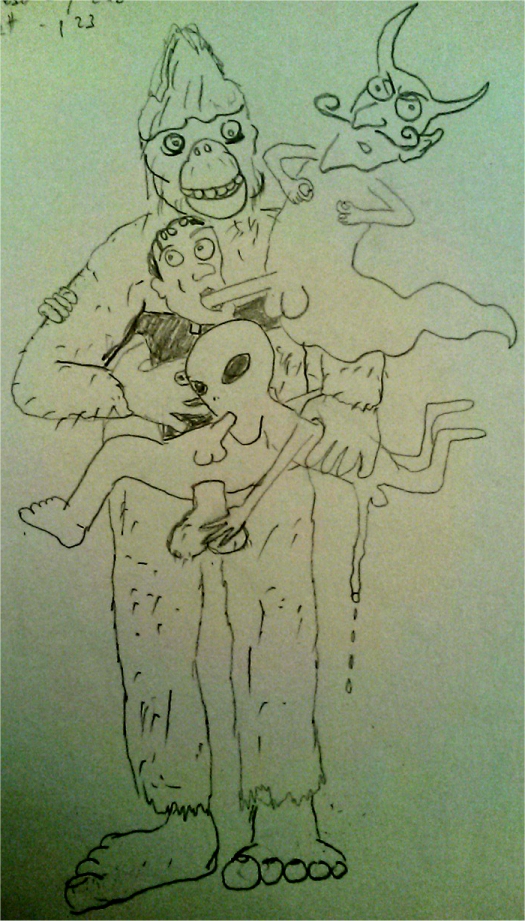
priest-having-sex-with-bigfoot-an-alien-and-a-demonIt’s all good, baby!

According to Sinistrari, Incubi and Succubi are surprisingly like people. They have physical needs and desires; they eat smells (solid food would be too much for them), and they fuck each other, people and animals. These spirits are endowed with both free-will and morality, and Sinistrari even suggests that they might have their own form of organized religion and worship. They are more spirity than humans and hence also more spiritual and closer to God. The fact that they are closer to God means that it’s as bad for them to have sex with us as it is for us to have sex with animals.

This weird logic means that for a human to have sex with an incubus or succubus is actually a dignifying rather than a shameful experience. Sinistrari never openly condones sex with this class of spirits, but it’s pretty clear that he doesn’t consider it to be all that bad. In terms of sin, he puts demoniality in the category of pollution. This means its comparable to getting or giving oral sex or a single finger up the bum. You might get an extra Hail Mary as penance after confessing it, but that probably wouldn’t stop you from doing it again.

Shagging one of Lucifer’s Henchmen is a different story; doing so is only ever done to improve your relationship with the Dark Lord. Satan’s malevolent spirit-servants are incorporeal and must either create a body out of filth or possess a corpse in order to be able to fuck. Also, they feel no joy when they’re getting rode. If you shag one of these, you are going to Hell. The sexual act itself would only count as pollution, but as it also serves as a contract with Satan, it becomes a damnable offence. The problem is that most people don’t know the difference between a friendly neighbourhood succubi and a cacodaemon, and just as attempted murder is as bad as murder, attempted sex with an evil demon is just as bad as sex with an evil demon. This means that a minor fling with an amorous Incubus could potentially land a person in as much trouble as bending over for the cock of Asmodeus. Now you know the difference, I hope you’ll think to look before you leap!

Another thing to be careful of is the way that spirits can alter their form. Regardless of their true appearance, demons seem to be able to appear in whatever form is most pleasing to their lover. This shapeshifting can get their lovers even deeper into sin. If a demon was to have sex with a man whilst appearing as that man’s sister, the man would be guilty of incest as well as demoniality. If the demon was to appear as that man’s dog, the man would be guilty of bestiality. Even if you knew full well that your lover was a demon and ask you asked it to look like a corpse for 10 minutes, you’d soon be guilty of necrophilia. Basically, roleplaying counts. You’re already in trouble for fucking a spirit; don’t make it worse by getting kinky.

But wait; wasn’t Sinistrari’s main problem with sodomy that it was sexual activity that didn’t lead to procreation? How is having sex with airy spirits any worse? Surely that doesn’ lead to procreation either! Well, actually…

Haven’t you read the Bible? Remember the Nephilim from Genesis? The Nephilim were a race of giants that were created when the Sons of God (fallen angels) mated with the daughters of men. Remember Jesus Christ. Who was his Da again? Now if he Bible contains stories of Spirits mating with humans, you’d better believe it’s possible. So how do they do it? Babies come when a penis sperms into a vagina; how can a spirit be expected to do this? Well, it used to be assumed that the spirits would turn into a succubus, fuck a man, save his cum, turn back into an incubus, fuck a woman and then fill her with the cum that they had taken, but there are a few problems with this theory. The first being that the resultant baby wouldn’t actually be demonspawn; it would be a perfectly normal human baby whose parents had never met. Another problem that Sinistrari notes is the fact that sperm rapidly loses its potency once its outside the body. Semi-corporeal demons would have no way of keeping the gip warm during the interlude between extracting it and injecting it. There’s other problems here too that I’m sure you can work out, and Sinistrari concludes that demons must cum their own cum and that this cum is capable of impregnating humans.
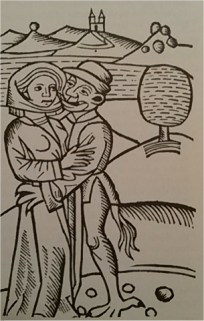
incubusAn Incubus works his magic. Why is he standing in a circle of eggs?

Sinistrari claims that Romulus and Remus, Plato, Caesar Augustus, Merlin, and “that damnable Heresiarch yclept Martin Luther” were all the offspring of spirits. You’ll notice that with the exception of Martin ‘the Proddy’ Luther’, these were all great men. That’s because spirits are closer to God than humans. The only problem is that human/spirit offspring are the same as horse/donkey offspring; they may get the beneficial aspects of both their parents, but mules can’t reproduce. Augustus had a daughter (who died very young), and Romulus may have had a son named Aollios and a daughter named Prima (such claims have been contradicted), but as far as I know all the other lads mentioned were either infertile, gay or just didn’t fuck. As mad as Sinistrari’s claims might seem to us, there was research and twisted, but apparent, logic behind them.

What about the Nephilim though? Why is it that demonspawn used to be giants, but modern day demonspawn are regular sized? Well there are four elements, right? So there must also be four kinds of spirits: air spirits, fire spirits, water spirits and earth spirits. (As silly as this might sound, it probably made decent sense to people living in the 17th century.) The spirits that fucked the daughters of men were air and fire spirits (again this is logical; angels came from the sky), and because fire and air are the more expansive elements, their offspring, the Nephilim were giant. After the flood, the fire and air spirits didn’t want to come down to Earth anymore because it was too wet for them, and so the only spirits left to fuck humans were the smaller, more condensed, water and Earth spirits. When you follow Sinistrari’s reasoning, it becomes apparent that he was actually a very smart guy living in a very dumb age.
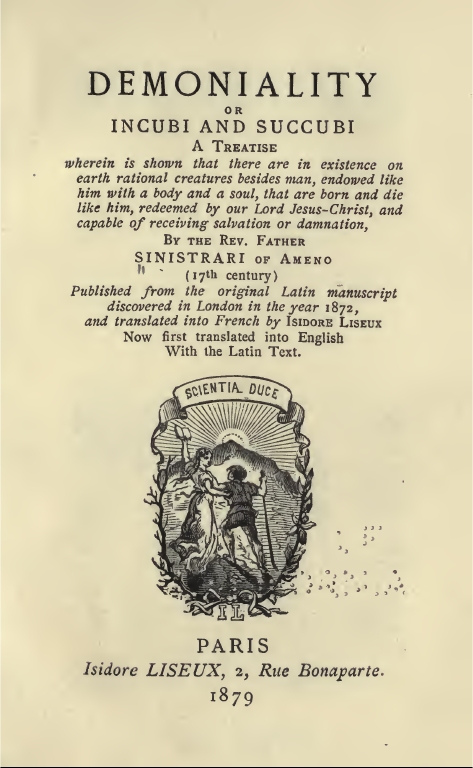
demoniality-title-pageThe subtitle of the work, “A treatise wherein is shown that there are in existence on earth rational creatures besides man, endowed like him with a body and soul, that are born and die like him, redeemed by our Lord Jesus-Christ, and capable of receiving salvation or damnation”, has a nice ring to it; don’t you think? It just slides off the tongue.

I have plenty more to say about Sinistrari, but I’ve already written more than 5000 words about him, and I doubt anyone is that interested. (If you ever want to chat about him, e-mail me or leave a comment!) Demoniality is genuinely one of the most interesting texts that I have come across, both for its history and content, and I’ve no doubt that I’ll be referring to it again. If you have an interest in demonology or cryptozoology, this is is a must-read. Both Demoniality and Peccatum Mutum are available online too, so you have no excuse other than being boring.