Half a Decade of Blogging about Creepy Books

I got a notification during the week informing me that this blog is now 5 years old. My first post, a look at Wade Baskin’s translation of Collin De Plancy’s Dictionary of Witchcraft, was published on February 27th, 2015. Since then, I have reviewed almost 350 books.

I’m a little bit surprised that I’ve lasted this long to be honest. I put a lot of work into this site, but I don’t see a huge amount of traffic. I have nobody to blame for this other than myself. Most of the books I write about are bottom of the barrel stuff that nobody will ever search for. I’ve thought about branching out and reading more contemporary fiction in attempt to draw more traffic, but while I certainly won’t rule out reading new books, I reckon weird old books will probably remain my focus. I think of this site more as a literary freakshow than a review site. I don’t really care if people want to read the books I write about or not, I just want you to know that these texts exist.

I write about famous books and popular authors regularly, but my favourite posts are always the ones about books that have an air of mystery to them. There have been a few posts on this blog where I have had the delight of presenting new information or theories on strange and mysterious texts. Here are a few posts that represent my best work. I beseech any lovers of peculiar literature to check these out if you haven’t already.


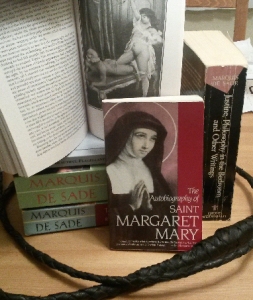
mmThe Autobiography of Saint Margaret Mary (March 2015)
This was one of my first posts. It’s about a Christian saint who had a shit fetish. I look back on it with a smile.


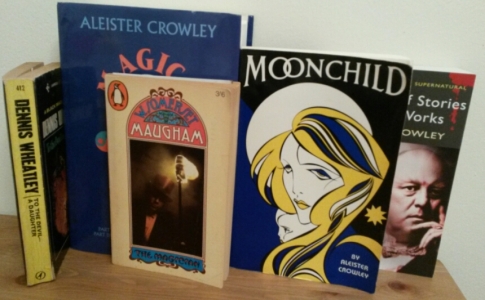
2015-12-28 02.38.38Did Aleister Crowley Create Strange Lifeforms? (December 2015)
This was my first post on Aleister Crowley. It’s a look at the different ways he was portrayed in fiction by those who actually knew him.


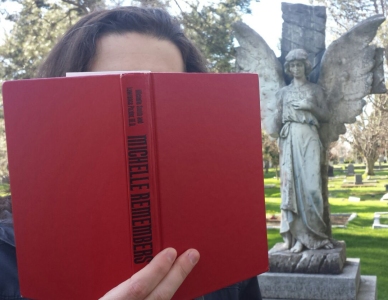
michelle remembers ross bayMichelle Remembers – Michelle Smith and Lawrence Pazder (March 2016)
I’m pretty confident in saying that at the time this post was published, it was the most comprehensive account of why this book is bullshit. It includes photos from the Satanic graveyard where the events in the book supposedly took place.


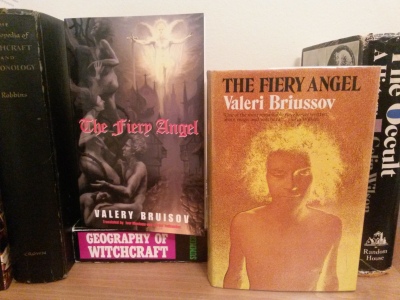
20160325_000821The Fiery Angel – Valery Bryusov (March 2016)
A look at the real events that inspired this peculiar occult novel.


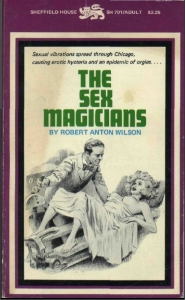
robert anton wilson the sex magiciansRobert Anton Wilson, Sex Magician! (July 2017)
An exegesis of a book of pulp occult pornography. (It’s one of those ‘use the text to interpret the text’ situations.)


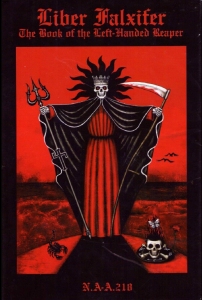
liber falxiferDeath Worship and Current 218 (November 2017)
An exploration of the link between heavy metal and Liber Falxifer, an infamous text of Black Magic.


spawn of the devil - aristotle leviSpawn of the Devil (Inpenetrable) – A Quaint and Curious Volume of Forgotten Porn (August 2018)
I still think this is the best post I’ve ever written.


dark gods - anthony roberts and Geoff GilbertsonDark Gods – Anthony Roberts and Geoff Gilbertson (July 2019)
It was a delight to be able to share information on this rare and curious tome of paranoid doom.


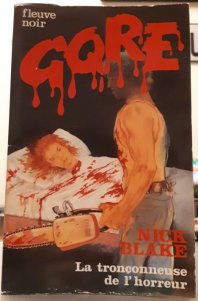
La Tronçonneuse de l'Horreur - nick blakeA History of Chainsaw Terror (Come the Night) by Nick Blake (Shaun Hutson) (February 2020)
There were histories of this book online before this, but this is the most complete one out there.


There’s lots of other good posts on here, but these few are special to me.

If you’ve been following this blog for a while, you’ve probably noticed a recent lack of posts on occult books. (The last non-fiction book I wrote about was Daughters of the Devil back at the beginning of December.) There’s a few reasons for this. I’m mainly just sick of wasting my time reading stupid spellbooks written by wankers. I have been reading other types of occult books over the past few months, but unfortunately, they have been extremely boring, long and difficult to get through. I’ve had a post about Nazi Grail Hunters in the works since early October and another on a horrendously stupid book about interdimensional sasquatches, but reading these texts has been so tedious that I have been avoiding them and breezing through enjoyable horror novels instead.

I have not abandoned occult books, but I have to be more picky these days. I don’t need to read any more books of love spells or nonsense about kaballah. I don’t want to read any more post-hypnotic accounts of alien abductions or any more books arguing that some cave paintings prove our ancestors were space people. I’m getting pretty jaded with Satanism now too. The more Satanists I interact with, the less interested I am in books about their hero.


Recently, I decided that I want to start writing more fiction. Between Nocturnal Revelries and my other blog, I write a lot, and I reckon that I’ve read enough books now to make a decent go at my own stories. I’ve posted my short fiction before (Kevin and The Compost Bin, two disgusting tales), and hopefully there’ll be more coming soon.

Blogging may be past its heyday, but I like doing it, so I reckon I’ll keep going for another few years. Thanks to everyone who reads this site. I really hope you enjoy it.

2019, The Year in Review

2019 was the busiest year yet for this blog. There were more posts, words, books and traffic than ever before. (I know I said the same thing last year, but I’ve outdone myself again.) I put a lot of effort in this year, and almost all of my reading was dedicated to this blog. I only managed to read 4 non horror/occult books over the whole year. If you haven’t been paying attention, this post will guide you through what I covered in 2019.

I read some really cool novels this year. I was so excited to find a cheap copy of Kathe Koja’s The Cipher in a thrift store, and I’m happy to report that it lived up to its reputation. I posted about Edward Lee’s The Bighead right at the beginning of the year, and it was an extremely gross, funny and enjoyable read.  My copy of C.S. Cody’s The Witching Night had been on my shelf for years, but I loved it when I got around to reading it this summer. Bari Wood’s The Tribe also blew me away. There’s no wonder that it was recently rereleased. Flesh by Richard Laymon may not have been a brilliant novel, but I really enjoyed it. I ended the year reading two classics of weird fiction, Fritz Leiber’s Our Lady of Darkness and William Hope Hodgson’s The House on the Borderland. Both of these books were awesome.

I did a few short story collections this year too. I was delighted to get my hands on Montague Summer’s long forgotten Ghost Stories. I also really enjoyed rereading Lovecraft’s stuff. (Part 1, Part 2, Part 3 and Part 4.) In May, I reviewed Teatro Grottesco by Thomas Ligotti. I absolutely adored that book, and I was surprised to see how much traffic that post got. (I also just finished his My Work is Not Yet Done, so expect to see more Ligotti here soon.) In October, I did a lengthy post on the two Splatterpunks anthologies from the 90s. The stories in these were of varying quality, but they did put me onto some cool writers. I actually thought that I had reviewed more short story collections than this when I started writing this paragraph, but that’s because I have spent the last few weeks working through Clive Barker’s Books of Blood. I haven’t finished all 6 yet, so it’ll be another while before they show up here. (Barker is one of the authors that Splatterpunks convinced me to check out.)

Of course, this blog isn’t just about fiction, and this year, I got into some very weird esoteric books indeed. The one I was most excited about was Geoff Gilbertson and Anthony Robert’s The Dark Gods. Jesus, that book was mental. (I’m also happy to report that a pdf copy has been uploaded to the internet since my post was published, so you won’t have to go through what I went through to read this very rare and very odd book.) I was also proud to present a review of Robert Eisler’s Man into Wolf, a very peculiar book on lycanthropy. Dr. Alexander James McIvor-Tyndall’s (pre-Nazi) swastika adorned Ghosts: A Message from the Illuminati was another interesting book to track down and read. Allen H. Greenfield’s books on UFOnauts and the secret rituals of the Men in Black are amoungst the strangest I have ever read. I read three (1, 2, 3) dumb books on sex magic over the course of the year, and George Bataille’s book on Gilles De Rais was a very depressing look at that dirty satanist paedophile. On top of H.P.’s fiction, the aforementioned Lovecraft posts all deal with Lovecraftian grimoires too.

I also read a bunch of utterly idiotic grimoires that were written by morons. Highlights include Fascination by Master Count de Leon, The Black Grimoire by Angel Zialor and Secrets of the Black Temple by the Red Spider. This shit was DUMB.

Finally, I reviewed a little bit of porn in 2019. Satan was a Lesbian and The She-Devils did not live up to their titles, but Ann L. Probe’s Alien Sex series was exactly as good as you’d expect.

We’re soon to enter the twenties, and while this post only looks at the books I’ve reviewed in 2019, this blog has been around for half a decade now. If you’re interested in looking back, you can check my yearly review posts for 2018, 2017, and 2016. (I didn’t do one for my first year.) You can also look through my site’s index for a complete list of the 300+ books that have been reviewed here over the past 5 years. If you enjoy this blog, please share it with like-minded people. You can get updates on twitter or facebook, and I’m always happy to get recommendations for my next review.

I hope you have a great new year!

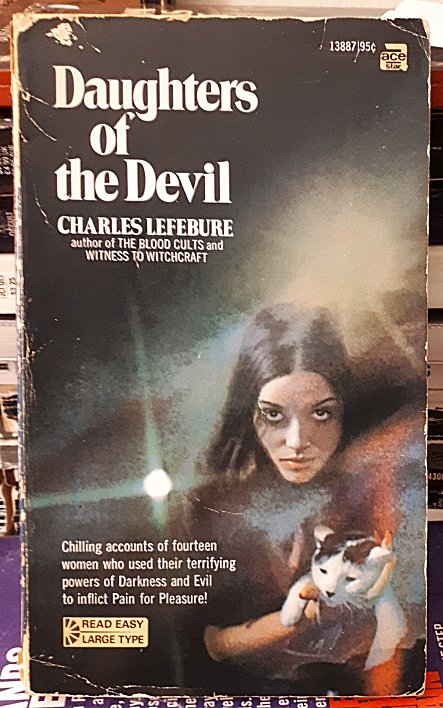
Daughters of the Devil – Charles LeFebure

daughters of the devil lefebure.jpgDaughters of the Devil – Charles LeFebure
1971 – Ace Books

The blurb on the back of this book describes its contents as “true stories of unparalleled sadistic erotica”. The front cover claims that it contains “Chilling accounts of fourteen women who used their terrifying powers of Darkness and Evil to inflict Pain for Pleasure!” It’s called Daughters of the Devil, for Christ’s sake. Can you imagine my delight when I found a copy of it for 5 dollars?

I mean, realistically, the book was shit, and I had known exactly what to expect. A few years ago, I read a book called The Devil’s Own by Peter Robson, and I had the feeling that this would be very similar. I just checked my copy of that book, and unsurprisingly, it was put out by the same publisher, Ace Books. After rereading my review of that book, I’m surprised at how similar it is to Daughters of the Devil. Charles LeFebure wrote two other books for Ace, Blood Cults and Witness to Witchcraft, and I reckon it’s safe to assume they’re the same kind of crap.

The chilling accounts in here are very sensational, and rarely convincing. Some of them are about real people, but I can’t find any evidence for the others. (This was my same complaint when I read The Devil’s Own.) When I googled some of the names in here, the only result I found was somebody else who had read this book complaining about the same lack of evidence.

I’m going to briefly describe each of the accounts in here in case anyone is interested.

  1. A girl gets involved in a Satanic cult. They have orgies and sacrifice a fetus during a black mass. This account references Crowley, H.T.F. Rhodes and the Abbé Guiborg’s Black Mass. It wasn’t believable, but it was a pretty good start to the book.
  2. Carletta Pantucci and her Daughters of Isis were a weird cult of lesbians that bred babies that they intended to raise as virgin cultists. They told the future by bloodletting women’s groins.
  3. There was a weird convent where nuns were crucified and whipped by a perverted priest and made to watch him fuck their Mother Superior. This was all done in the name of Christ.
  4. Caroline Langley, a one time friend of Aleister Crowley, commits acts of black magic, sometimes to kill people. I can find no evidence of Crowley ever knowing a Caroline Langley.
  5. A six month old curséd baby poisons a boy with witchcraft and the boy’s hand is amputated.
  6. Obango, the “Ga witch” from Ghana, bled ate and killed victims, 15 of whom were related to her. Ga witches have sex with animals.
  7. Annie Palmer, the rich voodoo priestess decapitated some of her slaves and raped others with snakes. (This one has some basis in fact.)
  8. Gdoma, an ugly Asian witch, coerces young people into sexing each-other up. LeFebure claims she’s very evil, but she doesn’t sound that bad really.
  9. Some Mexican woman ran a sex school for children in her house. She killed two abusive husbands.
  10. Caterina Sforza, a real Renaissance woman, is here described as ,’the most wicked woman of all time’.
  11. A Chinese child sex-slave grows up to start her own brothel in which random johns are taken to the secret rooms downstairs and tortured to death. The events in this story allow for no possible way that anyone could ever discover what had happened – there could be no evidence – but somehow the author is able to tell the tale. The lady died without any trial or case against her. It’s a cool story even if it’s completely fabricated.
  12. I got a bit into this one before I realised that I had actually heard it, or at least a version of it, before. It’s the story of Edward Arthur Wilson, the mysterious Brother XII, and his Madame Zee. Plenty of the details listed here are entirely false, but Lefebure’s fabrications don’t actually make the story any more interesting than it really is. I have another book on Brother XII that I have been meaning to read for a long time. I’ll definitely come back to Lefebure’s account when I get around to that one.
  13. Charlotte Gilbert leads a cult that worships cats and ritually sacrifices dogs because they are cat’s natural enemies. Her cult is a breakaway of the Glastonbury Essenes, a real order that supposedly worships aliens.
  14. The last account is of Catherine Deshayes (La Voisin), the abortionist and satanist involved in the Affair of the Poisons. This is the sensational account you’d expect.


Most of these stories contain little truth, and none of them are erotic. There is a fair bit of sadism though. This book is made up of descriptions of horrible women that probably never existed. The titles of this author’s other books sound very good, but they’re surely of the same quality. I’ll buy them if I ever see them for very cheap, but I wouldn’t be bothered hunting them down.

Secret Magic Spells of the Romany Gypsies and Fascination – A Feast of Finbarr

I was pretty lazy with reading this week, so here’s a post on two more awful magical pamphlets from Finbarr Publications, publisher of the worst magical texts ever printed.

secret magic spells of the romany gypsiesSecret Magic Spells of the Romany Gypsies – C. McGiolla Cathain & M. McGrath
Finbarr -1993

Secret Magic Spells of the Romany Gypsies purports to be a collection of authentic gypsy spells for love, money and revenge. It’s a load of shit. All of the spells in here look something like this:

For this spell, all you need is a green candle and a picture of your true love. First, thoroughly rub the tip of the candle against your anus. Then Light the candle and let some of the wax drip on the photograph while uttering the following incantation;

“Tweedly diddly fiddly dum,
Fiddeldy diddeldy widdeldy wee,
Boomboom bumbum bambam bum
So mote it be”

You will marry your true love within a month.

The spells take up roughly half of the text. The rest is made up of anecdotes of these spells being used succesfully. I’ve noticed a similar approach in quite a few other books from Finbarr publications, but the stories in here are particularly unconvincing. One of the characters is referred to only as “B.S.”. I can’t shake the feeling that this was the authors cryptically confessing to feeding their audience complete and utter bullshit.


fascination master count de leonFascination – Master Count de Leon
Finbarr – 2015

Fascination is the shortest pamphlet I’ve read from Finbarr, and it’s probably the most absurd. The actual text is barely 7 pages long. The first 5 of these pages are spent praising Adolph Hitler, and the last 2 describe a ritual that you can use to become more like Adolph. The ritual consists of wagging your dick at your reflection in a mirror while muttering your own name exactly 99 times. Seriously. I’m not even joking. That’s all this book contains. It suggests that Hitler himself performed this ritual.

This is obviously a noteworthy magical offering, but I don’t feel much need to comment any further on it. If you think I’ve exaggerated about its contents, read it for yourself – the text is easy to find online.

The Black Books of Elverum

the black books of elverum.jpgThe Black Books of Elverum – Mary Rustad
Galde Press – 1999

In the 1970s, Mary Rustad, a lady in Norway, was looking through the farmhouse that she had recently moved into. This house had belonged to her family for centuries, and it was filled with old junk. She found two curious books in a box in the attic. When she opened them, she realised that they were books of magic spells, compiled or collected by her ancestors. The books supposedly date from the late 1700s/early 1800s, and research proved that several of Mary’s ancestors had been involved in a witchcraft trial in the 1600s. It seems as though witchcraft ran in her family. These books were the real deal, forgotten grimoires of black magic. The Black Books of Elverum is a translation of these two handwritten grimoires.

lucifer elverum.jpgThis cool picture of Lucifer is included, but I don’t think it’s from the actual grimoires.

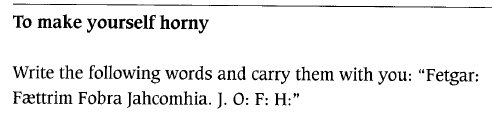
The spells in here seem pretty silly. Some are appeals to Jesus, others are appeals to demons, but some are just recipes or instructions that don’t have any spiritual element. (The ones on how to abort a fetus basically just tell the woman to drink a bunch of poison.) These books offer insight into the fears, customs and beliefs of Norwegian farmers, and I reckon they’re of more interest to historians than they are to occultists. Who needs a spell to make themselves horny in an age when viagra and internet porn are so readily available?

spell to make yourself horny.jpg(Just in case your wifi is down)

Some of the spells in here are very specific. There are two to be used against a thief who leaves his turd behind him after he has carried out a burglary. This is really convenient when you want to send the Devil out after the miscreant who shit on your carpet and nicked your telly.

There’s instructions on how to find witches in here. The curious are to go to a church on certain nights during the year and to wait near the church bells. Witches are apparently quite fond of gnawing church bells with their teeth, and will take any opportunity to do so. I had never heard of this before, but when I looked it up, I found a book that claims that this odd belief was also held in parts of Sweden. Witches were supposed to bite off bits of church bells to use in their potions. Jesus, I hope they had a good dentist.

This was a pretty cool book. It’s presented well, and the material is very interesting. It contains scans of original texts, and there’s an appendix recounting the 1625 court case against Ingeborg Økset, Rustad’s ancestor. The whole thing is pretty short too, so it doesn’t take long to get through. If you’re interested in Norwegian folk magic, you should definitely read this book.

Doll Magic – Basil LaCroix

doll magic basil crouch.jpg
Doll Magic – Basil Crouch

Finbarr – 2005

Ok, so I know that last week I said I was going to cut back on posting, and I know that one of the reasons for this cutback was the shockingly low standard of the stuff I’ve reviewed recently, but old habits die hard, so here is a post on an abhorrently stupid pamphlet on doll magic by the incredibly stupid occultist, liar and probable child predator, Basil Crouch. Crouch’s The Hallowed Genie deals with a similar topic, but Doll Magic is shorter than that book and therefore a bit less stupid.

Here’s a brief summary:

Basil spent his childhood travelling around with a circus. He used magic to help a girl whose skull had been fractured. 20 years later, this girl’s mother bequeathed Basil a pair of crudely made magical dolls and a text on how to use them.

Basil gives very basic instructions on how to make a doll – you can basically just tape 2 sticks together and stick a tennis ball on top of one. That’ll do. Then you put energy from your head into this doll, and it will do magic. The magic only works if you are willing to clear your house of stuff you no longer need. Hoarders can’t do magic. The Law of Attraction is real, but it doesn’t work if what you want is bad for you. Has this last paragraph seemed illogical and silly? The section of Doll Magic that it’s paraphrasing certainly is.

The next parts describes how to make a doll that will help you make decisions and talk to dead people and another that will help you contact the gods of voodoo when you need money. The spell you say for the money is, “Money and honey I need, Money and honey with speed, Money and honey I plead, Money and honey give me indeed”. This is bound to be effective.

The last part of the book describes how to make a doll that will cure you of any ailment or disability. You make the doll and then tell it stories about what you would do if you weren’t sick. The doll will help you believe these stories and then you won’t be sick. It really works. One guy was in a wheelchair for 20 years, but then he tried this and he could walk again!

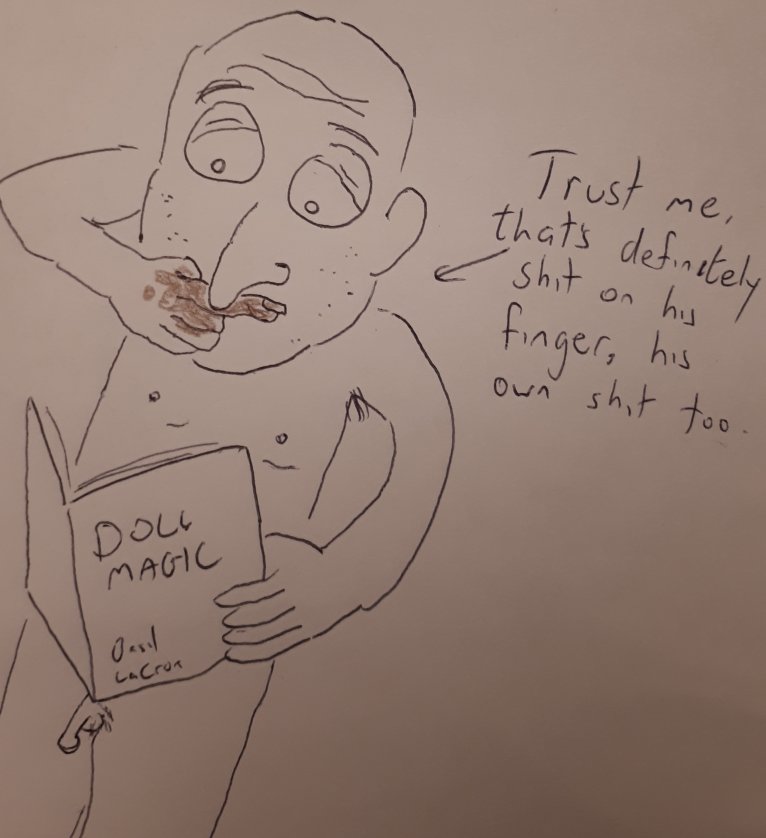
There’s not much to say about this pamphlet. If you ever come across a copy, use it for shitter-paper. Usually I spend more time and effort on my posts, but I only decided to do this one a bit before it was due, so it had to be on something very short and awful. You’d have to be a real pinhead to take this rubbish seriously, and I have drawn a picture of such an individual in an attempt to redeem myself for making my readers aware that this pile of stinking garbage exists. Ladies, gentlemen and everyone in between, I give you the scholar of Crouch:

basil lacroix crouch

The Magick of Ewaz – Robert Morga

book of ewaz review picture(The author of this book asked that I not use his “copyrighted artwork” in my post, so I will just include this piece of my own artwork so that the post doesn’t look boring to my viewers.)


The Magick of Ewaz – Robert Morga

IGOS – 1993

Edit 2023: I was actually lucky enough to hear from the author about this review (in the comments section below the review), and he was gracious enough to correct me on a few mistakes I had made in my original post. I have gone through the post to rectify my all of my mistakes. I hope this updated review is more accurate.

Here’s another GREAT book from the International Guild of Occult Sciences, The Magick of Ewaz. Ewaz is supposed to be a demon, and while his name sounds very similar to Aleister Crowley’s Aiwass, there doesn’t seem to be a link between these two entities.
ROBERT MORGA THE FAMOUS Magician claims to have written this grimoire in a cold, scary, demon-haunted cellar. Maybe that’s why it’s so full of BRILLIANT MATERIAL. This AWESOME piece of WRITING is supposed to be a powerful grimoire of black magic, but it reads like SOMETHING EVEN BETTER THAN THAT.

The author spends most of the text boasting about how powerful and clever he is, and then he gives a few REALLY GOOD spells alongside some doodles. PROOF OF HIS GENIUS.

This is seriously TOP tier stuff. It’s printed on somebody’s work (or highschool) photocopier, and the author is an EXCELLENT writer. He repeatedly spells sacrifice ‘sacrafice’, uses the word ‘alot’, and has A VERY GOOD UNDERSTANDING OF comma usage. Did EVERYbody at IGOS proofread this EXCELLENT BOOK?

I’m running out of things to say about GREAT BOOKS like this. How is there so much of this AWESOME STUFF? I have a few more texts put out by IGOS, but they’re all quite a bit longer than this one, and I don’t want to waste my time NOT reading them. These books are laughably BRILLIANT. I honestly find it difficult to imagine anyone NOT taking this REALLY CLEVER BOOK seriously.

On his old website, the author described this book as”the best grimoire on this planet.” HE WAS RIGHT. He doesn’t seem to have written much else, but this book went through several editions. I think this is the earliest one. It weighs in at about 20 pages. The 6th edition is 133 pages long. I’m sure the addition of more than 100 pages made it much better…

Magica Sexualis – Emile Laurent and Paul Nagour

magica sexualis.jpg
Magica Sexualis: Mystic Love Books of Black Arts and Secret Sciences
Emile Laurent and Paul Nagour
Falstaff Press – 1934

This is a rather curious book. A limited number of copies were printed privately in 1934, and one of these found its way onto the internet. I read it because I haven’t done any occult books in a while, and people seem to be more interested in the sexy ones.

Magica Sexualis is basically a compendium of information on the role of sex in different forms of occultism. The information within is fairly interesting, but it doesn’t seem to support any particular thesis. Each chapter deals with a different type of occultism and the corresponding role of sex. I don’t really want to go through each chapter, as quite a few were very boring (particulary the ones towards the end). The rest of this review is just some of the notes I took while reading through this strange book.

  1. The authors claim that the medieval witch-craze was caused by poor people turning to Satan because they found Catholicism too hard. Although the authors believe in witches, they concede that their night ride to the Sabbat was drug induced, not real.
  2. There’s a cool section on incubi and succubi. It’s mostly made up of  anecdotes from the classic witch-texts, and much discussion is given to Sinistrari’s question about whether incubi use their own demon sperm or the sperm collected from men they rode as succubi.
  3. In their description of the Black Mass, the authors describe how Satan would knead the dough of his unholy Eucharist on the buttocks of a recently deflowered virgin. That’s a pretty cool detail I can’t recall seeing elsewhere. There’s several accounts of Black Masses in here, including a lengthy quotation from the infamous scene in  Huysman’s Là Bas.secret rites of black mass 
  4. There was a lad called Gaufridi who supposedly used to breath on people to make them love him. Before he was executed for his evil deeds, he claimed that he had used his power on his accuser’s mother and that his accuser might be his daughter. Haha, owned. Apparently his accuser lived the rest of her life being teased, “continually hearing the taunts of the people and heavy breathing and snoring wherever they went.”.  This case actually set the precedent for the sentencing of Urbain Grandier during the Loudun Possessions 20 years later.
  5. This book contains the following description of an interesting West African ass-dance:black buttocks
  6. There’s a big section on Catholic views on the sinfulness of sex that was pretty interesting. Quoting Krafft-Ebing, the authors blame religion for creating perversions, not preventing them. This section also gives details about the Scopts, a sect of Russian mentallers who liked to cut off their own dicks. “In the first period of their existence, the operation consisted of the removal of the testes by glowing hot irons; this mutilation was called the baptism by fire.” These lads would also mutilate a young virgin every Easter; “Her breasts were removed and then the participants in the ceremony awesomely consumed a portion of the holy breasts. The virginal victim was then placed upon the altar; the frenetic believers danced and sang about her until they were aroused to the highest pitch of sexual madness when they gave way to their cruel and bestial desires upon one another.”
    Fucking Hell.
  7. Saint Veronica Juliani had sex with a lamb.witches ritual goat
  8. Sunamitism is the notion that young flesh and sweat makes you young again. This comes from Abishag of Shunem, the child who had to sleep with the Biblical King David to maintain his vitality. King David was a paedo. Sunamitism is supposedly why teachers generally live longer than other people.
  9. The chapter on the sex practices within certain religons is mostly boring, but it claims that Baal Peor was “the God Penis” and the male priests of Baal were teenage gay prostidudes who also pimped wuff-wuff dogs.

There’s also chapters on gross love potions, cures for magical impotency, werewolves, vampires, and Freudian dream interpretation. Like I said, there’s not much focus or cohesion here at all. It’s not an absolutely horrible book to read, but I wouldn’t recommend it to anyone for any reason.


The Old Ones were, the Old Ones are, and the Old Ones shall be – Lovecraft’s Legacy, Part 4

the book of old ones - scorpio.jpgThe Book of Old Ones – Scorpio
Finbarr – 2002

Truly, there are terrible primal arcana of earth which had better be left unknown and unevoked; dread secrets which have nothing to do with man, and which man may learn only in exchange for peace and sanity; cryptic truths which make the knower evermore an alien among his kind, and cause him to walk alone on earth. Likewise are there dread survivals of things older and more potent than man; things that have blasphemously straggled down through the aeons to ages never meant for them; monstrous entities that have lain sleeping endlessly in incredible crypts and remote caverns, outside the laws of reason and causation, and ready to be waked by such blasphemers as shall know their dark forbidden signs and furtive passwords. – from The Diary of Alonzo Typer

When I read a book on Lovecraftian magic, I want to learn about the aforementioned dark forbidden signs and furtive passwords. Unfortunately, this is never what these books contain. The one I’m reviewing today, Scorpio’s The Book of Old Ones, might well be the silliest of all the Lovecraftian grimoires I’ve read.

Imagine what a grimoire would read like if its author had absolutely zero understanding of magic. It’d probably contain powerful spells that are quick and easy to perform and unfailingly effective regardless of whether the person performing them believes in them or not – ‘say this magic word under your breath, and the girl beside you on the train will become your sex slave’ kinda crap. Take 20 pages of that garbage, add a few Lovecraft references and some stories about pathetic losers trying these rituals and then becoming rich, sexy and succesful, and you’ve got Scorpio’s Book of Old Ones.

Much like The Necronomian Workbook, this book shows little understanding of the total apathy of Lovecraftian entities towards human beings. The Old Ones are bigger and older than us. Their children made us for the sake of their amusement. Cthulhu is not concerned with the affairs of mere mortals. He’s plotting revenge on the elder things that imprisoned him. I doubt he’s interested in watching over you as you go on sea voyage, and I really struggle to imagine him helping you find a girlfriend.

cthulhu love spell.jpg
Seriously?

This book is stupid. The author understands neither magic nor Lovecraft’s mythos, but he has written a book combining them. This Scorpio guy seems like a real moron. Then again, this was published by Finbarr, so I’m not quite surprised.

I have made fun of the authors published by Finbarr Publications quite a few times at this stage, and I had initially planned this week’s post on two grimoires written by another of their authors. After doing a little bit of research though, I discovered that this guy actually has a learning disability and has suffered tremendously with his mental health. I’m not being facetious. I decided against reviewing his books, as he uses his real name, and I don’t want to cause any suffering for a person with serious mental problems. I mention it here only to highlight the remarkably low standard of stuff that this publisher puts out. I didn’t find out much about this Scorpio guy, but he’s clearly an imbecile too.
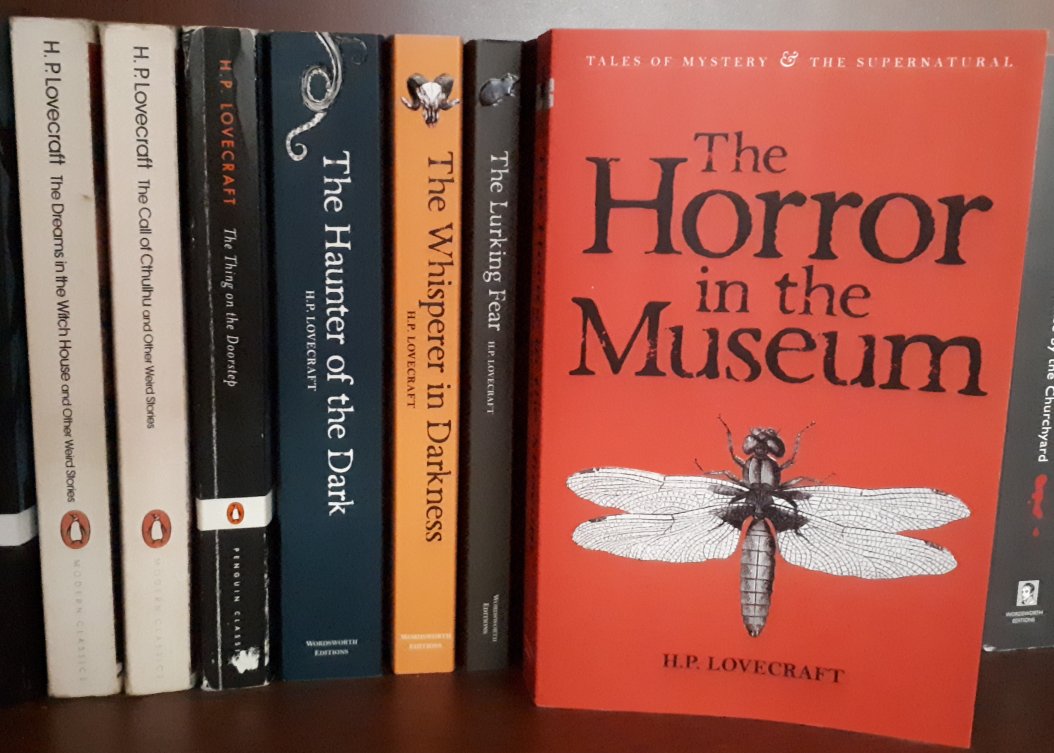
 

lovecraft horror in the museum.jpgH.P. Lovecraft – The Horror in the Museum
Wordsworth
This is the second entry in Wordsworth’s Lovecraft series, and it is comprised of works that Lovecraft worked on with other authors, only one of which I had read before. Most of the stories in the other 3 Wordsworth entries are included in the Penguin editions which I read and reviewed years ago, and after a year of rereading tales I had previously encountered, it was really cool to dive into a fresh batch of unread terror. The quality here is pretty high, and I enjoyed most of the stories in here more the fantasy stuff in Volume 3 and the odds and ends in Volume 4. Picking favourite stories from this collection is quite difficult. The tales in here are really good, and many of them flesh out the Cthulhu mythos – there’s references to Yog-Sothoth and Cthulhu every few pages.

This volume contains the following stories:
The Green Meadow, Poetry and the Gods, The Crawling Chaos, The Horror at Martin’s Beach, Imprisoned with the Pharaohs, Two Black Bottles, The Thing in the Moonlight, The Last Test, The Curse of Yig, The Elecrtic Executioner, The Mound, Medusa’s Coil, The Trap, The Man of Stone, The Horror in the Museum, Winged Death, Out of the Aeons, The Horror in the Burying Ground, Till A’ the Seas, The Disinternment, The Diary of Alonzo Typer, Within the Walls of Eryx and The Night Ocean
(Imprisoned with the Pharaohs appears in the Penguin collections as Under the Pyramids.)

Some of these tales are fairly racist. The word ‘nigger’ is thrown around quite a bit. One of the stories, Medusa’s Coil, is particularly nasty. It’s about a very evil woman. I was quite confused when I finished reading it. In this edition, the last line reads; “It would be too hideous if they knew that the one-time heiress of Riverside… was faintly, subtly, yet to the eyes of genius unmistakenly the scion of Zimbabwe’s most primal grovellers.” I wasn’t entirely sure what to make of this, so I looked up a summary, and it seems as though the editor at Wordsworth actually cut the final line of the story. The original text ends: “No wonder she owned a link with that old witch-woman—for, though in deceitfully slight proportion, Marceline was a negress.” The final revelation of tale is that the anatagonist is a bit black. This is not made very clear in the Wordsworth edition. In 1944, August Derleth anthologised this story and altered the final line to say “though in deceitfully slight proportion, Marceline was a loathsome, bestial thing, and her forebears had come from Africa.” At least Derleth’s version kept the meaning. The redacted Wordsworth edition makes the ending confusing rather than ugly. This is obviously a horribly racist ending to a horribly racist tale, but I’m pretty disgusted that Wordsworth thought it acceptable to censor it. I absolutely hate when publishers do that. If you choose to publish a dead racist’s work, don’t pretend he wasn’t a racist.

So why do I devote so much of my time to reading and reviewing books by and about this horribly bigoted individual? Well, it has a lot do with passages of writing like this:

These scribbled words can never tell of the hideous loneliness (something I did not even wish assuaged, so deeply was it embedded in my heart) which had insinuated itself within me, mumbling of terrible and unknown things stealthily circling nearer. It was not a madness: rather it was a too clear and naked perception of the darkness beyond this frail existence, lit by a momentary sun no more secure than ourselves: a realization of futility that few can experience and ever again touch the life about them: a knowledge that turn as I might, battle as I might with all the remaining power of my spirit, I could neither win an inch of ground from the inimical universe, nor hold for even a moment the life entrusted to me. Fearing death as I did life, burdened with a nameless dread yet unwilling to leave the scenes evoking it, I awaited whatever consummating horror was shifting itself in the immense region beyond the walls of consciousness.

Come on. That is brilliant. This is from The Night Ocean, the last story in the collection. Of all the stories in here, this one is the least explicit in its horrors, but the sense of gloom and despair that pervades the narrative is perfectly effective. Lovecraft may have been a horrible racist, but damn, his work does a damn fine job of expressing the futility of life. Interestingly enough, the author of The Night Ocean (Lovecraft was mainly an editor for this one) was gay. He was also an anthropologist, and was actually one of William Burroughs’ professors at Mexico City University.

There’s another curious little tale in here called Till A’ the Seas that I really liked. It’s about the last human on an Earth that has overheated. It’s set in the distant future, but by now it could believably be set 60-70 years from today. You should definitely read the full story (link above), but if you’re too lazy, just read this:

And now at last the Earth was dead. The final, pitiful survivor had perished. All the teeming billions; the slow aeons; the empires and civilizations of mankind were summed up in this poor twisted form—and how titanically meaningless it all had been! Now indeed had come an end and climax to all the efforts of humanity—how monstrous and incredible a climax in the eyes of those poor complacent fools of the prosperous days! Not ever again would the planet know the thunderous tramping of human millions—or even the crawling of lizards and the buzz of insects, for they, too, had gone. Now was come the reign of sapless branches and endless fields of tough grasses. Earth, like its cold, imperturbable moon, was given over to silence and blackness forever.

God damn, that’s beautiful.

Originally, the second collection of Lovecraft’s work put out by Wordsworth was titled The Loved Dead, but this story was removed from this collection after the people at Wordsworth decided that Lovecraft’s influence on that tale was only minor. Also, Through the Gates of the Silver Key is curiously absent from this collection despite being a collaboration between Lovecraft and E. Hoffmann Price. Through the Gates… is the only story to appear in the Penguin editions of Lovecraft’s work that is missing from the Wordsworth collections. I’m planning a fifth and final post in this series on the few tales by Lovecraft that are missing from this series, so keep an eye out for that in the near future.

Edit: For convenience sake, I’m including the links to all of the posts in this series for anyone who’s interested. (Part 1, Part 2, Part 3, Part 4, Part 5)

Dark Gods – Anthony Roberts and Geoff Gilbertson

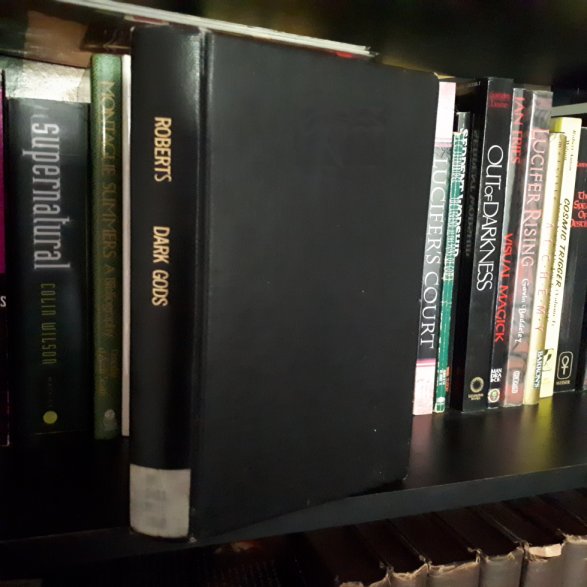
dark gods - anthony roberts and Geoff Gilbertson.jpgDark Gods – Anthony Roberts and Geoff Gilbertson
Rider/Hutchinson – 1980

Malevolent forces from another dimension have long been plotting against humanity. Throughout history these forces have manifested as demons, angels, spirits, fairies, vampires, dragons, aliens and Men in Black. They have convinced some humans to create secret societies that unwittingly aim to bring about the downfall of humanity. Lovecraft’s tales are not mere fiction. Nyarlathotep and Cthulhu are very real, and they’re patiently waiting for misguided humans to call them forth so that they can lead us into an era of blasphemous anarchy and interdimensional terror.

I mean… if you don’t want to read this book after that description, you’re on the wrong blog.

There’s so much to unpack here. This utterly insane book takes the work of H.P. Lovecraft, Bulwer Lytton, Erich Von DänikenFrancis King, Pauwels and Bergier, Eliphas Levi, Aleister Crowley, Trevor Ravenscroft, and John Keel and mixes it with Biblical Lore, black magic, cryptozoology, secret society conspiracy theories and UFO abduction stories. This is essential reading.

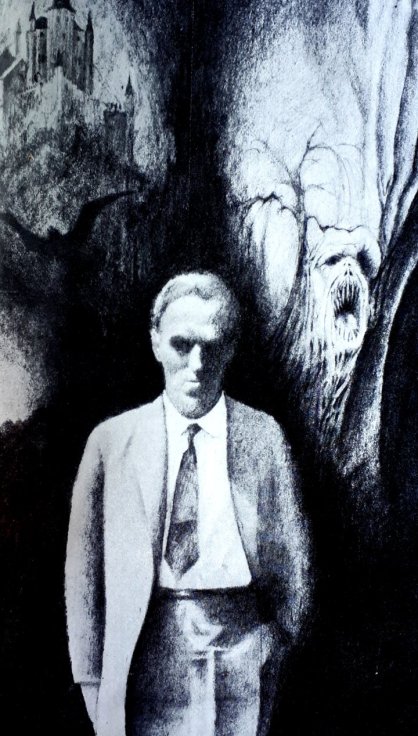
h.p.lovecraft - tom evesonjpg.jpgI’ve seen this image of Lovecraft before. It’s by Tom Eveson.

When I read Colin Wilson’s The Occult, I complained about the author’s unquestioning acceptance of ridiculous ideas. This approach made a little more sense to me after I read Morning of the Magicians by Pauwels and Bergier and understood their concept of fantastic realism, but I still thought of Wilson as a fairly credulous yet knowledgeable individual. Wilson actually wrote the foreword for this book, and it’s rather telling that he seems uncomfortable accepting this book’s findings. While he praises the authors of Dark Gods’ inquisitive vigor, he can not endorse their blind acceptance of their own conjecture. What is too much for Wilson will be far too much for almost everybody else.

Truly, this is a ridiculous book. There is no consideration given to the reliability of any of the authors’ sources; they even accept testimony from individuals they acknowledge as being liars.  They make no distinction between myths, fiction and eye-witness witness reports. Lovecraft’s short stories, extracts from The History of the Damnable Life and Deserved Death of Doctor John Faustus and Bulwer Lyton’s novel The Coming Race are presented alongside historical documents as proof of the conspiracy.

I don’t mind authors being ridiculous if the material they’re presenting is entertaining, but unfortunately, not all of the stuff in here is hugely interesting. Much of the second half of the book is taken up with descriptions of different secret societies such as the Golden Dawn, the Illuminati and even the Bilderburg Group. I recently wrote about my current disdain for conspiracy theories, and I found this section of the book to be grueling. The general message of the last 100 pages or so can be summed up by saying that any secret society that claims to offer illumination is actually run by Satanic forces that aim to enslave the society’s members and ultimately destroy humanity. I will give the authors some credit for briefly suggesting Reptilian government leaders 10 years before David Icke went mad, but this part of the book was painfully dull.

dark gods crowley blavatksy weishauptMadame Blavatsky, Rudolf Steiner, Adam Weishaupt, Aleister Crowley, Houston Stewart Chamberlain and Dietrich Eckart – Satanic Illuminatists (Picture by Tom Eveson)

Overall, the writing is quite bad. The authors seem to dance around the points they’re trying to make rather than just stating them clearly. This is particularly unfortunate as the points they are making are hardly common-sense ideas.

Perhaps the most confusing, convoluted part of this book is the bit explaining the motives of the entities who seem to abduct people in UFOs. ‘The phrase ‘seem to’ is very deliberate in that sentence. The authors of Dark Gods don’t believe that aliens are coming to Earth and abducting humans; they believe that interdimensional beings are coming to Earth and pretending to be aliens that are coming to Earth and abducting humans. We’re talking about malevolent ultra-terrestrials, not inquisitive extra terrestrials. (The idea of ultra-terrestrials rather than extra-terrestrials can be found in Whitley Strieber‘s abduction books too, but ol’ Whitley never imagines his visitors to be so deceptive.) Why are these weird entities playing such an elaborate hoax on humanity? According to Gilbertson and Roberts, it’s basically just to confuse us.

golem dark godsThis image of a Golem later appeared on the cover of a book by David Schow.

Think about that for a second. Inter-dimensional creatures are crossing over into our dimension and then pretending to be aliens because they think that will make us feel afraid and uncertain. The pretending to be aliens part just seems a little bit redundant to me. They’re inter-dimensional creatures – that’s plenty frightening and confusing. What kind of deranged people came up with this nonsense?

There’s sparse information on the authors available online, and I had to dig around quite a bit for it to paint a cohesive picture. What I could find was fairly depressing. Both men are now dead.

Anthony Roberts had previously published some other books on Atlantis and mythology. Paul Weston, an expert on Glastonbury’s mythology, claims that the mood of Roberts’ earlier books were “considerably different” to Dark Gods. Roberts ran a publication company called Zodiac House with his wife. He died in 1990 while climbing up Glastonbury Tor to see a lunar eclipse. He died of a heart attack, but some have suggested that he was actually killed by fairies for planning to summon the ghost of Robert Kirk, a folklorist who was supposedly abducted by the fairies in 1692. Most accounts of Anthony Roberts that I have found have presented him as a rather temperamental individual. (Sources: an essay on meeting Roberts, Paul Weston’s notes, and Roberts’ obituary on page 12 of The Ley Hunter Winter 1989/1990)

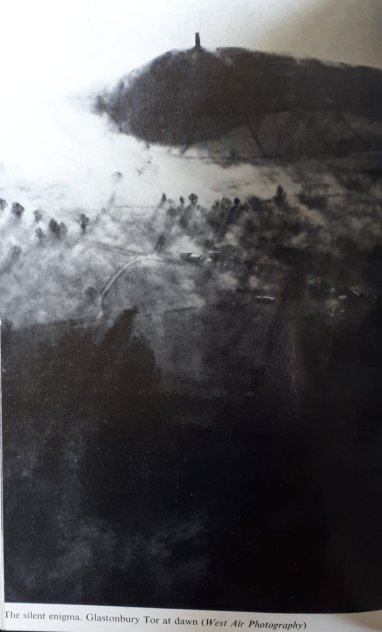
glastonbury tor - dark gods.jpgThis creepy image from the book shows the spot where Anthony Roberts would later die.

Geoff Gilbertson died more recently, in 2017. Despite living longer, he seems to have been the more tragic of the pair. He died alone of untreated cancer. I believe Dark Gods is his only book. After publishing it, he supposedly became convinced that the Dark Gods were after him for doing so. He apparently suffered several psychotic breakdowns and spent time living on the streets and in a mental institution. One of his friends believed that he was on the autism spectrum. This guy genuinely seems to have suffered horribly with his mental health. People that knew him seem to have thought him a very nice guy though, a fact which is not true for Anthony Roberts. Nearly all of the information I could find on Gilbertson came from this article.

I’ve read accounts describing both men as unstable. I don’t know how they met or what their relationship was like, but it seems that their interactions with each other created an echo-chamber of Fortean paranoia. Dark Gods doesn’t read like some transparent attempt to synthesize occult ideas in order to make a quick buck. No, this book is a genuine trek into Crazy Town.

I first saw Dark Gods being mentioned on twitter. Somebody was discussing how difficult it is to find these days. Underneath that comment, somebody else had posted a video review of the book by Occult Book Review, one of my favourite youtube accounts. (He’s another Irish dad with an interest in occult books, basically a nicer, smarter, more respectful version of me.) After the first few minutes of that video, I knew I’d have to track down and read this thing as soon as possible.

Doing so wasn’t easy. This book really is quite tricky to find. You’ll be very lucky to buy a copy for less than 200 dollars, and I wasn’t able to find a digital version. With a little bit of work, I managed to get my greedy little claws on a physical copy. It’s actually a very tedious read, but if you’re determined to read it and can’t afford to spend a bunch of money, ask me nicely and I might be able to help you out.